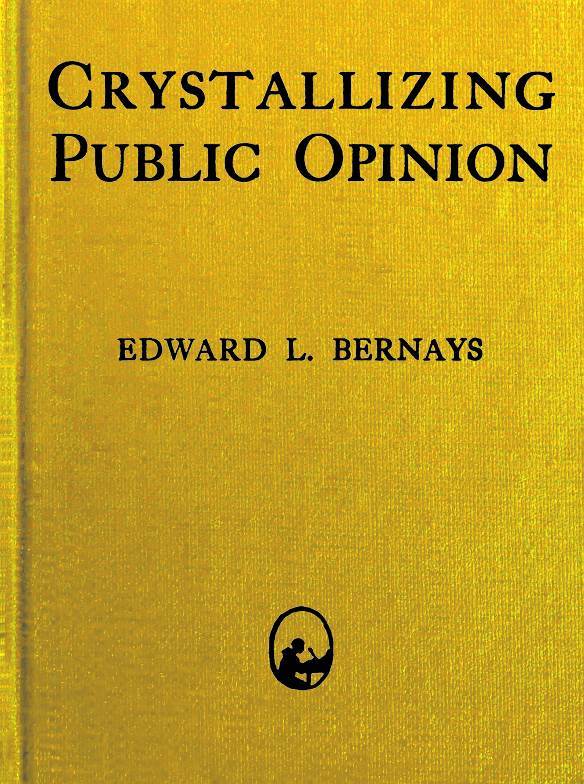
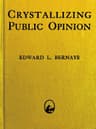
Crystallizing Public Opinion
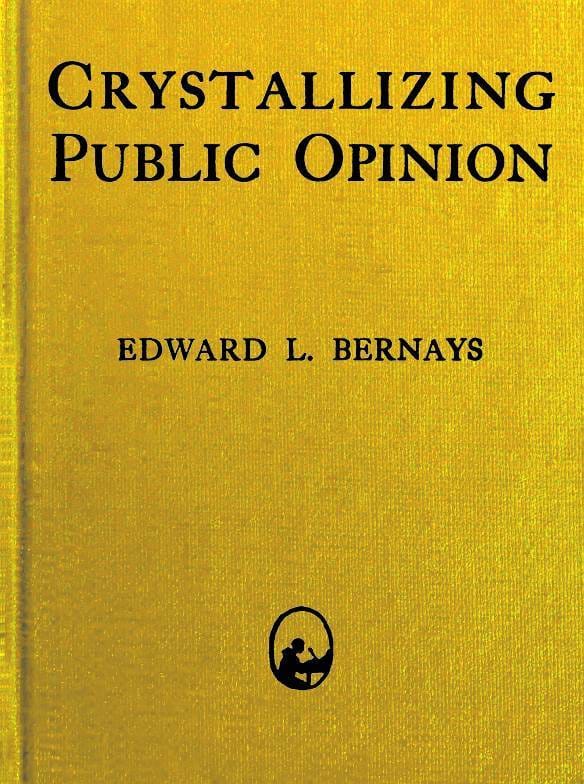
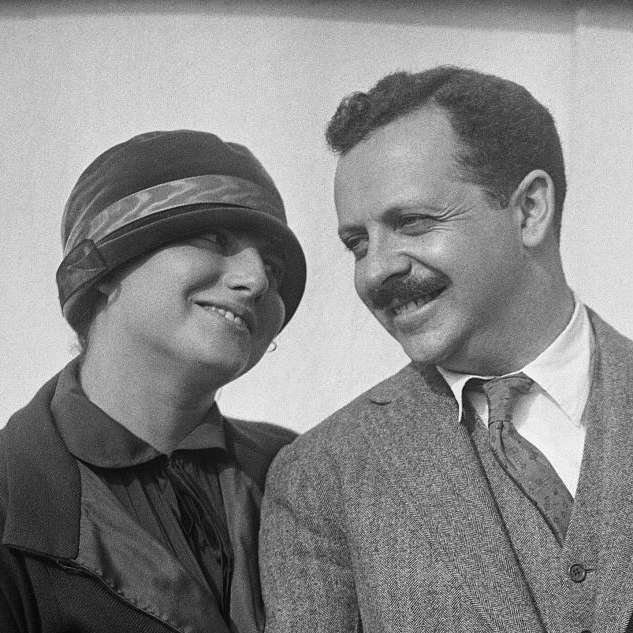
Published in 1923, this book essentially invented public relations as we know it. Edward Bernays, the nephew of Sigmund Freud, translated his uncle's theories of the unconscious into a practical manual for manipulating what the public thinks and believes. He argued that the average person is irrational, easily led by emotion and stereotype, and that smart operators could shape mass opinion by engineering consent rather than waiting for it to form organically. Bernays believed the PR counselor's job was not to report news but to create it, to understand the herd mentality of groups, and to craft messages that would resonate with whatever audience needed to be moved. What's remarkable about this book is its candor: Bernays openly discusses how to make unpopular ideas palatable, how to use symbols and psychology to sway the stubborn, and how the powerful could engineer the appearance of public support. Reading it now feels like discovering the instruction manual behind a century of spin, marketing, and political manipulation. It remains essential for anyone who wants to understand how consent is manufactured in modern democracy.
Editions
X-Ray
“The average citizen is the world’s most efficient censor. His own mind is the greatest barrier between him and the facts. His own “logic-proof compartments,” his own absolutism are the obstacles which prevent him from seeing in terms of experience and thought rather than in terms of group reaction.””
— Edward L. Bernays
“The only difference between “propaganda” and “education,” really, is in the point of view. The advocacy of what we believe in is education. The advocacy of what we don’t believe in is propaganda.””
— Edward L. Bernays
“People accept the facts which come to them through existing channels. They like to hear new things in accustomed ways. They have neither the time nor the inclination to search for facts that are not readily available to them.””
— Edward L. Bernays
“The truth is that while it appears to be forming the public opinion on fundamental matters, the press is often conforming to it.””
— Edward L. Bernays
“no matter how objectionable the character of a paper may be, it is always a trifle better than the patrons on whom it relies for its support.””
— Edward L. Bernays
“It is axiomatic that men who know little are often intolerant of a point of view that is contrary to their own.””
— Edward L. Bernays
“How does the public relations counsel approach any particular problem? First he must analyze his client's problem and his client's objective. Then he must analyze the public he is trying to reach. He must devise a plan of action for the client to follow and determine the methods and the organs of distribution available for reaching his public. Finally he must try to estimate the interaction between the public he seeks to reach and his client. How will his client's case strike the public mind? And by public mind here is meant that section or those sections of the public which must be reached.””
— Edward L. Bernays
“The public relations counsel must deal with the fact that persons who have little knowledge of a subject almost invariably form definite and positive judgments upon that subject.””
— Edward L. Bernays
Link to this book
Add a free, dofollow link to Lex on your blog, forum, syllabus, or reading list.

<a href="https://lex-books.com/book/crystallizing-public-opinion-2c0a31ae-1550-436e-92e4-7e409398283f"><img src="https://lex-books.com/badges/read-on-lex.svg" alt="Read Crystallizing Public Opinion by Edward L. Bernays free on Lex" width="160" height="40"></a>[](https://lex-books.com/book/crystallizing-public-opinion-2c0a31ae-1550-436e-92e4-7e409398283f)[url=https://lex-books.com/book/crystallizing-public-opinion-2c0a31ae-1550-436e-92e4-7e409398283f][img]https://lex-books.com/badges/read-on-lex.svg[/img][/url]Read Crystallizing Public Opinion by Edward L. Bernays free on Lex: https://lex-books.com/book/crystallizing-public-opinion-2c0a31ae-1550-436e-92e4-7e409398283fCite this book
Reading this edition for a paper or guide? Copy a citation.
Bernays, Edward L.. Crystallizing Public Opinion. Lex, lex-books.com/book/crystallizing-public-opinion-2c0a31ae-1550-436e-92e4-7e409398283f.Bernays, E. L. (n.d.). Crystallizing Public Opinion. Lex. https://lex-books.com/book/crystallizing-public-opinion-2c0a31ae-1550-436e-92e4-7e409398283fBernays, Edward L.. Crystallizing Public Opinion. Lex. https://lex-books.com/book/crystallizing-public-opinion-2c0a31ae-1550-436e-92e4-7e409398283f.