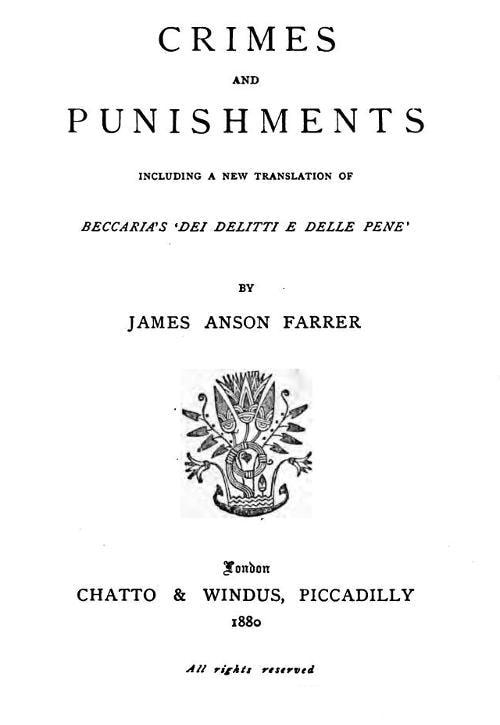
Crimes and Punishments: Including a New Translation of Beccaria's 'Dei Delitti E Delle Pene
1880
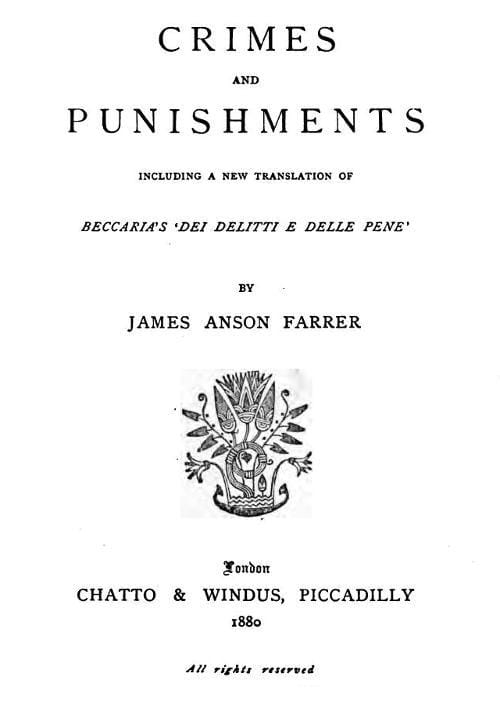
Crimes and Punishments: Including a New Translation of Beccaria's 'Dei Delitti E Delle Pene
1880
In 1764, a young Milanese aristocrat published a slender volume that would reshape the moral architecture of Western law. Cesare Beccaria's treatise on crimes and punishments argued, with reasoned fury, that torture was not justice but cruelty, that death penalties served no deterrent purpose, and that laws existed to protect citizens rather than annihilate them. James Anson Farrer's 1880 translation brings this foundational text back into English with fresh clarity, pairing Beccaria's radical arguments with illuminating commentary that traces their journey from Enlightenment controversy to modern statute. The work reads as both legal critique and philosophical declaration. Beccaria, writing as an outsider to the legal profession, dismantled the baroque brutality of eighteenth-century justice: the confession extracted through pain, the arbitrary sentences, the theatrical executions. His core insight remains electric two centuries later: that punishment's purpose is social defense, not retribution, and that the moment a state tortures a prisoner, it descends to the criminal's level. Farrer situates this argument within its historical moment, showing how Beccaria's courage in confronting Lombardy's corrupt judiciary anticipated the humanitarian movements that would follow. This edition matters for anyone who cares about where our ideas of justice came from and whether they've truly taken root.
Editions
Link to this book
Add a free, dofollow link to Lex on your blog, forum, syllabus, or reading list.

<a href="https://lex-books.com/book/crimes-and-punishments-including-a-new-translation-of-beccaria-s-dei-delitti-e-d-e41dd818-31be-4001-ab12-98d24a918661"><img src="https://lex-books.com/badges/read-on-lex.svg" alt="Read Crimes and Punishments: Including a New Translation of Beccaria's 'Dei Delitti E Delle Pene by James Anson Farrer free on Lex" width="160" height="40"></a>[](https://lex-books.com/book/crimes-and-punishments-including-a-new-translation-of-beccaria-s-dei-delitti-e-d-e41dd818-31be-4001-ab12-98d24a918661)[url=https://lex-books.com/book/crimes-and-punishments-including-a-new-translation-of-beccaria-s-dei-delitti-e-d-e41dd818-31be-4001-ab12-98d24a918661][img]https://lex-books.com/badges/read-on-lex.svg[/img][/url]Read Crimes and Punishments: Including a New Translation of Beccaria's 'Dei Delitti E Delle Pene by James Anson Farrer free on Lex: https://lex-books.com/book/crimes-and-punishments-including-a-new-translation-of-beccaria-s-dei-delitti-e-d-e41dd818-31be-4001-ab12-98d24a918661Cite this book
Reading this edition for a paper or guide? Copy a citation.
Farrer, James Anson. Crimes and Punishments: Including a New Translation of Beccaria's 'Dei Delitti E Delle Pene. Lex, lex-books.com/book/crimes-and-punishments-including-a-new-translation-of-beccaria-s-dei-delitti-e-d-e41dd818-31be-4001-ab12-98d24a918661.Farrer, J. A. (1880). Crimes and Punishments: Including a New Translation of Beccaria's 'Dei Delitti E Delle Pene. Lex. https://lex-books.com/book/crimes-and-punishments-including-a-new-translation-of-beccaria-s-dei-delitti-e-d-e41dd818-31be-4001-ab12-98d24a918661Farrer, James Anson. Crimes and Punishments: Including a New Translation of Beccaria's 'Dei Delitti E Delle Pene. Lex. https://lex-books.com/book/crimes-and-punishments-including-a-new-translation-of-beccaria-s-dei-delitti-e-d-e41dd818-31be-4001-ab12-98d24a918661.