Craft Gilds
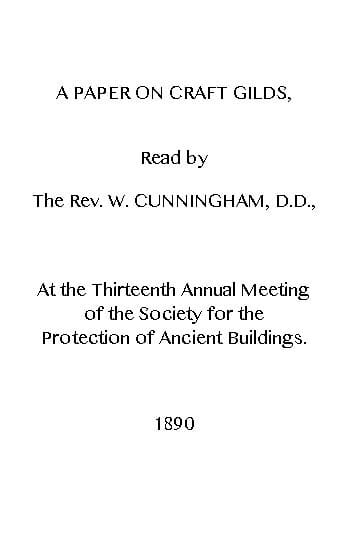
Craft Gilds, written by W. Cunningham in the early 20th century, provides a historical analysis of craft guilds during the Middle Ages. The book examines their role in regulating trades, maintaining quality standards, and overseeing apprentice training. Cunningham highlights the tensions between guilds and municipal authorities, using examples from Coventry, and reflects on the decline of these institutions while discussing their relevance to modern industrial society.
Editions
X-Ray
The author and speaker, a reverend doctor presenting scholarly research on craft guilds. He serves as the primary voice analyzing medieval guild systems and their historical significance.
An antiquary in Coventry who assisted Cunningham with his research. He provided access to historical records and local knowledge of the guild system.
A municipal official who facilitated Cunningham's research by providing access to historical documents and records.
The collective body of artisans whose work and organizations form the central subject of study. They represent the skilled workers who created the beautiful medieval craftsmanship that survives today.
About Craft Gilds
Chapter Summaries
- Introduction
- Cunningham establishes the purpose of studying ancient buildings and institutions, arguing they serve both as historical curiosities and examples of superior craftsmanship. He introduces the guild system as worthy of study for understanding medieval achievement in various crafts.
- I
- Traces the origins of craft guilds in England, arguing they were introduced after the Norman Conquest, particularly through Flemish weavers. The earliest guilds operated under royal authority and regulated trades that required quality control for public welfare.
- II
- Examines the structure and function of mature guild systems, focusing on Coventry examples. Discusses the three main sources of conflict: between guilds and municipal authorities, between different guilds, and within guilds between masters, journeymen, and apprentices.
Key Themes
- Decline of Craftsmanship
- Cunningham argues that medieval craftsmen achieved superior quality through guild organization, which modern industrial methods cannot match. The loss of personal skill and direct human involvement in production represents a fundamental change in the nature of work.
- Institutional Evolution
- The paper traces how craft guilds evolved from royal charters to municipal authority to eventual decline and attempted revival. This demonstrates how institutions must adapt to changing social and economic conditions or face obsolescence.
- Quality vs. Efficiency
- Medieval guilds prioritized quality and reputation over speed and profit, contrasting with modern industrial values. The guild motto that 'honourable thing was convenable' represents a different approach to commerce and craftsmanship.
Characters
- W. Cunningham(protagonist)
- The author and speaker, a reverend doctor presenting scholarly research on craft guilds. He serves as the primary voice analyzing medieval guild systems and their historical significance.
- W. G. Fretton(minor)
- An antiquary in Coventry who assisted Cunningham with his research. He provided access to historical records and local knowledge of the guild system.
- Town Clerk of Coventry(minor)
- A municipal official who facilitated Cunningham's research by providing access to historical documents and records.
- Medieval Craftsmen(major)
- The collective body of artisans whose work and organizations form the central subject of study. They represent the skilled workers who created the beautiful medieval craftsmanship that survives today.
- Guild Masters(major)
- The skilled craftsmen who controlled the guilds and supervised training and quality. They held authority over their respective trades and maintained standards.
- Apprentices(major)
- Young workers learning their trades under the guild system. Their training and treatment were central concerns of guild regulations.
Link to this book
Add a free, dofollow link to Lex on your blog, forum, syllabus, or reading list.

<a href="https://lex-books.com/book/craft-gilds-c5e57531-f72f-4b0b-8c59-e7131cc0ebb4"><img src="https://lex-books.com/badges/read-on-lex.svg" alt="Read Craft Gilds by W. Cunningham free on Lex" width="160" height="40"></a>[](https://lex-books.com/book/craft-gilds-c5e57531-f72f-4b0b-8c59-e7131cc0ebb4)[url=https://lex-books.com/book/craft-gilds-c5e57531-f72f-4b0b-8c59-e7131cc0ebb4][img]https://lex-books.com/badges/read-on-lex.svg[/img][/url]Read Craft Gilds by W. Cunningham free on Lex: https://lex-books.com/book/craft-gilds-c5e57531-f72f-4b0b-8c59-e7131cc0ebb4Cite this book
Reading this edition for a paper or guide? Copy a citation.
Cunningham, W.. Craft Gilds. Lex, lex-books.com/book/craft-gilds-c5e57531-f72f-4b0b-8c59-e7131cc0ebb4.Cunningham, W. (n.d.). Craft Gilds. Lex. https://lex-books.com/book/craft-gilds-c5e57531-f72f-4b0b-8c59-e7131cc0ebb4Cunningham, W.. Craft Gilds. Lex. https://lex-books.com/book/craft-gilds-c5e57531-f72f-4b0b-8c59-e7131cc0ebb4.