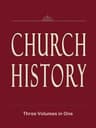
Church History (volumes 1-3)
1888
This monumental 19th-century scholarly work traces the entire arc of Christian church history from its origins through the medieval period. Johann Heinrich Kurtz, a professor of theology at the University of Dorpat, brings rigorous German historiography to bear on the development of Christian institutions, doctrine, and practice across nearly two millennia. Originally designed as a comprehensive textbook for theological students, the three volumes balance chronological narrative with thematic analysis, examining how a small sect in the Roman Empire transformed into a dominant cultural and spiritual force shaping Western civilization. The work proceeds through the early church, the patristic period, the medieval church, and the Reformation, weaving together analysis of key figures, doctrinal controversies, institutional evolution, and the fraught relationship between religious and secular power. Kurtz's method treats history and theology as inseparable disciplines, making this as much a work of religious philosophy as empirical historical scholarship. For over a century this served as a foundational text in seminaries and universities, and it remains valuable for its archival rigor and its attempt to trace the full sweep of Christian historical development through a single interpretive lens.
Editions
Link to this book
Add a free, dofollow link to Lex on your blog, forum, syllabus, or reading list.

<a href="https://lex-books.com/book/church-history-volumes-1-3-6ef1d341-4ab7-4c4f-8b5b-c5c18d8afbec"><img src="https://lex-books.com/badges/read-on-lex.svg" alt="Read Church History (volumes 1-3) by J. H. Kurtz free on Lex" width="160" height="40"></a>[](https://lex-books.com/book/church-history-volumes-1-3-6ef1d341-4ab7-4c4f-8b5b-c5c18d8afbec)[url=https://lex-books.com/book/church-history-volumes-1-3-6ef1d341-4ab7-4c4f-8b5b-c5c18d8afbec][img]https://lex-books.com/badges/read-on-lex.svg[/img][/url]Read Church History (volumes 1-3) by J. H. Kurtz free on Lex: https://lex-books.com/book/church-history-volumes-1-3-6ef1d341-4ab7-4c4f-8b5b-c5c18d8afbecCite this book
Reading this edition for a paper or guide? Copy a citation.
Kurtz, J. H.. Church History (volumes 1-3). Lex, lex-books.com/book/church-history-volumes-1-3-6ef1d341-4ab7-4c4f-8b5b-c5c18d8afbec.Kurtz, J. H. (1888). Church History (volumes 1-3). Lex. https://lex-books.com/book/church-history-volumes-1-3-6ef1d341-4ab7-4c4f-8b5b-c5c18d8afbecKurtz, J. H.. Church History (volumes 1-3). Lex. https://lex-books.com/book/church-history-volumes-1-3-6ef1d341-4ab7-4c4f-8b5b-c5c18d8afbec.