Cathay
1915
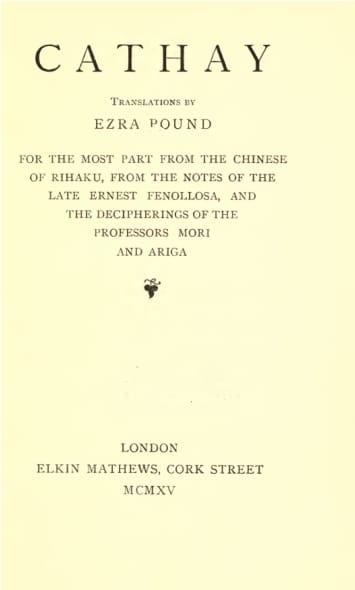
In 1915, as Europe tore itself apart in the First World War, Ezra Pound published a small book of Chinese poetry that would reshape English-language verse forever. Working from fragmentary notes left by the scholar Ernest Fenollosa and his own luminous intuition, Pound rendered the Tang Dynasty poets Li Bai and Du Fu into English with an immediacy that felt less like translation than resurrection. The poems here are ancient, but Pound's rendering makes them startlingly new: a river merchant's wife waits by the falling flowers for a husband who may never return; a frontier guard sings of the vast loneliness of the northern wastes; lovers part at dawn with the moon still bright above them. These are poems of profound stillness in the midst of impermanence, of beauty acknowledged precisely because it cannot last. Pound stripped away the fuss of Victorian poetry to find something spare and devastating. This is the book that taught modern poetry that less could be infinitely more, and that Chinese poets had been writing with that wisdom for a thousand years.
Editions

X-Ray
“And if you ask how I regret that parting: It is like the flowers falling at Spring’s end Confused, whirled in a tangle. What is the use of talking, and there is no end of talking, There is no end of things in the heart. I””
— Ezra Pound
“And if you ask how I regret that parting?It is like the flowers falling at spring’s end,confused, whirled in a tangle.What is the use of talking! And there is no end of talking”
— Ezra Pound
“Separation on the River Kiang KO-JIN goes west from Ko-kaku-ro, The smoke-flowers are blurred over the river. His lone sail blots the far sky. And now I see only the river, The long Kiang, reaching heaven. Taking””
— Ezra Pound
Link to this book
Add a free, dofollow link to Lex on your blog, forum, syllabus, or reading list.

<a href="https://lex-books.com/book/cathay-c58d8d1d-be70-4303-9f49-c6416bacb9e7"><img src="https://lex-books.com/badges/read-on-lex.svg" alt="Read Cathay by Ezra Pound free on Lex" width="160" height="40"></a>[](https://lex-books.com/book/cathay-c58d8d1d-be70-4303-9f49-c6416bacb9e7)[url=https://lex-books.com/book/cathay-c58d8d1d-be70-4303-9f49-c6416bacb9e7][img]https://lex-books.com/badges/read-on-lex.svg[/img][/url]Read Cathay by Ezra Pound free on Lex: https://lex-books.com/book/cathay-c58d8d1d-be70-4303-9f49-c6416bacb9e7Cite this book
Reading this edition for a paper or guide? Copy a citation.
Pound, Ezra. Cathay. Lex, lex-books.com/book/cathay-c58d8d1d-be70-4303-9f49-c6416bacb9e7.Pound, E. (1915). Cathay. Lex. https://lex-books.com/book/cathay-c58d8d1d-be70-4303-9f49-c6416bacb9e7Pound, Ezra. Cathay. Lex. https://lex-books.com/book/cathay-c58d8d1d-be70-4303-9f49-c6416bacb9e7.




![Birds and Nature, Vol. 12 No. 1 [June 1902]illustrated by Color Photography](/_next/image?url=https%3A%2F%2Fd3b2n8gj62qnwr.cloudfront.net%2FCOVERS%2Fgutenberg_covers75k%2Febook-47881.png&w=3840&q=75)