Catastrophe and Social Change: Based Upon a Sociological Study of the Halifax Disaster
1920
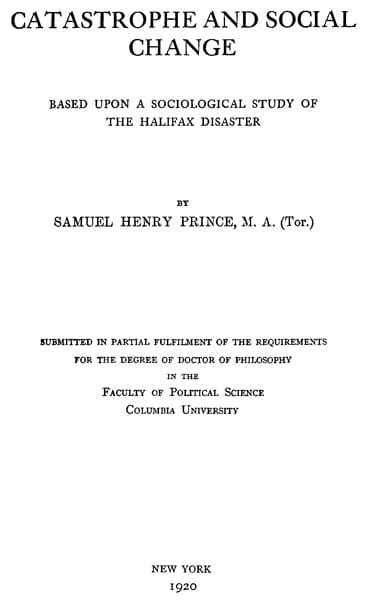
Catastrophe and Social Change: Based Upon a Sociological Study of the Halifax Disaster
1920
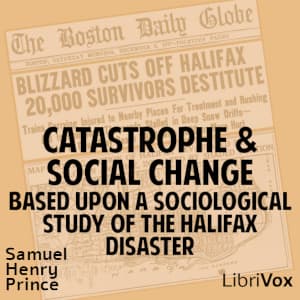
On December 6, 1917, a French cargo ship loaded with high explosives collided with another vessel in Halifax Harbour, creating an explosion that leveled two square miles of the city and killed nearly 2,000 people. Samuel Henry Prince witnessed the catastrophe firsthand, and then set out to study it with the rigor of a sociologist and the urgency of a survivor. This 1920 work stands as a landmark in disaster sociology, one of the first books to treat catastrophe not as mere tragedy but as a natural laboratory for understanding how societies function under extreme pressure. Prince examines how the explosion shattered social order, how communities responded in those chaotic hours and weeks, and what the processes of relief and reconstruction reveal about human resilience. He analyzes the mechanics of social disintegration and recovery, tracking individual and group behavior during the crisis, and argues that disasters serve as crucibles for lasting social change. More than a century later, the book remains essential reading for anyone seeking to understand how catastrophe reshapes the human world.
Editions
Link to this book
Add a free, dofollow link to Lex on your blog, forum, syllabus, or reading list.

<a href="https://lex-books.com/book/catastrophe-and-social-change-based-upon-a-sociological-study-of-the-halifax-dis-96e0e6e7-dbfd-4bc0-8904-08d148d4824e"><img src="https://lex-books.com/badges/read-on-lex.svg" alt="Read Catastrophe and Social Change: Based Upon a Sociological Study of the Halifax Disaster by Samuel Henry Prince free on Lex" width="160" height="40"></a>[](https://lex-books.com/book/catastrophe-and-social-change-based-upon-a-sociological-study-of-the-halifax-dis-96e0e6e7-dbfd-4bc0-8904-08d148d4824e)[url=https://lex-books.com/book/catastrophe-and-social-change-based-upon-a-sociological-study-of-the-halifax-dis-96e0e6e7-dbfd-4bc0-8904-08d148d4824e][img]https://lex-books.com/badges/read-on-lex.svg[/img][/url]Read Catastrophe and Social Change: Based Upon a Sociological Study of the Halifax Disaster by Samuel Henry Prince free on Lex: https://lex-books.com/book/catastrophe-and-social-change-based-upon-a-sociological-study-of-the-halifax-dis-96e0e6e7-dbfd-4bc0-8904-08d148d4824eCite this book
Reading this edition for a paper or guide? Copy a citation.
Prince, Samuel Henry. Catastrophe and Social Change: Based Upon a Sociological Study of the Halifax Disaster. Lex, lex-books.com/book/catastrophe-and-social-change-based-upon-a-sociological-study-of-the-halifax-dis-96e0e6e7-dbfd-4bc0-8904-08d148d4824e.Prince, S. H. (1920). Catastrophe and Social Change: Based Upon a Sociological Study of the Halifax Disaster. Lex. https://lex-books.com/book/catastrophe-and-social-change-based-upon-a-sociological-study-of-the-halifax-dis-96e0e6e7-dbfd-4bc0-8904-08d148d4824ePrince, Samuel Henry. Catastrophe and Social Change: Based Upon a Sociological Study of the Halifax Disaster. Lex. https://lex-books.com/book/catastrophe-and-social-change-based-upon-a-sociological-study-of-the-halifax-dis-96e0e6e7-dbfd-4bc0-8904-08d148d4824e.