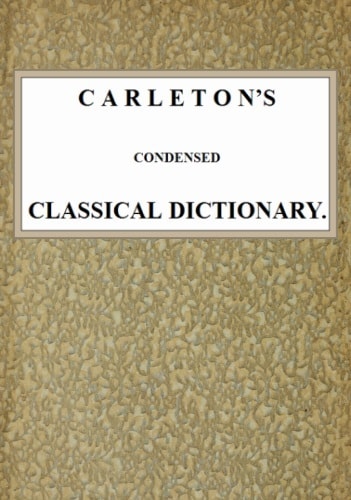
Carleton's Condensed Classical Dictionary
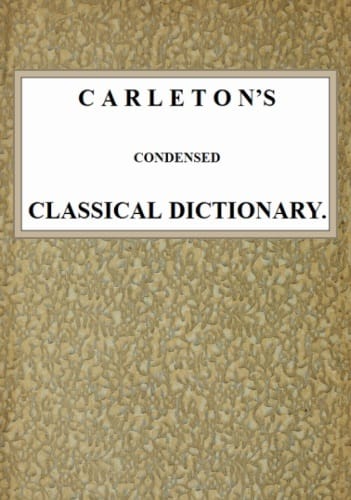
Carleton's Condensed Classical Dictionary
This compact Victorian reference work offers more than mere definitions: it is a portal to a world where classical mythology was considered essential knowledge for any educated person. Compiled in an era when schoolboys memorized the Iliad and Latin was the language of scholarship, the dictionary distills gods, heroes, and legendary figures into brisk, authoritative entries. Here Achilles is not just the Greek warrior but the embodiment of heroic vulnerability; here Hercules becomes a catalog of impossible labors, and the tragic lovers Hero and Leander merit only a few sentences that somehow capture an entire ocean of longing. The condensed format was clearly designed for busy readers, students, and anyone who needed quick access to the building blocks of Western culture. What gives the book its peculiar charm is not comprehensiveness but economy: each entry assumes you want the essential facts, delivered without flourish, in the confident tone of 19th-century certainty. For readers today, it functions both as a practical guide to classical references that still surface in literature and conversation, and as a fascinating artifact of how our ancestors organized their knowledge of the ancient world.
Editions
X-Ray
First emperor of Rome, descended from Julus son of Aeneas. Famous for his eloquence, military conquests including Gaul and Britain, and crossing the Rubicon to declare war on the Senate.
Son of Philip and Olympias, born when Diana's temple at Ephesus burned. Built Alexandria on the Nile and conquered territories extending to India before dying at Babylon aged 32.
Bravest Greek in Trojan War, son of Peleus and Thetis. Made invulnerable except for his heel when dipped in River Styx. Killed Hector to avenge Patroclus's death.
Son of Jupiter and Alcmena, ranked among gods after death. Famous for Twelve Labors including slaying Nemean lion, destroying Lernaean hydra, and bringing Cerberus from underworld.
About Carleton's Condensed Classical Dictionary
Chapter Summaries
- A
- Covers major figures from Abydos (famous for Hero and Leander) through Azores. Includes Achilles, the greatest Greek warrior made invulnerable except for his heel, and Alexander the Great, who conquered from Macedonia to India.
Key Themes
- Heroism and Glory
- Classical heroes like Achilles, Hercules, and Alexander pursue immortal fame through great deeds. Their achievements in war, conquest, and overcoming impossible challenges define the heroic ideal of antiquity.
- Fate and Divine Intervention
- The gods constantly intervene in human affairs, from Jupiter's transformations to pursue mortals to oracles predicting destinies. Mortals struggle against or fulfill their fated roles in the cosmic order.
- Love and Transformation
- Passionate love leads to dramatic transformations, both literal (gods changing lovers into animals or plants) and metaphorical (love driving characters to extreme actions like Hero and Leander's tragic devotion).
Characters
- Julius Caesar(major)
- First emperor of Rome, descended from Julus son of Aeneas. Famous for his eloquence, military conquests including Gaul and Britain, and crossing the Rubicon to declare war on the Senate.
- Alexander the Great(major)
- Son of Philip and Olympias, born when Diana's temple at Ephesus burned. Built Alexandria on the Nile and conquered territories extending to India before dying at Babylon aged 32.
- Achilles(major)
- Bravest Greek in Trojan War, son of Peleus and Thetis. Made invulnerable except for his heel when dipped in River Styx. Killed Hector to avenge Patroclus's death.
- Hercules(major)
- Son of Jupiter and Alcmena, ranked among gods after death. Famous for Twelve Labors including slaying Nemean lion, destroying Lernaean hydra, and bringing Cerberus from underworld.
- Augustus(major)
- First Roman emperor, originally Octavianus Caesar. Formed triumvirate with Antony and Lepidus, defeated Brutus and Cassius at Philippi, and Antony and Cleopatra at Actium.
- Brutus(major)
- Marcus Junius Brutus, Caesar's intimate friend who led conspiracy to assassinate him. Defeated at Philippi and fell on his own sword, honored with magnificent funeral by Antony.
Link to this book
Add a free, dofollow link to Lex on your blog, forum, syllabus, or reading list.

<a href="https://lex-books.com/book/carleton-s-condensed-classical-dictionary-260e04f5-7733-49a3-a9e7-d8dfe7deee80"><img src="https://lex-books.com/badges/read-on-lex.svg" alt="Read Carleton's Condensed Classical Dictionary by Unknown free on Lex" width="160" height="40"></a>[](https://lex-books.com/book/carleton-s-condensed-classical-dictionary-260e04f5-7733-49a3-a9e7-d8dfe7deee80)[url=https://lex-books.com/book/carleton-s-condensed-classical-dictionary-260e04f5-7733-49a3-a9e7-d8dfe7deee80][img]https://lex-books.com/badges/read-on-lex.svg[/img][/url]Read Carleton's Condensed Classical Dictionary by Unknown free on Lex: https://lex-books.com/book/carleton-s-condensed-classical-dictionary-260e04f5-7733-49a3-a9e7-d8dfe7deee80Cite this book
Reading this edition for a paper or guide? Copy a citation.
Unknown. Carleton's Condensed Classical Dictionary. Lex, lex-books.com/book/carleton-s-condensed-classical-dictionary-260e04f5-7733-49a3-a9e7-d8dfe7deee80.Unknown (n.d.). Carleton's Condensed Classical Dictionary. Lex. https://lex-books.com/book/carleton-s-condensed-classical-dictionary-260e04f5-7733-49a3-a9e7-d8dfe7deee80Unknown. Carleton's Condensed Classical Dictionary. Lex. https://lex-books.com/book/carleton-s-condensed-classical-dictionary-260e04f5-7733-49a3-a9e7-d8dfe7deee80.