Cambridge and Its Colleges
1898
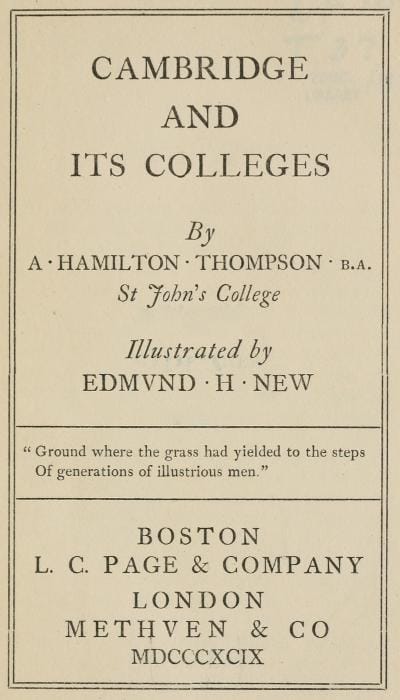
Cambridge and Its Colleges
1898
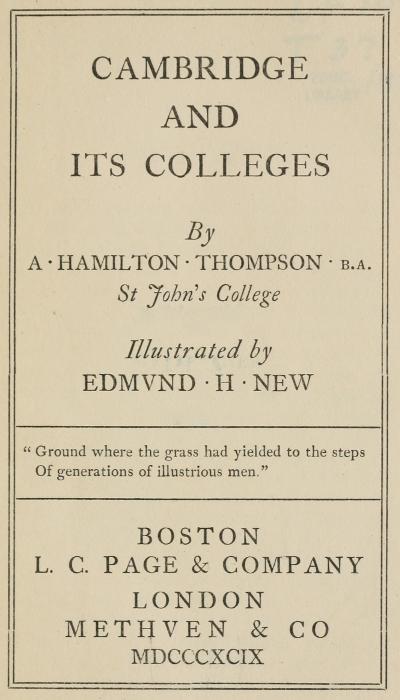
Cambridge is not merely a university but a living museum of English architectural ambition, and Hamilton Thompson's 1898 study captures it at a moment when its medieval bones were still newly shadowed by Victorian change. Beginning with the contested origins of the town itself, its Roman roads, its Saxon name, its uncertain emergence from the Fens, Thompson traces the remarkable transformation of a modest market settlement into the world's most enduring system of higher learning. The book moves through the monastic foundations that seeded Cambridge's intellectual life, then follows the gradual accretion of colleges, each built (and rebuilt) according to the tastes and fortunes of royal, ecclesiastical, and aristocratic benefactors. Thompson writes with an architect's eye for detail and a historian's patience, rendering the fan-vaulted chapels, the Tudor gatehouses, the Wren chapels, and the Gothic libraries not as frozen monuments but as arguments about power, faith, and memory. The relationship between town and gown, the tensions, the dependencies, the shared streets, receives its due, setting the stage for the individual portraits of each college that follow. For anyone who has walked King's Parade at dusk or sat in a college garden listening to the bells, this book explains why Cambridge looks the way it does, and why it matters.
Editions
Link to this book
Add a free, dofollow link to Lex on your blog, forum, syllabus, or reading list.

<a href="https://lex-books.com/book/cambridge-and-its-colleges-1fe9161b-d222-4713-8171-7f9cd76901fb"><img src="https://lex-books.com/badges/read-on-lex.svg" alt="Read Cambridge and Its Colleges by A. Hamilton Thompson free on Lex" width="160" height="40"></a>[](https://lex-books.com/book/cambridge-and-its-colleges-1fe9161b-d222-4713-8171-7f9cd76901fb)[url=https://lex-books.com/book/cambridge-and-its-colleges-1fe9161b-d222-4713-8171-7f9cd76901fb][img]https://lex-books.com/badges/read-on-lex.svg[/img][/url]Read Cambridge and Its Colleges by A. Hamilton Thompson free on Lex: https://lex-books.com/book/cambridge-and-its-colleges-1fe9161b-d222-4713-8171-7f9cd76901fbCite this book
Reading this edition for a paper or guide? Copy a citation.
Thompson, A. Hamilton. Cambridge and Its Colleges. Lex, lex-books.com/book/cambridge-and-its-colleges-1fe9161b-d222-4713-8171-7f9cd76901fb.Thompson, A. H. (1898). Cambridge and Its Colleges. Lex. https://lex-books.com/book/cambridge-and-its-colleges-1fe9161b-d222-4713-8171-7f9cd76901fbThompson, A. Hamilton. Cambridge and Its Colleges. Lex. https://lex-books.com/book/cambridge-and-its-colleges-1fe9161b-d222-4713-8171-7f9cd76901fb.