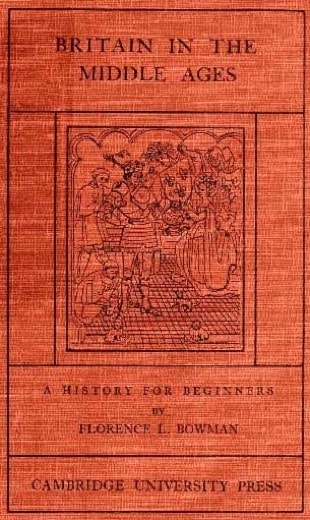
Britain in the Middle Ages: A History for Beginners
1920
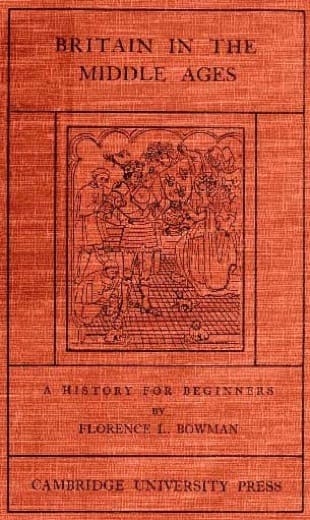
Britain in the Middle Ages: A History for Beginners
1920
Britain in the Middle Ages: A History for Beginners, written by Florence L. Bowman and first published in 1920, provides an accessible overview of Britain's medieval history for younger readers and novices. The book covers key events and cultural shifts from ancient times through the end of the Middle Ages in 1485, including the Roman invasion, the arrival of the Saxons, and the spread of Christianity. Bowman's work serves as an introductory guide to understanding the significant historical developments that shaped medieval Britain.
Editions
X-Ray
The indigenous people of Britain, described as skilled horsemen, artisans, and farmers, who faced successive invasions.
A powerful army from Italy who conquered Britain, bringing infrastructure, towns, and a new way of life, before withdrawing.
Sea robbers from Denmark and Germany who invaded and settled Britain, establishing Angleland and developing a distinct culture and governance.
The chief god of the Saxons, representing their pagan beliefs before the arrival of Christianity.
About Britain in the Middle Ages: A History for Beginners
Chapter Summaries
- I
- This chapter describes ancient Britain, its changing climate, and the early inhabitants, the Britons. It details their simple dwellings, hunting practices, craftsmanship, and beliefs, highlighting their love for beautiful things and their skill with horses and chariots.
- II
- The Romans invade Britain, building roads, towns, and Hadrian's Wall, bringing their advanced civilization and military might. The chapter describes Roman life, architecture, and administration, and the Britons' adoption of some of their ways, before the Romans eventually withdraw.
- III
- The Angles and Saxons, fierce sea robbers, invade Britain after the Romans leave, renaming it England. The chapter details their appearance, fighting skills, and their rich pagan culture, including stories of gods like Odin and Thor, and their burial customs.
Key Themes
- Conquest and Settlement
- The book repeatedly highlights how Britain's history is shaped by waves of invaders—Romans, Saxons, Danes, Normans—each conquering, settling, and leaving an indelible mark on the land, its people, and its culture. This theme explores the violent displacement of existing populations and the subsequent integration or subjugation of new ones.
- The Evolution of Governance and Law
- From Saxon village meetings under an oak tree to the establishment of the Exchequer, the Great Charter, and Parliament, the narrative traces the development of legal and administrative systems. It shows how kings sought to centralize power, how barons resisted, and how the concept of justice evolved over centuries.
- The Influence of Religion
- The transition from pagan beliefs (Odin, Thor) to Christianity is a major turning point, brought by Augustine and spread by monks. The Church's growing power, its role in education and social welfare, and its conflicts with royal authority (e.g., Anselm, Becket) are consistently explored, as is the later rise of the Friars.
Characters
- The Britons(supporting)
- The indigenous people of Britain, described as skilled horsemen, artisans, and farmers, who faced successive invasions.
- The Romans(antagonist)
- A powerful army from Italy who conquered Britain, bringing infrastructure, towns, and a new way of life, before withdrawing.
- The Saxons(protagonist)
- Sea robbers from Denmark and Germany who invaded and settled Britain, establishing Angleland and developing a distinct culture and governance.
- Odin(minor)
- The chief god of the Saxons, representing their pagan beliefs before the arrival of Christianity.
- Augustine(supporting)
- A monk sent by Pope Gregory to convert the Saxons to Christianity, establishing churches and monasteries.
- Alfred the Great(protagonist)
- A Saxon King who fought against the Danes, promoted learning, translated books, and reformed governance, leaving a lasting legacy.
Link to this book
Add a free, dofollow link to Lex on your blog, forum, syllabus, or reading list.

<a href="https://lex-books.com/book/britain-in-the-middle-ages-a-history-for-beginners-7e93e27e-ccdb-4129-adf1-8e9fb1dd5fd6"><img src="https://lex-books.com/badges/read-on-lex.svg" alt="Read Britain in the Middle Ages: A History for Beginners by Florence L. Bowman free on Lex" width="160" height="40"></a>[](https://lex-books.com/book/britain-in-the-middle-ages-a-history-for-beginners-7e93e27e-ccdb-4129-adf1-8e9fb1dd5fd6)[url=https://lex-books.com/book/britain-in-the-middle-ages-a-history-for-beginners-7e93e27e-ccdb-4129-adf1-8e9fb1dd5fd6][img]https://lex-books.com/badges/read-on-lex.svg[/img][/url]Read Britain in the Middle Ages: A History for Beginners by Florence L. Bowman free on Lex: https://lex-books.com/book/britain-in-the-middle-ages-a-history-for-beginners-7e93e27e-ccdb-4129-adf1-8e9fb1dd5fd6Cite this book
Reading this edition for a paper or guide? Copy a citation.
Bowman, Florence L.. Britain in the Middle Ages: A History for Beginners. Lex, lex-books.com/book/britain-in-the-middle-ages-a-history-for-beginners-7e93e27e-ccdb-4129-adf1-8e9fb1dd5fd6.Bowman, F. L. (1920). Britain in the Middle Ages: A History for Beginners. Lex. https://lex-books.com/book/britain-in-the-middle-ages-a-history-for-beginners-7e93e27e-ccdb-4129-adf1-8e9fb1dd5fd6Bowman, Florence L.. Britain in the Middle Ages: A History for Beginners. Lex. https://lex-books.com/book/britain-in-the-middle-ages-a-history-for-beginners-7e93e27e-ccdb-4129-adf1-8e9fb1dd5fd6.