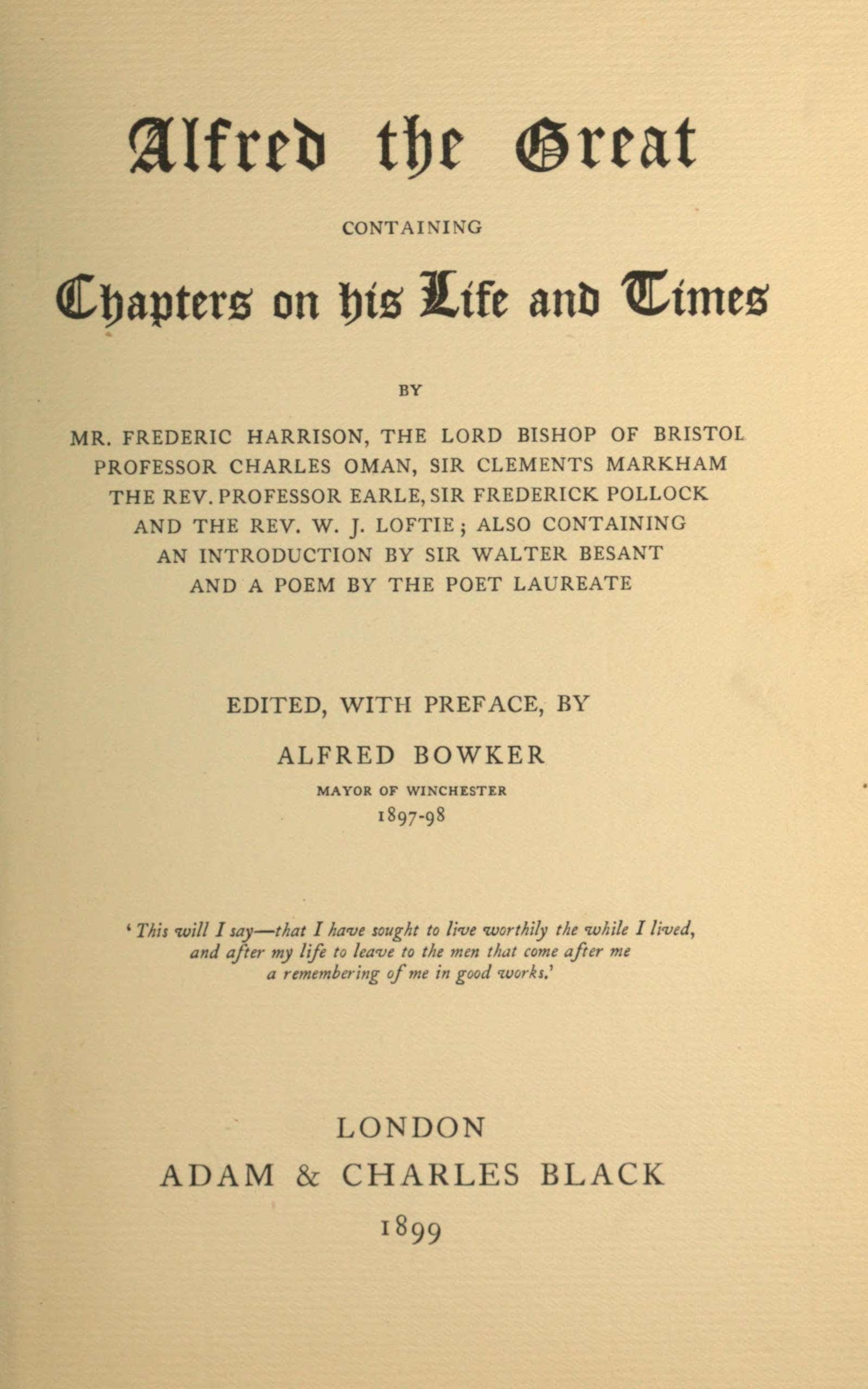
Alfred the Great: Containing Chapters on His Life and Times
1849
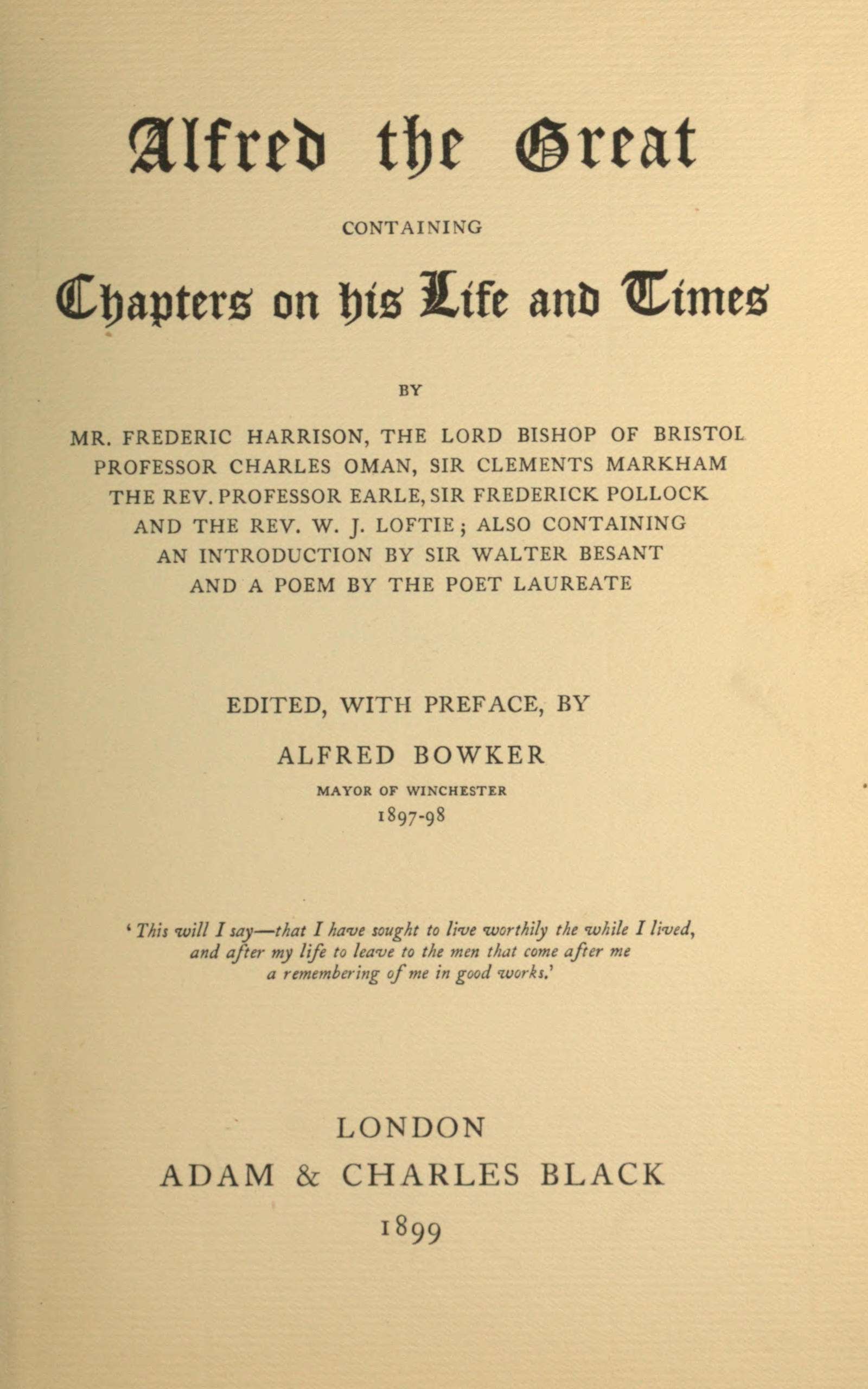
Alfred the Great: Containing Chapters on His Life and Times
1849
Published in 1849, 'Alfred the Great: Containing Chapters on His Life and Times' is a historical compendium that examines the life and reign of King Alfred of England (849-899). The book features essays by notable scholars, detailing Alfred's military victories against Viking invasions, his contributions to law, education, and culture, and his role in nation-building. It highlights his legacy as a model of wisdom and virtue, emphasizing his impact on the development of English prose and national identity.
Editions
X-Ray
“One man running from fear was far more damaging to the integrity of the wall than twenty men falling from stab wounds.””
— Unknown
“very soon, for two reasons. First, the Wessex fyrd could only be kept in the field for a short period. Soon their supplies would dwindle, and the need for the men of Wessex to return to their fields and shops would begin to sap away the strength of the Saxon shieldwall. Second, Alfred had a very ominous foreboding about Guthrum’s strategy. The Danish king had clearly chosen a position easily reached from the sea and well connected to the waterways of Wessex. Why would he choose what was clearly a naval base when he had come with land forces? Wareham was the perfect stronghold for a ship army. But where were the ships? Alfred knew that at any moment swarms of Viking longboats were likely to arrive, bringing thousands of Danish warriors, doubling or tripling Guthrum’s army and killing any possibility the men of Wessex had of repelling this attack. Guthrum must be driven from Warehem immediately. Alfred’s desperation showed in the approach he finally chose. Once more, he paid the danegeld. Of course this wasn’t the sort of tactic that could work over any extended period of time, but it was enough to extract Guthrum and his troop from Wareham. It should also be pointed out that, as disastrous as paying the danegeld had been for East Anglia and Mercia, Alfred’s previous payment had been temporarily successful. It had seemed to buy a few years of peace. Alfred clearly felt uneasy about this payment and made two extra demands as he negotiated the Viking withdrawal. First, the two armies exchanged hostages. A selection of Wessex men were taken into captivity by Guthrum, and Alfred chose an assortment of the most distinguished Danish noblemen to remain with him. These hostages were to ensure that the two kings honored their pledges to one another. If Guthrum failed to keep his end of the peace bargain, then Alfred would be free to exact his revenge on the Viking hostages, and vice versa. Second, Alfred insisted””
— Unknown
“Although these were easily the darkest days in Alfred’s life, they also were to become the most famous. The stories of his persevering against the Vikings transformed King Alfred into Alfred the Great. The story falls into a category that the modern ear can easily recognize and appreciate. From the legends of Robin Hood hiding out with his band of merry men in Sherwood Forest to the tales of men fighting in the underground French resistance during World War II, the modern listener has been well trained to be moved by the courageous nobility of continuing a campaign of resistance long after being driven into hiding. The seeming despair of a life of defiant resistance, while being hunted in one’s homeland, captures the imagination and takes on a romantic hue. But this was not a category of story that the Anglo-Saxon ear was accustomed to hearing. To his contemporaries, Alfred’s plight was an unqualified tragedy, utterly devoid of romanticism””
— Unknown
“Some accounts describe a thick mist that swallowed the ships and led them blindly to be dashed on the treacherous shores. In that one calamitous storm, 120 ships of the Viking fleet sank. Assuming that each of these ships was manned by an average of thirty men, this would have cost the Vikings thirty-six hundred men”
— Unknown
About Alfred the Great: Containing Chapters on His Life and Times
Chapter Summaries
- Introduction
- Establishes Alfred's historical context, describing the fragmented state of England with eight separate kingdoms and the Danish threat. Outlines Alfred's achievements in creating English unity, naval power, and educational foundations.
- 1
- Analyzes Alfred's political and military leadership, from his early defeats to ultimate victory over the Danes. Emphasizes his role in creating English national identity and his unique combination of warrior and scholar.
- 2
- Examines Alfred's deep Christian faith, his educational reforms, and his translations of religious texts. Details his establishment of schools and his vision of universal education.
Key Themes
- Leadership and Kingship
- Alfred exemplifies ideal Christian kingship, balancing military prowess with wisdom, justice, and devotion to his people's welfare. His concept of kingship emphasizes service over power.
- Education and Learning
- Alfred's commitment to translating Latin works into English and establishing schools demonstrates his belief that education is fundamental to national strength and moral development.
- Religious Faith and Duty
- Alfred's deep Christian faith guides all his actions, from his laws based on Biblical principles to his view of kingship as divinely ordained service to his people.
Characters
- Alfred the Great(protagonist)
- King of Wessex (871-901), described as the only perfect man of action in history. A warrior, scholar, law-giver, and religious leader who saved England from Danish conquest and established foundations of English civilization.
- Guthrum(antagonist)
- Danish king who led major invasions of England but was ultimately defeated by Alfred at Edington. Later converted to Christianity and made peace with Alfred.
- Ethelwulf(major)
- Alfred's father, King of Wessex who sent Alfred to Rome as a child and established religious foundations for Alfred's later work.
- Asser(major)
- Welsh monk who became Alfred's biographer, teacher, and close advisor. Primary source for Alfred's life and character.
- Ethelred(major)
- Alfred's brother and predecessor as King of Wessex. Died fighting the Danes, leaving Alfred to inherit the throne during a crisis.
- Osburga(minor)
- Alfred's mother, described as very religious and noble. Died before Alfred's major campaigns.
Link to this book
Add a free, dofollow link to Lex on your blog, forum, syllabus, or reading list.

<a href="https://lex-books.com/book/alfred-the-great-containing-chapters-on-his-life-and-times-d707b507-d92d-4d8d-a479-c83f29433447"><img src="https://lex-books.com/badges/read-on-lex.svg" alt="Read Alfred the Great: Containing Chapters on His Life and Times by Unknown free on Lex" width="160" height="40"></a>[](https://lex-books.com/book/alfred-the-great-containing-chapters-on-his-life-and-times-d707b507-d92d-4d8d-a479-c83f29433447)[url=https://lex-books.com/book/alfred-the-great-containing-chapters-on-his-life-and-times-d707b507-d92d-4d8d-a479-c83f29433447][img]https://lex-books.com/badges/read-on-lex.svg[/img][/url]Read Alfred the Great: Containing Chapters on His Life and Times by Unknown free on Lex: https://lex-books.com/book/alfred-the-great-containing-chapters-on-his-life-and-times-d707b507-d92d-4d8d-a479-c83f29433447Cite this book
Reading this edition for a paper or guide? Copy a citation.
Unknown. Alfred the Great: Containing Chapters on His Life and Times. Lex, lex-books.com/book/alfred-the-great-containing-chapters-on-his-life-and-times-d707b507-d92d-4d8d-a479-c83f29433447.Unknown (1849). Alfred the Great: Containing Chapters on His Life and Times. Lex. https://lex-books.com/book/alfred-the-great-containing-chapters-on-his-life-and-times-d707b507-d92d-4d8d-a479-c83f29433447Unknown. Alfred the Great: Containing Chapters on His Life and Times. Lex. https://lex-books.com/book/alfred-the-great-containing-chapters-on-his-life-and-times-d707b507-d92d-4d8d-a479-c83f29433447.