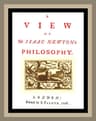
A View of Sir Isaac Newton's Philosophy
1728

In 1728, England was still processing the revolution in human thought precipitated by Isaac Newton. Henry Pemberton, a physician and mathematician who had known Newton personally, undertook something ambitious: explaining the master's discoveries for readers who lacked advanced mathematical training. This is not a textbook. It is a portrait of genius rendered by someone who watched it operate up close. Pemberton weaves between explaining Newton's core ideas, the mechanics of the heavens, the nature of light, the principles that would become classical physics, while also capturing the man himself. The preface, written after Newton's death, mixes reverence with intimate recollection. Here is Newton not as monument but as a thinking being whose friendship Pemberton valued. The book matters because it captures a pivotal moment in science history: the translation of profound mathematical work into ideas that could spread beyond Cambridge. Pemberton wanted to inspire a new generation, to show them that nature's laws were legible to patient inquiry. For anyone curious about how the scientific revolution actually reached the reading public, this is a primary source, written by a man who stood in the room where it happened.
Editions
Link to this book
Add a free, dofollow link to Lex on your blog, forum, syllabus, or reading list.

<a href="https://lex-books.com/book/a-view-of-sir-isaac-newton-s-philosophy-115454a7-d702-49f2-9491-74e5866d959f"><img src="https://lex-books.com/badges/read-on-lex.svg" alt="Read A View of Sir Isaac Newton's Philosophy by Henry Pemberton free on Lex" width="160" height="40"></a>[](https://lex-books.com/book/a-view-of-sir-isaac-newton-s-philosophy-115454a7-d702-49f2-9491-74e5866d959f)[url=https://lex-books.com/book/a-view-of-sir-isaac-newton-s-philosophy-115454a7-d702-49f2-9491-74e5866d959f][img]https://lex-books.com/badges/read-on-lex.svg[/img][/url]Read A View of Sir Isaac Newton's Philosophy by Henry Pemberton free on Lex: https://lex-books.com/book/a-view-of-sir-isaac-newton-s-philosophy-115454a7-d702-49f2-9491-74e5866d959fCite this book
Reading this edition for a paper or guide? Copy a citation.
Pemberton, Henry. A View of Sir Isaac Newton's Philosophy. Lex, lex-books.com/book/a-view-of-sir-isaac-newton-s-philosophy-115454a7-d702-49f2-9491-74e5866d959f.Pemberton, H. (1728). A View of Sir Isaac Newton's Philosophy. Lex. https://lex-books.com/book/a-view-of-sir-isaac-newton-s-philosophy-115454a7-d702-49f2-9491-74e5866d959fPemberton, Henry. A View of Sir Isaac Newton's Philosophy. Lex. https://lex-books.com/book/a-view-of-sir-isaac-newton-s-philosophy-115454a7-d702-49f2-9491-74e5866d959f.