A Treatise on the Incubus, or Night-Mare, Disturbed Sleep, Terrific Dreams and Nocturnal Visions
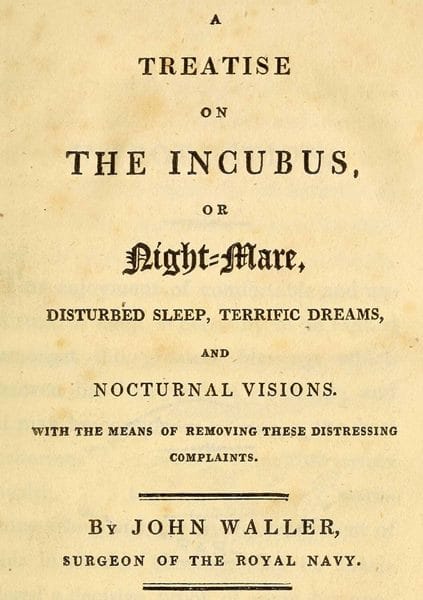
A Treatise on the Incubus, or Night-Mare, Disturbed Sleep, Terrific Dreams and Nocturnal Visions
In the early nineteenth century, a doctor sat down to write about the creature that visited him in the night. He called it the night-mare: that weight on the chest, the throat pressed closed, the terror of waking unable to move. John Augustine Waller had suffered these episodes himself, and in this treatise he attempted what was then radical, to understand them through reason rather than superstition, through observation rather than prayer. This is not a medieval text conjuring demons, though demons once filled this space in the popular imagination. Waller approaches the incubus as a physician examines his patient, gathering accounts from his own experience and others', tracing patterns in diet, sleep position, and constitution. He seeks remedies in ancient practice and his own experiments, while navigating between the emerging language of medicine and older folk explanations that had not yet been fully displaced. The work endures because it captures a peculiar historical threshold: the moment before science could fully explain what happens in that threshold state between sleep and waking, when the supernatural had not yet been entirely excised from the bedroom. It is for readers curious about how we once understood the night terrors that still visit us, and for those interested in the strange, fumbling early history of sleep science.
Editions
Link to this book
Add a free, dofollow link to Lex on your blog, forum, syllabus, or reading list.

<a href="https://lex-books.com/book/a-treatise-on-the-incubus-or-night-mare-disturbed-sleep-terrific-dreams-and-noct-66a74128-3932-428f-b371-5de9835cd785"><img src="https://lex-books.com/badges/read-on-lex.svg" alt="Read A Treatise on the Incubus, or Night-Mare, Disturbed Sleep, Terrific Dreams and Nocturnal Visions by John Augustine Waller free on Lex" width="160" height="40"></a>[](https://lex-books.com/book/a-treatise-on-the-incubus-or-night-mare-disturbed-sleep-terrific-dreams-and-noct-66a74128-3932-428f-b371-5de9835cd785)[url=https://lex-books.com/book/a-treatise-on-the-incubus-or-night-mare-disturbed-sleep-terrific-dreams-and-noct-66a74128-3932-428f-b371-5de9835cd785][img]https://lex-books.com/badges/read-on-lex.svg[/img][/url]Read A Treatise on the Incubus, or Night-Mare, Disturbed Sleep, Terrific Dreams and Nocturnal Visions by John Augustine Waller free on Lex: https://lex-books.com/book/a-treatise-on-the-incubus-or-night-mare-disturbed-sleep-terrific-dreams-and-noct-66a74128-3932-428f-b371-5de9835cd785Cite this book
Reading this edition for a paper or guide? Copy a citation.
Waller, John Augustine. A Treatise on the Incubus, or Night-Mare, Disturbed Sleep, Terrific Dreams and Nocturnal Visions. Lex, lex-books.com/book/a-treatise-on-the-incubus-or-night-mare-disturbed-sleep-terrific-dreams-and-noct-66a74128-3932-428f-b371-5de9835cd785.Waller, J. A. (n.d.). A Treatise on the Incubus, or Night-Mare, Disturbed Sleep, Terrific Dreams and Nocturnal Visions. Lex. https://lex-books.com/book/a-treatise-on-the-incubus-or-night-mare-disturbed-sleep-terrific-dreams-and-noct-66a74128-3932-428f-b371-5de9835cd785Waller, John Augustine. A Treatise on the Incubus, or Night-Mare, Disturbed Sleep, Terrific Dreams and Nocturnal Visions. Lex. https://lex-books.com/book/a-treatise-on-the-incubus-or-night-mare-disturbed-sleep-terrific-dreams-and-noct-66a74128-3932-428f-b371-5de9835cd785.