A Drunk Man Looks at the Thistle
1926
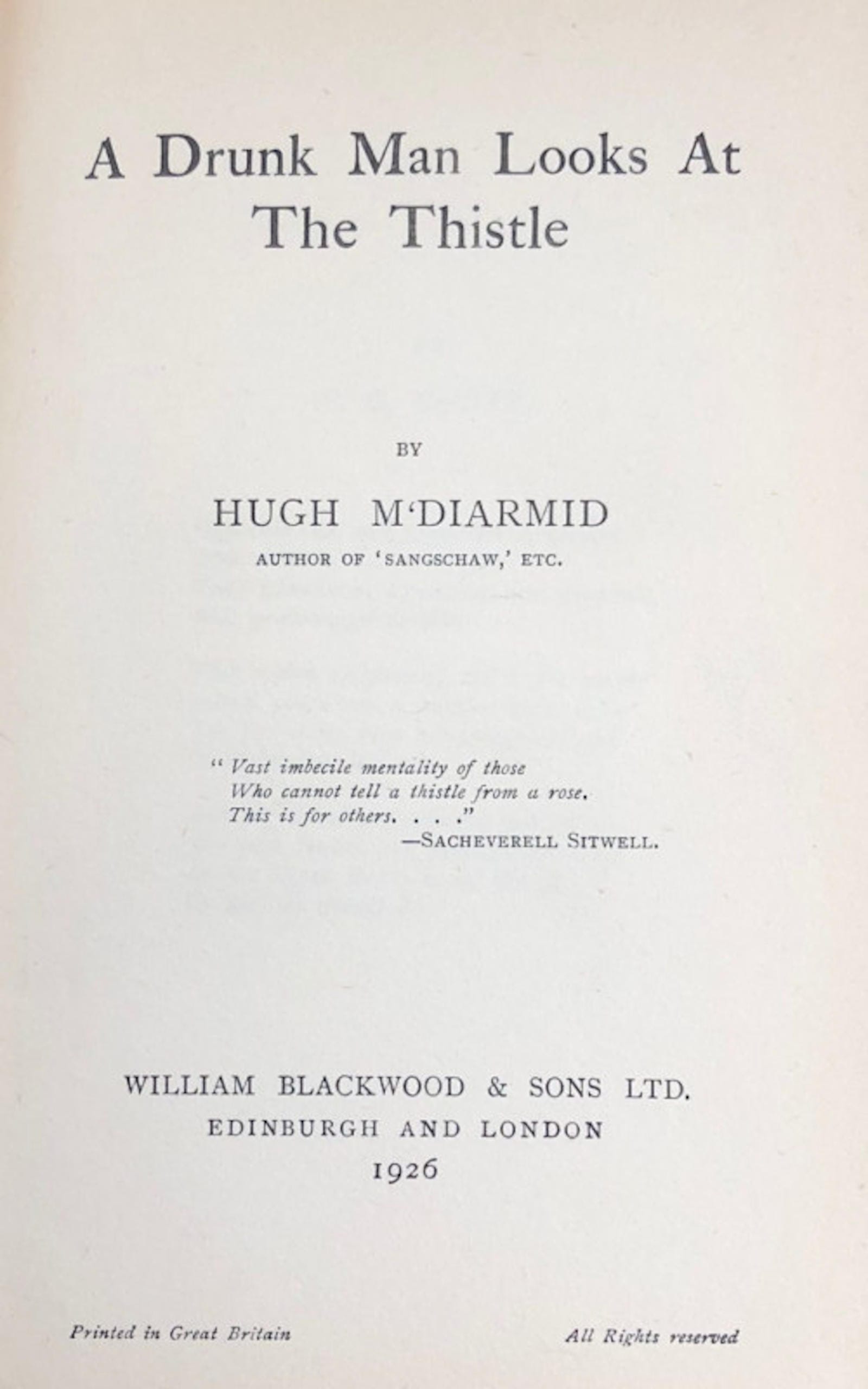
A drunk man stares at Scotland's national emblem and sees everything wrong with his nation. That's the conceit of Hugh MacDiarmid's towering modernist poem, written in 1926 in the Scots dialect and published at the height of the interwar crisis. The poem unfolds as a feverish, stream-of-consciousness monologue where intoxication becomes a lens for examining Scottish identity with unflinching honesty. MacDiarmid ranges from comic to tragic, weaving in Dostoevsky and Nietzsche, the 1926 General Strike, sexual longing, and cosmic despair. The thistle becomes both symbol and provocation, a prickly embodiment of Scottishness the narrator loves and hates in equal measure. It's a poem about freedom and cage, language and nation, delivered in a voice that's bitter, funny, obscene, and genuinely visionary. This is one of the twentieth century's major modernist achievements, a work that asked what Scotland could be and answered with everything.
Editions
Link to this book
Add a free, dofollow link to Lex on your blog, forum, syllabus, or reading list.

<a href="https://lex-books.com/book/a-drunk-man-looks-at-the-thistle-9fc0bf19-0fe9-40f8-b26a-92b935974954"><img src="https://lex-books.com/badges/read-on-lex.svg" alt="Read A Drunk Man Looks at the Thistle by Hugh MacDiarmid free on Lex" width="160" height="40"></a>[](https://lex-books.com/book/a-drunk-man-looks-at-the-thistle-9fc0bf19-0fe9-40f8-b26a-92b935974954)[url=https://lex-books.com/book/a-drunk-man-looks-at-the-thistle-9fc0bf19-0fe9-40f8-b26a-92b935974954][img]https://lex-books.com/badges/read-on-lex.svg[/img][/url]Read A Drunk Man Looks at the Thistle by Hugh MacDiarmid free on Lex: https://lex-books.com/book/a-drunk-man-looks-at-the-thistle-9fc0bf19-0fe9-40f8-b26a-92b935974954Cite this book
Reading this edition for a paper or guide? Copy a citation.
MacDiarmid, Hugh. A Drunk Man Looks at the Thistle. Lex, lex-books.com/book/a-drunk-man-looks-at-the-thistle-9fc0bf19-0fe9-40f8-b26a-92b935974954.MacDiarmid, H. (1926). A Drunk Man Looks at the Thistle. Lex. https://lex-books.com/book/a-drunk-man-looks-at-the-thistle-9fc0bf19-0fe9-40f8-b26a-92b935974954MacDiarmid, Hugh. A Drunk Man Looks at the Thistle. Lex. https://lex-books.com/book/a-drunk-man-looks-at-the-thistle-9fc0bf19-0fe9-40f8-b26a-92b935974954.

![Birds and Nature, Vol. 12 No. 1 [June 1902]illustrated by Color Photography](/_next/image?url=https%3A%2F%2Fd3b2n8gj62qnwr.cloudfront.net%2FCOVERS%2Fgutenberg_covers75k%2Febook-47881.png&w=3840&q=75)