President's Task Force on 21st Century Policing
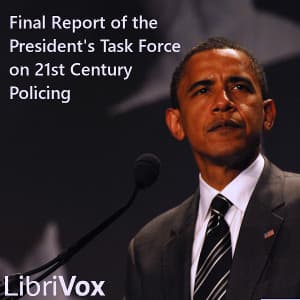
The President's Task Force on 21st Century Policing was created by an executive order signed by United States President Barack Obama on December 18, 2014. Obama created it in response to the unrest in Ferguson, Missouri following the shooting of Michael Brown by a police officer there. The eleven members of the task force include academics, law enforcement officials, and civil rights activists. The co-chairs of the task force are former Philadelphia police commissioner Charles H. Ramsey and George Mason University professor of criminology, law and society Laurie Robinson.
Famous Quotes
View all 6 quotes“Building trust and nurturing legitimacy on both sides of the police/citizen divide is not only the first pillar of this task force’s report but also the foundational principle underlying this inquiry into the nature of relations between law enforcement and the communities they serve.””
“Community policing must be a way of doing business by an entire police force, not just a specialized unit of that force.77””
“Half of all law enforcement agencies in the United States have fewer than ten officers, and nearly three-quarters have fewer than 25 officers.48 Lawrence Sherman noted in his testimony that “so many problems of organizational quality control are made worse by the tiny size of most local police agencies . . . less than 1 percent of 17,985 U.S. police agencies meet the English minimum of 1,000 employees or more.”49 These small forces often lack the resources for training and equipment accessible to larger departments and often are prevented by municipal boundaries and local custom from combining forces with neighboring agencies. Funding and technical assistance can give smaller agencies the incentive to share policies and practices and give them access to a wider variety of training, equipment, and communications technology than they could acquire on their own. Table 1. Full-time state and local law enforcement employees, by size of agency, 2008””
Audiobooks from the author

Link to this page
Add a free, dofollow link to Lex on your blog, forum, syllabus, or reading list.

<a href="https://lex-books.com/author/presidents-task-force-on-21st-century-policing"><img src="https://lex-books.com/badges/read-on-lex.svg" alt="President's Task Force on 21st Century Policing on Lex" width="160" height="40"></a>[](https://lex-books.com/author/presidents-task-force-on-21st-century-policing)[url=https://lex-books.com/author/presidents-task-force-on-21st-century-policing][img]https://lex-books.com/badges/read-on-lex.svg[/img][/url]President's Task Force on 21st Century Policing on Lex: https://lex-books.com/author/presidents-task-force-on-21st-century-policing