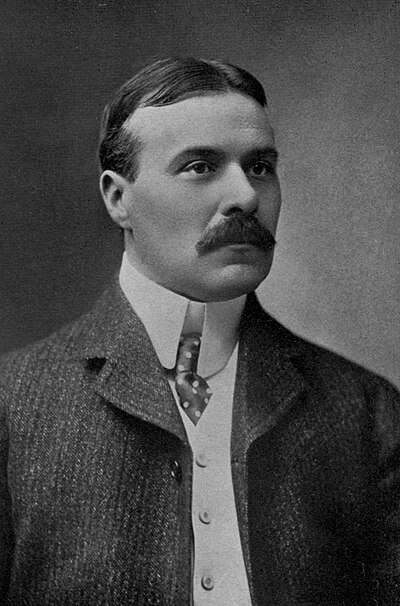
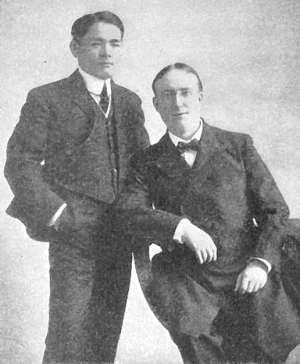
John Matthews Manly
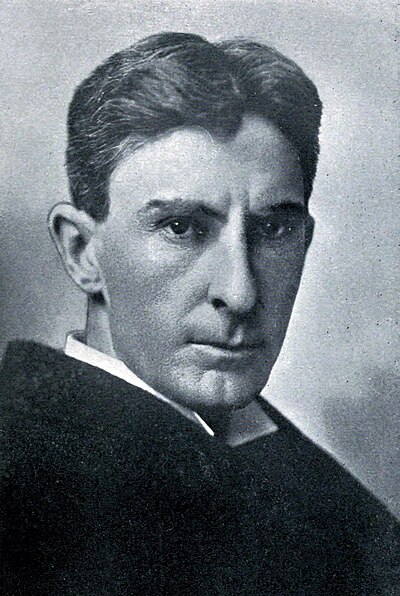
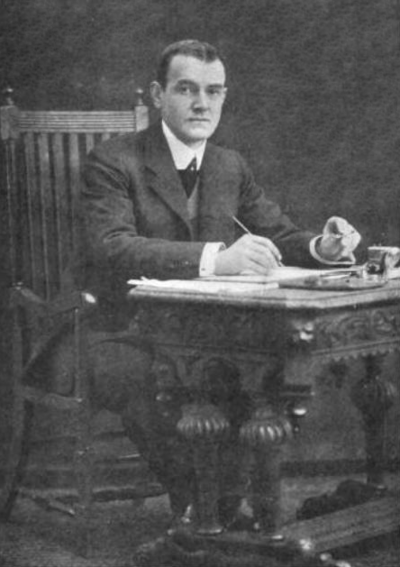
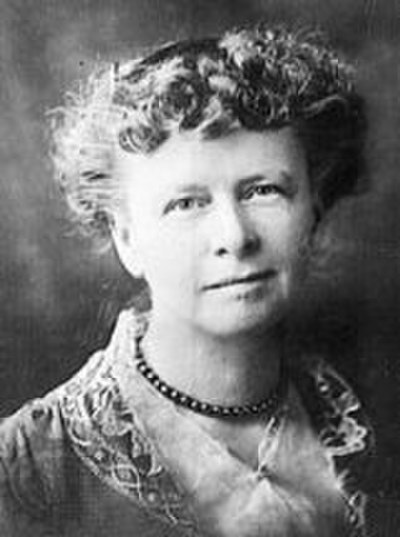
John Matthews Manly was an esteemed American professor of English literature and philology, renowned for his scholarly contributions to the study of classical English authors, particularly William Shakespeare and Geoffrey Chaucer. He served at the University of Chicago, where he influenced generations of students and scholars alike with his deep understanding of literary texts and their historical contexts. Manly's expertise in philology allowed him to delve into the intricacies of language and its evolution, enriching the academic discourse surrounding English literature. His most significant work, co-authored with former student Edith Rickert, is the eight-volume 'The Text of the Canterbury Tales' (1940), which is widely regarded as a definitive edition of Chaucer's works. This comprehensive study not only provided critical insights into Chaucer's text but also set a high standard for future scholarly editions of medieval literature. Manly's legacy endures through his meticulous research and dedication to the field, marking him as a pivotal figure in the study of English literary heritage.
Famous Quotes
View all 2 quotes“One author, in writing of the Bible’s uniqueness, put it this way: Here is a book: 1. written over a 1500 year span; 2. written over 40 generations; 3. written by more than 40 authors, from every walk of life”
“Unqualified Champions Consider these individuals from the Bible. Each person was aware of a personal shortcoming which should have rendered him disqualified for service. God, however, saw champion potential … Moses struggled with a speech impediment: “Then Moses said to the LORD, ‘Please, Lord, I have never been eloquent, neither recently nor in time past, nor since You have spoken to Your servant; for I am slow of speech and slow of tongue’” (Exodus 4:10). Yet God served as Moses’ source of strength. God used him to deliver the Israelites from bondage. Jeremiah considered himself too young to deliver a prophetic message to an adult population: “Then I said, ‘Alas, Lord GOD! Behold, I do not know how to speak, because I am a youth’” (Jeremiah 1:6). God’s reply: “Do not be afraid of them, for I am with you to deliver you,” (Jeremiah 1:8). Isaiah, whose encouragement I quoted earlier, had reservations of his own. Perhaps his vocabulary reflected my own”
Books from the author




Link to this page
Add a free, dofollow link to Lex on your blog, forum, syllabus, or reading list.

<a href="https://lex-books.com/author/john-matthews-manly"><img src="https://lex-books.com/badges/read-on-lex.svg" alt="John Matthews Manly on Lex" width="160" height="40"></a>[](https://lex-books.com/author/john-matthews-manly)[url=https://lex-books.com/author/john-matthews-manly][img]https://lex-books.com/badges/read-on-lex.svg[/img][/url]John Matthews Manly on Lex: https://lex-books.com/author/john-matthews-manly