An introduction to the Langlands program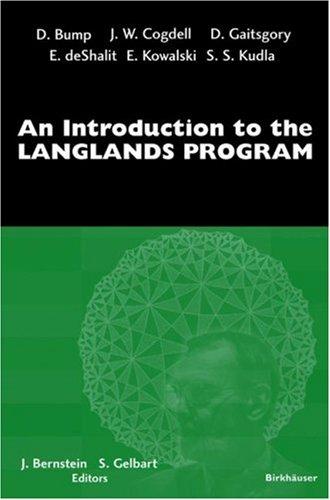
An introduction to the Langlands program
About this book
For the past several decades the theory of automorphic forms has become a major focal point of development in number theory and algebraic geometry, with applications in many diverse areas, including combinatorics and mathematical physics. The twelve chapters of this monograph present a broad, user-friendly introduction to the Langlands program, that is, the theory of automorphic forms and its connection with the theory of L-functions and other fields of mathematics. Key features of this self-contained presentation: A variety of areas in number theory from the classical zeta function up to the Langlands program are covered. The exposition is systematic, with each chapter focusing on a particular topic devoted to special cases of the program: • Basic zeta function of Riemann and its generalizations to Dirichlet and Hecke L-functions, class field theory and some topics on classical automorphic functions (E. Kowalski) • A study of the conjectures of Artin and Shimura–Taniyama–Weil (E. de Shalit) • An examination of classical modular (automorphic) L-functions as GL(2) functions, bringing into play the theory of representations (S.S. Kudla) • Selberg's theory of the trace formula, which is a way to study automorphic representations (D. Bump) • Discussion of cuspidal automorphic representations of GL(2,(A)) leads to Langlands theory for GL(n) and the importance of the Langlands dual group (J.W. Cogdell) • An introduction to the geometric Langlands program, a new and active area of research that permits using powerful methods of algebraic geometry to construct automorphic sheaves (D. Gaitsgory) Graduate students and researchers will benefit from this beautiful text.
Details
- OL Work ID
- OL18797090W
Subjects
L-functionsAutomorphic formsMathematicsGeometry, algebraicTopological GroupsNumber theory