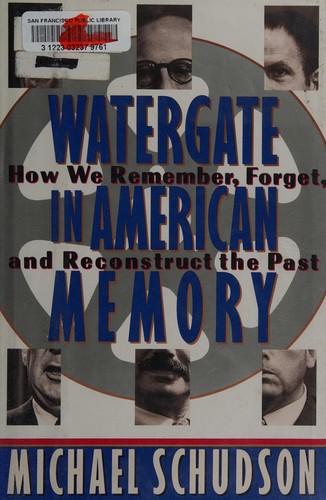
Watergate in American memory1992
About this book
It began with a burglary, the objectives of which are to this day unclear, and it led to the unprecedented resignation of a president in disgrace. For years the story dominated the airwaves and the headlines. Yet today a third of all high school students do not know that Watergate occurred after 1950, and many cannot name the president who resigned. How do Americans remember Watergate? Should we remember it? To what extent does our current "memory" of Watergate jibe with the historical record? Most important, who--the media? political elites? the courts?--are responsible for the particular version of those tumultous?sic? events we remember today? What Americans remember (and what they have forgotten) about the most traumatic domestic event in our recent history offers startling insights into the nature of collective memory.
Michael Schudson, one of this country's most perceptive observers of the media, uses interviews, press accounts of recent political controversies, and poll data to explore how America's collective memory of Watergate has changed over the years, and what this reveals about how we can learn from the past. Schudson argues that Watergate was both a Constitutional crisis triggered by presidential wrongdoing and a scandal in which investigators pursued multiple, and sometimes veiled, objectives. He explores the continuing unsettled relationship between these two faces of Watergate. Liberals who deny that scandals are socially constructed miss part of the story, as do conservatives who deny or minimize the Constitutional crisis.
The book gives special attention to several key domains where the memory of Watergate has been contested and transmitted: as a myth inside journalism, as a debate over reform legislation in Congress, as a set of lessons in school textbooks, as a new language for the public at large. Schudson's findings are often surprising. He argues that Richard Nixon has not been rehabilitated in the public mind and that there is good reason to think he never will be. And he shows that the myth spawned by Watergate of an all-powerful press has proved a mixed blessing. Above all, by examining more recent events like the Iran-contra Affair, this important and insightful book documents how the metaphor of Watergate continues to influence the White House, the Congress, and the nation's political life in general. The book thus offers an original argument about how the past survives and is transmitted across generations, even in the face of conscious efforts to rewrite history.
Details
- First published
- 1992
- OL Work ID
- OL1884591W
Subjects
Mass mediaPolitical aspectsPolitical aspects of Mass mediaPublic opinionUnited StatesWatergate Affair, 1972-1974