The Universal Counterfeit and Altered Bank Note Detector, at Sight
1949
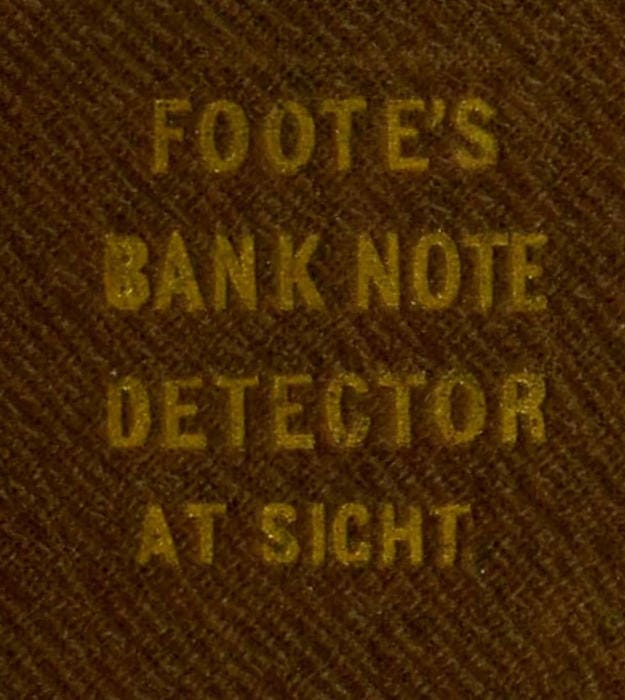
The Universal Counterfeit and Altered Bank Note Detector, at Sight
1949
Before federal currency and the Secret Service, American merchants lived in a world of chaos: hundreds of banks issued their own notes, and counterfeiters operated with alarming sophistication. Henry C. Foote's guide was the frontline defense, a practical manual designed to give anyone handling money the power to spot a fake at a glance. Organized into seven systematic rules, the book breaks down the intricate craft of banknote production: the secrets of engraving, the limitations of printing technology, the specific machinery that legitimate printers used and counterfeiters could not replicate. Foote doesn't just describe what to look for; he explains why certain features are impossible to forge, transforming visual inspection into a reasoned science rather than a guess. The book stands as a remarkable time capsule of 19th-century commerce, where the difference between solvency and ruin often hinged on one person's ability to study a piece of paper for a few seconds. This is practical knowledge rendered with the precision of a craftsman, essential reading for anyone curious about the hidden technical history behind the money we handle every day.
Editions
Link to this book
Add a free, dofollow link to Lex on your blog, forum, syllabus, or reading list.

<a href="https://lex-books.com/book/the-universal-counterfeit-and-altered-bank-note-detector-at-sight-4020e9e3-eef1-4503-b524-62ccac807432"><img src="https://lex-books.com/badges/read-on-lex.svg" alt="Read The Universal Counterfeit and Altered Bank Note Detector, at Sight by Henry C. Foote free on Lex" width="160" height="40"></a>[](https://lex-books.com/book/the-universal-counterfeit-and-altered-bank-note-detector-at-sight-4020e9e3-eef1-4503-b524-62ccac807432)[url=https://lex-books.com/book/the-universal-counterfeit-and-altered-bank-note-detector-at-sight-4020e9e3-eef1-4503-b524-62ccac807432][img]https://lex-books.com/badges/read-on-lex.svg[/img][/url]Read The Universal Counterfeit and Altered Bank Note Detector, at Sight by Henry C. Foote free on Lex: https://lex-books.com/book/the-universal-counterfeit-and-altered-bank-note-detector-at-sight-4020e9e3-eef1-4503-b524-62ccac807432Cite this book
Reading this edition for a paper or guide? Copy a citation.
Foote, Henry C.. The Universal Counterfeit and Altered Bank Note Detector, at Sight. Lex, lex-books.com/book/the-universal-counterfeit-and-altered-bank-note-detector-at-sight-4020e9e3-eef1-4503-b524-62ccac807432.Foote, H. C. (1949). The Universal Counterfeit and Altered Bank Note Detector, at Sight. Lex. https://lex-books.com/book/the-universal-counterfeit-and-altered-bank-note-detector-at-sight-4020e9e3-eef1-4503-b524-62ccac807432Foote, Henry C.. The Universal Counterfeit and Altered Bank Note Detector, at Sight. Lex. https://lex-books.com/book/the-universal-counterfeit-and-altered-bank-note-detector-at-sight-4020e9e3-eef1-4503-b524-62ccac807432.