The Threshold Covenant; Or, The Beginning of Religious Rites
1896
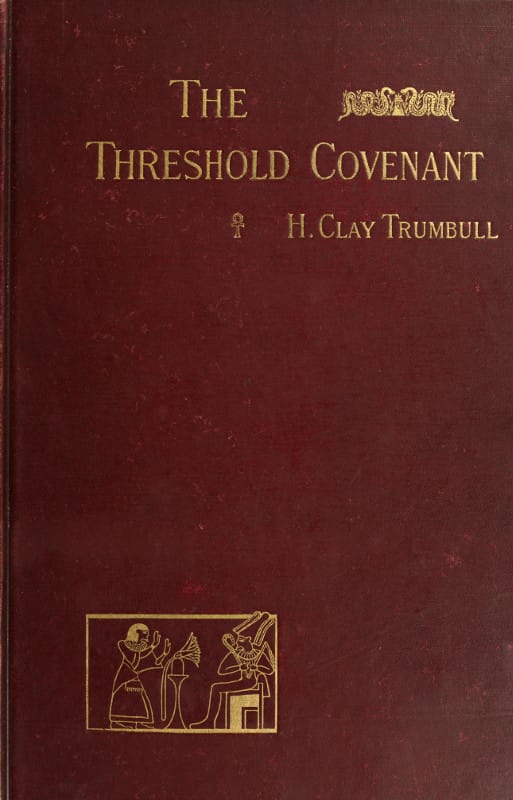
The Threshold Covenant; Or, The Beginning of Religious Rites
1896
The threshold was once the most dangerous place in the home. In this groundbreaking 1896 study, H. Clay Trumbull excavates the sacred history of the doorway, revealing how ancient civilizations understood the threshold not as mere architecture but as a primitive altar where humanity negotiated with the divine. Through meticulous analysis of blood covenants, sacrificial rites, and hospitality customs spanning multiple civilizations, Trumbull demonstrates that the doorway represented a liminal space where the human and supernatural worlds intersected. The family altar positioned at the threshold served as the mechanism by which guests were welcomed into covenant relationships, their acceptance through blood sacrifice marking entry into both family and divine protection. Trumbull traces these practices from ancient Israel to surrounding cultures, revealingPersistent cultural patterns that honor the threshold as a sacred entity. The work remains essential reading for anyone seeking to understand the primal origins of religious ritual and the profound significance humans have assigned to the spaces between.
Editions
Link to this book
Add a free, dofollow link to Lex on your blog, forum, syllabus, or reading list.

<a href="https://lex-books.com/book/the-threshold-covenant-or-the-beginning-of-religious-rites-49b60f83-3754-4a80-855f-6f0d70a67596"><img src="https://lex-books.com/badges/read-on-lex.svg" alt="Read The Threshold Covenant; Or, The Beginning of Religious Rites by H. Clay Trumbull free on Lex" width="160" height="40"></a>[](https://lex-books.com/book/the-threshold-covenant-or-the-beginning-of-religious-rites-49b60f83-3754-4a80-855f-6f0d70a67596)[url=https://lex-books.com/book/the-threshold-covenant-or-the-beginning-of-religious-rites-49b60f83-3754-4a80-855f-6f0d70a67596][img]https://lex-books.com/badges/read-on-lex.svg[/img][/url]Read The Threshold Covenant; Or, The Beginning of Religious Rites by H. Clay Trumbull free on Lex: https://lex-books.com/book/the-threshold-covenant-or-the-beginning-of-religious-rites-49b60f83-3754-4a80-855f-6f0d70a67596Cite this book
Reading this edition for a paper or guide? Copy a citation.
Trumbull, H. Clay. The Threshold Covenant; Or, The Beginning of Religious Rites. Lex, lex-books.com/book/the-threshold-covenant-or-the-beginning-of-religious-rites-49b60f83-3754-4a80-855f-6f0d70a67596.Trumbull, H. C. (1896). The Threshold Covenant; Or, The Beginning of Religious Rites. Lex. https://lex-books.com/book/the-threshold-covenant-or-the-beginning-of-religious-rites-49b60f83-3754-4a80-855f-6f0d70a67596Trumbull, H. Clay. The Threshold Covenant; Or, The Beginning of Religious Rites. Lex. https://lex-books.com/book/the-threshold-covenant-or-the-beginning-of-religious-rites-49b60f83-3754-4a80-855f-6f0d70a67596.