The Story of the Solar System
1895
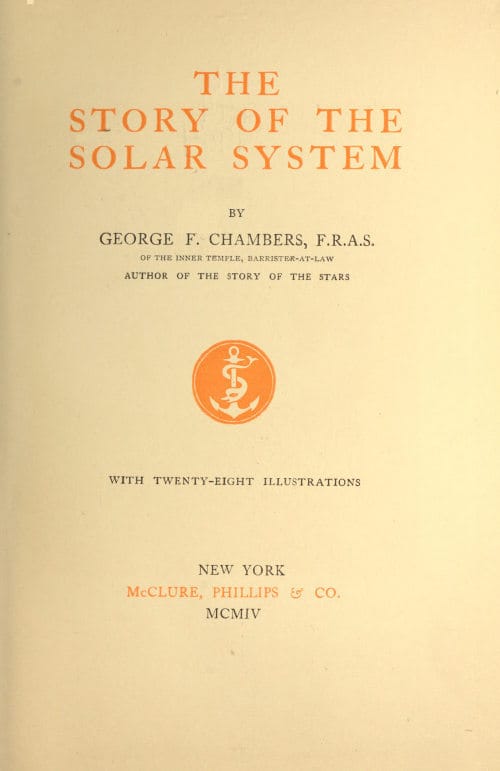
Published in 1895, this is a charming time capsule of Victorian astronomical knowledge. George F. Chambers wrote for the general reader who wanted to understand the cosmic bodies visible from Earth without wading through dense technical mathematics. He begins with the Sun as the sovereign center around which everything revolves, then guides readers through the planets, distinguishing between primary and secondary worlds, major and minor bodies. The book carries an delightful practical urgency: Chambers repeatedly urges his readers to obtain small telescopes and observe the heavens firsthand. What makes this volume endlessly fascinating today is precisely what Chambers could not anticipate: our reading becomes an act of historical archaeology. We watch a brilliant Victorian mind confidently explain what we now know to be profoundly incomplete. The moons of Mars are mentioned as可疑 new discoveries. Comets are treated with appropriate awe. The planets are old friends whose personalities Chambers sketches with warmth. For anyone curious about how our ancestors understood the cosmos, or for readers who want to remember that every age believes it has grasped the truth, this book is a small jewel of scientific nostalgia.
Editions
Link to this book
Add a free, dofollow link to Lex on your blog, forum, syllabus, or reading list.

<a href="https://lex-books.com/book/the-story-of-the-solar-system-1d76cdf4-6afa-4940-a352-38330d749860"><img src="https://lex-books.com/badges/read-on-lex.svg" alt="Read The Story of the Solar System by George F. Chambers free on Lex" width="160" height="40"></a>[](https://lex-books.com/book/the-story-of-the-solar-system-1d76cdf4-6afa-4940-a352-38330d749860)[url=https://lex-books.com/book/the-story-of-the-solar-system-1d76cdf4-6afa-4940-a352-38330d749860][img]https://lex-books.com/badges/read-on-lex.svg[/img][/url]Read The Story of the Solar System by George F. Chambers free on Lex: https://lex-books.com/book/the-story-of-the-solar-system-1d76cdf4-6afa-4940-a352-38330d749860Cite this book
Reading this edition for a paper or guide? Copy a citation.
Chambers, George F.. The Story of the Solar System. Lex, lex-books.com/book/the-story-of-the-solar-system-1d76cdf4-6afa-4940-a352-38330d749860.Chambers, G. F. (1895). The Story of the Solar System. Lex. https://lex-books.com/book/the-story-of-the-solar-system-1d76cdf4-6afa-4940-a352-38330d749860Chambers, George F.. The Story of the Solar System. Lex. https://lex-books.com/book/the-story-of-the-solar-system-1d76cdf4-6afa-4940-a352-38330d749860.