The Sidereal Messenger of Galileo Galilei: And a Part of the Preface to Kepler's Dioptrics Containing the Original Account of Galileo's Astronomical Discoveries
1610
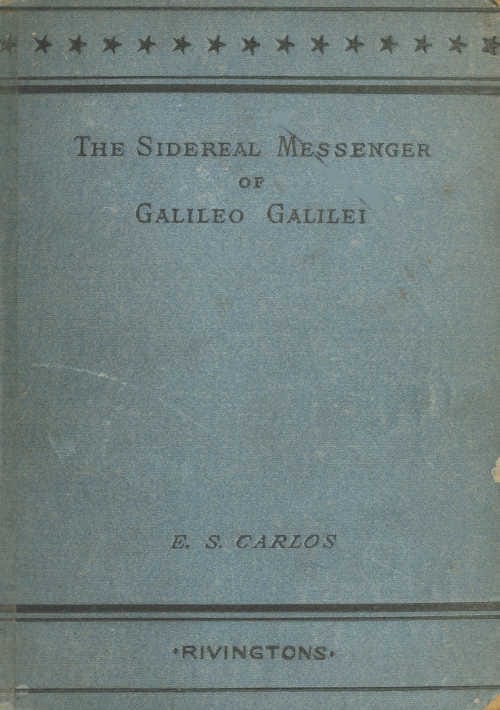
The Sidereal Messenger of Galileo Galilei: And a Part of the Preface to Kepler's Dioptrics Containing the Original Account of Galileo's Astronomical Discoveries
1610
Translated by Edward Stafford Carlos
In 1610, a professor of mathematics in Padua pointed a homemade telescope at the night sky and forever changed how humans understand their place in the cosmos. This slim volume contains the first published account of telescopic astronomy, and it detonated like a bomb across Europe. Galileo had seen mountains on the Moon, proving Aristotle's perfect celestial sphere a fantasy. He had discovered four worlds orbiting Jupiter, demonstrating that not everything in the heavens revolved around Earth. The implications were staggering: the universe was not what anyone had believed. The Sidereal Messenger reads less like a scientific paper and more like a dispatch from an explorer returning from unknown lands. Galileo writes with urgency and triumph, inviting readers to verify his observations, to look through their own telescopes and see what he saw. Here is the moment science became experimental, empirical, undeniable. For anyone curious about where modern astronomy began, or how a single book can rearrange the heavens, this is the essential document.
Editions
X-Ray
“It is a beautiful and delightful sight to behold the body of the Moon.””
— Galileo Galilei
Link to this book
Add a free, dofollow link to Lex on your blog, forum, syllabus, or reading list.

<a href="https://lex-books.com/book/the-sidereal-messenger-of-galileo-galilei-and-a-part-of-the-preface-to-kepler-s--ea1907c6-085f-4274-a1ac-a45a05832c2f"><img src="https://lex-books.com/badges/read-on-lex.svg" alt="Read The Sidereal Messenger of Galileo Galilei: And a Part of the Preface to Kepler's Dioptrics Containing the Original Account of Galileo's Astronomical Discoveries by Galileo Galilei free on Lex" width="160" height="40"></a>[](https://lex-books.com/book/the-sidereal-messenger-of-galileo-galilei-and-a-part-of-the-preface-to-kepler-s--ea1907c6-085f-4274-a1ac-a45a05832c2f)[url=https://lex-books.com/book/the-sidereal-messenger-of-galileo-galilei-and-a-part-of-the-preface-to-kepler-s--ea1907c6-085f-4274-a1ac-a45a05832c2f][img]https://lex-books.com/badges/read-on-lex.svg[/img][/url]Read The Sidereal Messenger of Galileo Galilei: And a Part of the Preface to Kepler's Dioptrics Containing the Original Account of Galileo's Astronomical Discoveries by Galileo Galilei free on Lex: https://lex-books.com/book/the-sidereal-messenger-of-galileo-galilei-and-a-part-of-the-preface-to-kepler-s--ea1907c6-085f-4274-a1ac-a45a05832c2fCite this book
Reading this edition for a paper or guide? Copy a citation.
Galilei, Galileo. The Sidereal Messenger of Galileo Galilei: And a Part of the Preface to Kepler's Dioptrics Containing the Original Account of Galileo's Astronomical Discoveries. Lex, lex-books.com/book/the-sidereal-messenger-of-galileo-galilei-and-a-part-of-the-preface-to-kepler-s--ea1907c6-085f-4274-a1ac-a45a05832c2f.Galilei, G. (1610). The Sidereal Messenger of Galileo Galilei: And a Part of the Preface to Kepler's Dioptrics Containing the Original Account of Galileo's Astronomical Discoveries. Lex. https://lex-books.com/book/the-sidereal-messenger-of-galileo-galilei-and-a-part-of-the-preface-to-kepler-s--ea1907c6-085f-4274-a1ac-a45a05832c2fGalilei, Galileo. The Sidereal Messenger of Galileo Galilei: And a Part of the Preface to Kepler's Dioptrics Containing the Original Account of Galileo's Astronomical Discoveries. Lex. https://lex-books.com/book/the-sidereal-messenger-of-galileo-galilei-and-a-part-of-the-preface-to-kepler-s--ea1907c6-085f-4274-a1ac-a45a05832c2f.