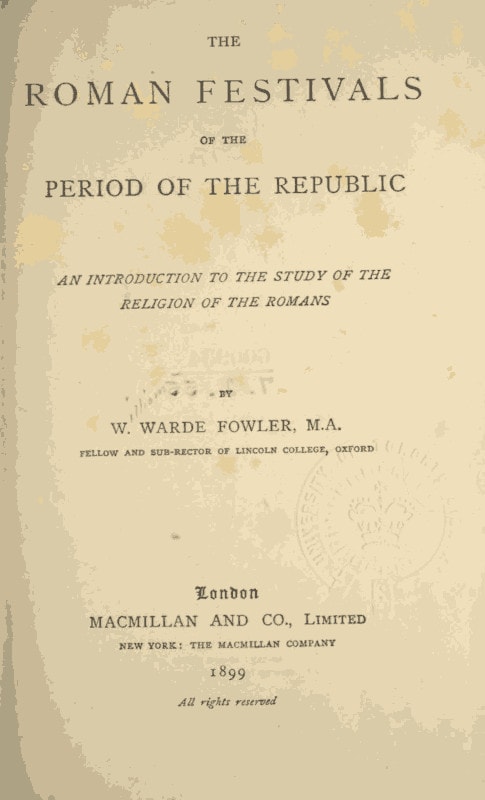
The Roman Festivals of the Period of the Republic: An Introduction to the Study of the Religion of the Romans
1899
The Roman Festivals of the Period of the Republic: An Introduction to the Study of the Religion of the Romans
1899
For readers curious about how ancient peoples experienced time itself, this 1899 study illuminates the religious calendar that organized Roman life. W. Warde Fowler examines how Romans structured their year through festivals, agricultural rites, and sacred ceremonies, not as isolated events but as an interconnected system expressing their deepest values. The book opens with the Roman method of calculating time, exploring the complex interplay between lunar and solar cycles that shaped their calendar, then moves through the festival cycle to show how sacred observances governed everything from planting to warfare. Fowler treats Roman religion as something to be understood on its own terms, not as a mere precursor to Christianity, and his analysis of how these festivals reveal the Roman character remains a window into one of history's most influential civilizations.
Editions
X-Ray
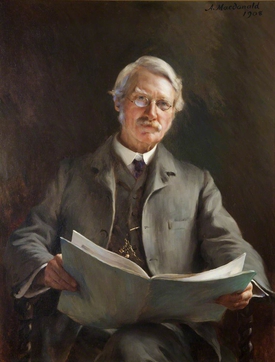
The author and scholar who undertakes the systematic study of Roman religious festivals. A Fellow and Sub-Rector of Lincoln College, Oxford, he approaches the subject with scholarly rigor despite acknowledging the fragmentary nature of the evidence.
The great Roman scholar of the Augustan age whose fragmentary works provide crucial information about Roman religious practices. His 'de Lingua Latina' serves as a primary source for understanding ancient Roman ritual.
The Roman poet whose 'Fasti' provides detailed descriptions of festivals from January through June. Though sometimes fanciful, his work preserves valuable eyewitness accounts of religious ceremonies.
Augustan scholar whose dictionary and calendar annotations provide crucial information about Roman festivals. His work survives in excerpts by Festus and Paulus Diaconus.
About The Roman Festivals of the Period of the Republic: An Introduction to the Study of the Religion of the Romans
Chapter Summaries
- Introduction
- Fowler explains his methodology for studying Roman festivals through the calendar, discusses the sources available, and outlines the challenges of reconstructing ancient religious practices from fragmentary evidence.
- Calendar
- Detailed explanation of how Romans calculated the year, the evolution from lunar to solar-lunar systems, and the structure of months with their divisions into Kalends, Nones, and Ides.
- March
- March was the original first month, dominated by Mars as both war god and deity of spring vegetation. Key festivals include the Salii's processions with sacred shields and the purification rituals preparing for the active season.
Key Themes
- Archaeological Methodology
- Fowler demonstrates the careful, systematic approach needed to study ancient religions from fragmentary sources. He emphasizes the importance of distinguishing genuine ancient practices from later interpretations and foreign influences.
- Religious Evolution
- The work traces how Roman religious practices evolved from simple agricultural and household rituals to complex state ceremonies, showing how primitive beliefs adapted to urban civilization and foreign contact.
- Calendar as Historical Document
- The Roman calendar serves as a unique window into ancient religious and social life, preserving in its structure the agricultural rhythms and spiritual concerns of early Roman society.
Characters
- W. Warde Fowler(protagonist)
- The author and scholar who undertakes the systematic study of Roman religious festivals. A Fellow and Sub-Rector of Lincoln College, Oxford, he approaches the subject with scholarly rigor despite acknowledging the fragmentary nature of the evidence.
- Varro(major)
- The great Roman scholar of the Augustan age whose fragmentary works provide crucial information about Roman religious practices. His 'de Lingua Latina' serves as a primary source for understanding ancient Roman ritual.
- Ovid(major)
- The Roman poet whose 'Fasti' provides detailed descriptions of festivals from January through June. Though sometimes fanciful, his work preserves valuable eyewitness accounts of religious ceremonies.
- Verrius Flaccus(major)
- Augustan scholar whose dictionary and calendar annotations provide crucial information about Roman festivals. His work survives in excerpts by Festus and Paulus Diaconus.
- Mars(major)
- The Roman god of war and agriculture, particularly prominent in March. Originally a deity of vegetation and fertility who evolved into the protector of the Roman people and their military endeavors.
- Jupiter(major)
- The supreme Roman deity, god of sky and thunder. All Ides were sacred to him, and he presided over the most important state ceremonies including the epulum Jovis.
Link to this book
Add a free, dofollow link to Lex on your blog, forum, syllabus, or reading list.

<a href="https://lex-books.com/book/the-roman-festivals-of-the-period-of-the-republic-an-introduction-to-the-study-o-b4110b7b-789e-4108-a84e-3ac74758cf7b"><img src="https://lex-books.com/badges/read-on-lex.svg" alt="Read The Roman Festivals of the Period of the Republic: An Introduction to the Study of the Religion of the Romans by W. Warde Fowler free on Lex" width="160" height="40"></a>[](https://lex-books.com/book/the-roman-festivals-of-the-period-of-the-republic-an-introduction-to-the-study-o-b4110b7b-789e-4108-a84e-3ac74758cf7b)[url=https://lex-books.com/book/the-roman-festivals-of-the-period-of-the-republic-an-introduction-to-the-study-o-b4110b7b-789e-4108-a84e-3ac74758cf7b][img]https://lex-books.com/badges/read-on-lex.svg[/img][/url]Read The Roman Festivals of the Period of the Republic: An Introduction to the Study of the Religion of the Romans by W. Warde Fowler free on Lex: https://lex-books.com/book/the-roman-festivals-of-the-period-of-the-republic-an-introduction-to-the-study-o-b4110b7b-789e-4108-a84e-3ac74758cf7bCite this book
Reading this edition for a paper or guide? Copy a citation.
Fowler, W. Warde. The Roman Festivals of the Period of the Republic: An Introduction to the Study of the Religion of the Romans. Lex, lex-books.com/book/the-roman-festivals-of-the-period-of-the-republic-an-introduction-to-the-study-o-b4110b7b-789e-4108-a84e-3ac74758cf7b.Fowler, W. W. (1899). The Roman Festivals of the Period of the Republic: An Introduction to the Study of the Religion of the Romans. Lex. https://lex-books.com/book/the-roman-festivals-of-the-period-of-the-republic-an-introduction-to-the-study-o-b4110b7b-789e-4108-a84e-3ac74758cf7bFowler, W. Warde. The Roman Festivals of the Period of the Republic: An Introduction to the Study of the Religion of the Romans. Lex. https://lex-books.com/book/the-roman-festivals-of-the-period-of-the-republic-an-introduction-to-the-study-o-b4110b7b-789e-4108-a84e-3ac74758cf7b.