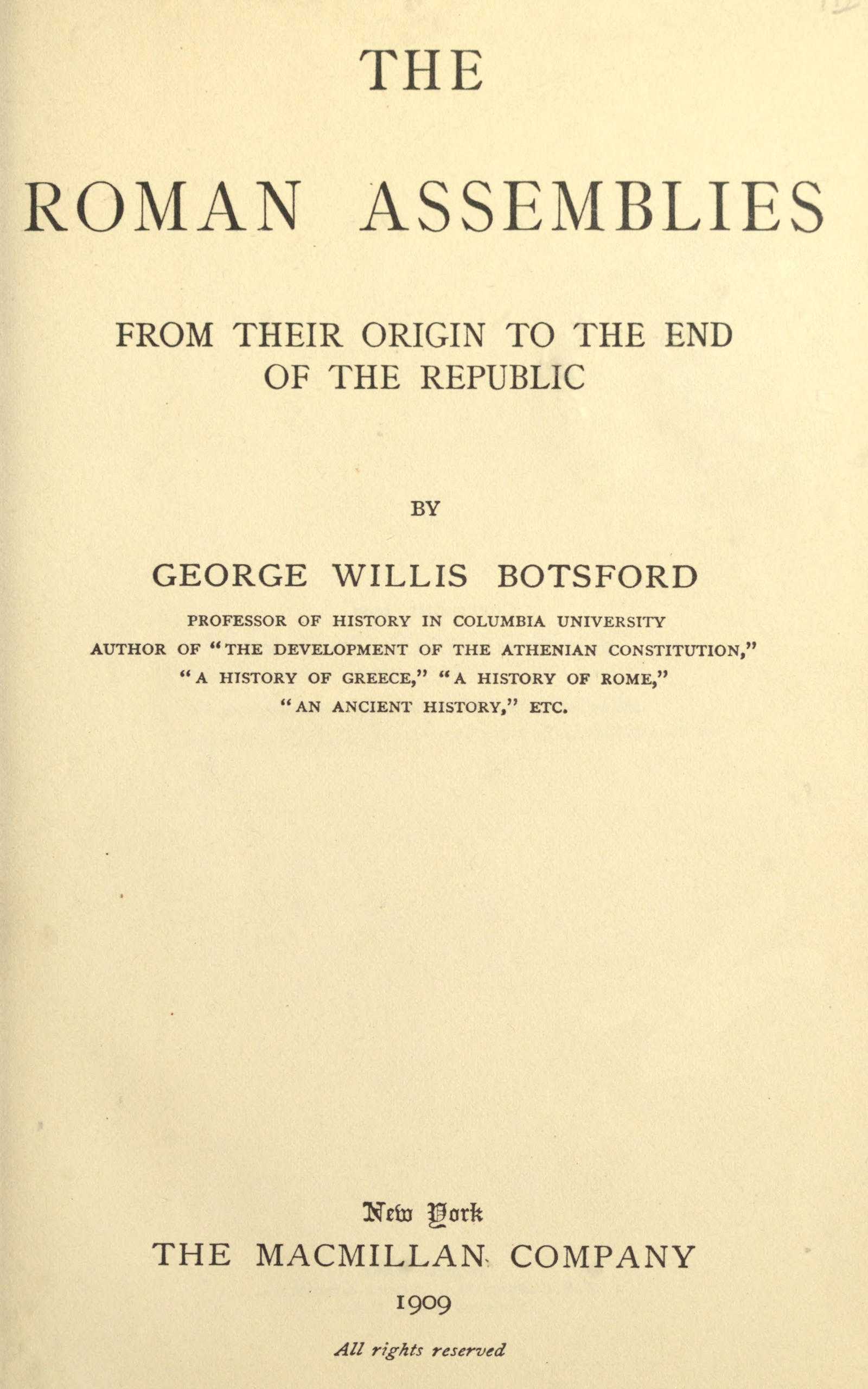
The Roman Assemblies from Their Origin to the End of the Republic
1909
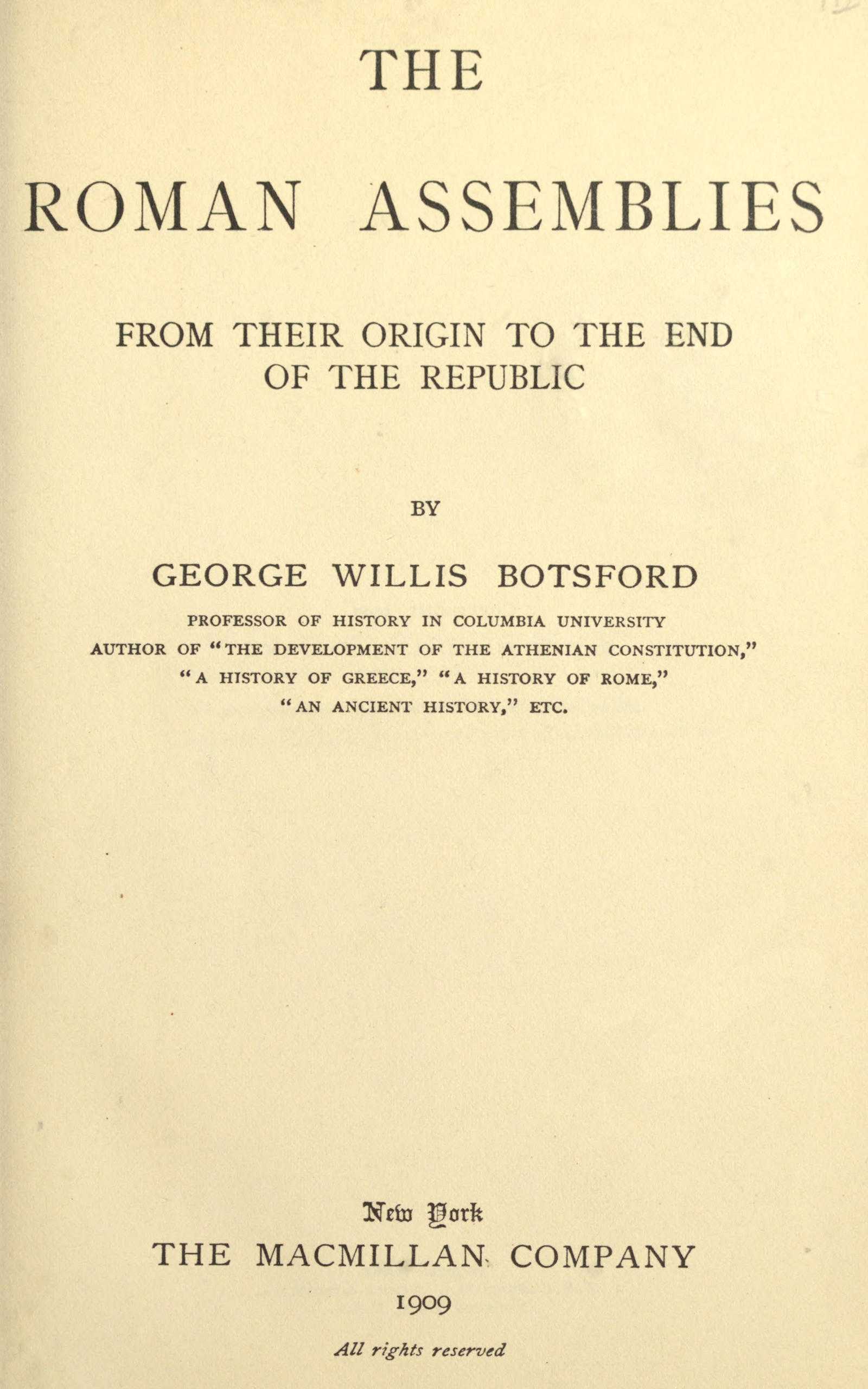
The Roman Assemblies from Their Origin to the End of the Republic
1909
The Roman Republic was not merely an oligarchy of senators. It was a polity where ordinary citizens gathered in assemblies to elect magistrates, pass laws, and decide matters of war and peace. Botsford's 1909 study reconstructs the lost world of these popular bodies, the comitia curiata, comitia tributa, and comitia centuriata, tracing their evolution from the earliest tribal divisions of the Roman people through the turbulent final centuries of the Republic. He examines how the populi, the original political units of Roman society, gave way to the curiae and tribes, and how these structures both empowered and constrained popular participation. The work stands as a rigorous examination of ancient democracy in action: not the democracy of philosophers, but the messy, contested practice of citizens voting in formal assemblies. For classicists, political scientists, and anyone curious about how democracy functioned before modern institutions existed, Botsford offers an indispensable account of one of antiquity's most ambitious experiments in self-governance.
Editions
Link to this book
Add a free, dofollow link to Lex on your blog, forum, syllabus, or reading list.

<a href="https://lex-books.com/book/the-roman-assemblies-from-their-origin-to-the-end-of-the-republic-60095fb0-fe9a-4b45-bcdf-b3fc355dcd2c"><img src="https://lex-books.com/badges/read-on-lex.svg" alt="Read The Roman Assemblies from Their Origin to the End of the Republic by George Willis Botsford free on Lex" width="160" height="40"></a>[](https://lex-books.com/book/the-roman-assemblies-from-their-origin-to-the-end-of-the-republic-60095fb0-fe9a-4b45-bcdf-b3fc355dcd2c)[url=https://lex-books.com/book/the-roman-assemblies-from-their-origin-to-the-end-of-the-republic-60095fb0-fe9a-4b45-bcdf-b3fc355dcd2c][img]https://lex-books.com/badges/read-on-lex.svg[/img][/url]Read The Roman Assemblies from Their Origin to the End of the Republic by George Willis Botsford free on Lex: https://lex-books.com/book/the-roman-assemblies-from-their-origin-to-the-end-of-the-republic-60095fb0-fe9a-4b45-bcdf-b3fc355dcd2cCite this book
Reading this edition for a paper or guide? Copy a citation.
Botsford, George Willis. The Roman Assemblies from Their Origin to the End of the Republic. Lex, lex-books.com/book/the-roman-assemblies-from-their-origin-to-the-end-of-the-republic-60095fb0-fe9a-4b45-bcdf-b3fc355dcd2c.Botsford, G. W. (1909). The Roman Assemblies from Their Origin to the End of the Republic. Lex. https://lex-books.com/book/the-roman-assemblies-from-their-origin-to-the-end-of-the-republic-60095fb0-fe9a-4b45-bcdf-b3fc355dcd2cBotsford, George Willis. The Roman Assemblies from Their Origin to the End of the Republic. Lex. https://lex-books.com/book/the-roman-assemblies-from-their-origin-to-the-end-of-the-republic-60095fb0-fe9a-4b45-bcdf-b3fc355dcd2c.