The Relations Between the Laws of Babylonia and the Laws of the Hebrew Peoples: The Schweich Lectures
1917
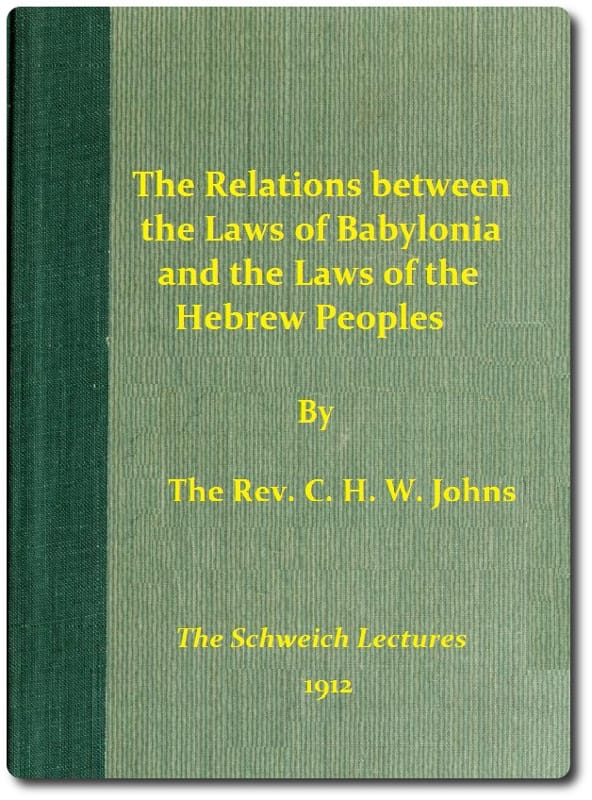
The Relations Between the Laws of Babylonia and the Laws of the Hebrew Peoples: The Schweich Lectures
1917
In 1901, archaeologists unearthed something that would upend centuries of assumptions: the Code of Hammurabi, a Babylonian legal text predating Moses by centuries. Suddenly, scholars could no longer ignore the possibility that Hebrew law emerged not from divine isolation, but from a rich tapestry of ancient Near Eastern legal tradition. C.H.W. Johns, drawing on his Schweich Lectures of 1917, embarks on one of the earliest systematic comparisons between these two great legal codes. He examines point by point whether the laws of Babylon influenced those of Israel, or whether both reflected shared solutions to universal human problems of justice, property, and injury. This is a book that captures a pivotal intellectual moment, when the comparative method was newly applied to biblical texts and the question of Hebrew law's uniqueness hung in the balance. While subsequent archaeology has deepened our understanding, Johns' work remains a fascinating time capsule of early twentieth-century biblical scholarship and its bold attempts to situate Mosaic law within the broader currents of ancient civilization.
Editions

Link to this book
Add a free, dofollow link to Lex on your blog, forum, syllabus, or reading list.

<a href="https://lex-books.com/book/the-relations-between-the-laws-of-babylonia-and-the-laws-of-the-hebrew-peoples-t-4bc22306-8168-4eba-a20b-9ddcc1407817"><img src="https://lex-books.com/badges/read-on-lex.svg" alt="Read The Relations Between the Laws of Babylonia and the Laws of the Hebrew Peoples: The Schweich Lectures by C. H. W. Johns free on Lex" width="160" height="40"></a>[](https://lex-books.com/book/the-relations-between-the-laws-of-babylonia-and-the-laws-of-the-hebrew-peoples-t-4bc22306-8168-4eba-a20b-9ddcc1407817)[url=https://lex-books.com/book/the-relations-between-the-laws-of-babylonia-and-the-laws-of-the-hebrew-peoples-t-4bc22306-8168-4eba-a20b-9ddcc1407817][img]https://lex-books.com/badges/read-on-lex.svg[/img][/url]Read The Relations Between the Laws of Babylonia and the Laws of the Hebrew Peoples: The Schweich Lectures by C. H. W. Johns free on Lex: https://lex-books.com/book/the-relations-between-the-laws-of-babylonia-and-the-laws-of-the-hebrew-peoples-t-4bc22306-8168-4eba-a20b-9ddcc1407817Cite this book
Reading this edition for a paper or guide? Copy a citation.
Johns, C. H. W.. The Relations Between the Laws of Babylonia and the Laws of the Hebrew Peoples: The Schweich Lectures. Lex, lex-books.com/book/the-relations-between-the-laws-of-babylonia-and-the-laws-of-the-hebrew-peoples-t-4bc22306-8168-4eba-a20b-9ddcc1407817.Johns, C. H. W. (1917). The Relations Between the Laws of Babylonia and the Laws of the Hebrew Peoples: The Schweich Lectures. Lex. https://lex-books.com/book/the-relations-between-the-laws-of-babylonia-and-the-laws-of-the-hebrew-peoples-t-4bc22306-8168-4eba-a20b-9ddcc1407817Johns, C. H. W.. The Relations Between the Laws of Babylonia and the Laws of the Hebrew Peoples: The Schweich Lectures. Lex. https://lex-books.com/book/the-relations-between-the-laws-of-babylonia-and-the-laws-of-the-hebrew-peoples-t-4bc22306-8168-4eba-a20b-9ddcc1407817.
