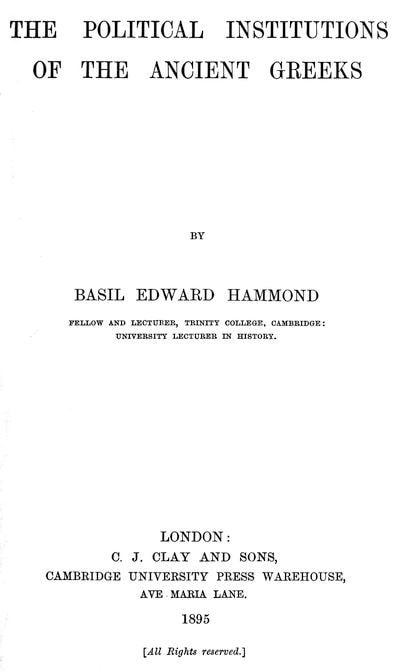
The Political Institutions of the Ancient Greeks
1895
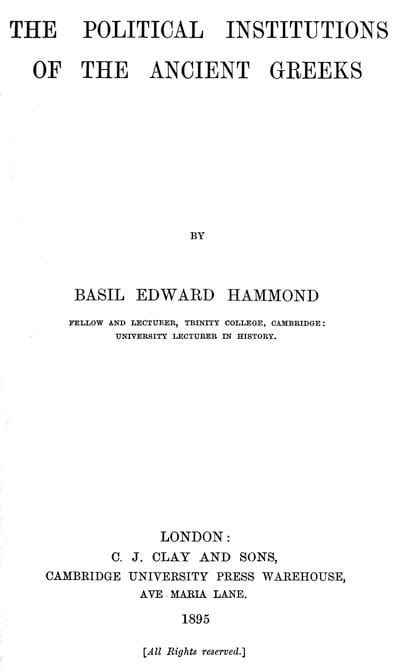
A pioneering work of political science from 1895, this book traces the remarkable transformation of Greek governance from loose tribal arrangements into the revolutionary city-state systems that would shape Western political thought for millennia. Basil Edward Hammond, writing from the formative years of comparative politics as a discipline, examines how geography, social structure, and historical contingency combined to produce the polis the democracy of Athens, the militarized society of Sparta, and the various oligarchic regimes in between. Though derived from lecture notes, the work possesses a narrative arc uncommon in Victorian scholarship: it is less a catalog of institutions than an investigation into why certain forms of government emerged when and where they did. Hammond's willingness to situate Greek developments within a broader European comparative framework gives the text a surprising modernity, even as his discussion of Aryan linguistic and political origins reflects the racial theories of his era. For readers interested in the intellectual origins of political science or the classical foundations of Western governance, this remains a valuable window into how late-Victorian scholars understood the ancient world that shaped them.
Editions
X-Ray
Fellow and Lecturer at Trinity College, Cambridge, and University Lecturer in History. The author presents himself as a scholarly observer attempting to establish comparative politics as a scientific discipline through historical analysis of Greek political institutions.
Legendary Spartan lawgiver credited with establishing the mixed constitution that combined kingship, aristocracy, and popular elements. His reforms created the disciplinary system that defined Spartan society.
Athenian lawgiver and archon who created a moderate popular government around 594 B.C. He established the foundation for Athenian democracy by balancing different social classes and creating popular law courts.
Athenian statesman who established the democratic constitution around 508 B.C. He created the tribal system, ostracism, and expanded citizenship while maintaining moderate popular government.
About The Political Institutions of the Ancient Greeks
Chapter Summaries
- Preface
- Hammond explains his methodology and goals for establishing comparative politics as a scientific discipline. He acknowledges intellectual debts to Sir John Seeley and Professor Henry Sidgwick while outlining his systematic approach to analyzing political institutions.
- I
- Hammond establishes the common origin of European peoples through linguistic evidence and describes their primitive political institutions. He argues that all settled peoples develop some form of government, with the Aryans having tribal governments before their dispersion.
- II
- A comprehensive classification system distinguishing political communities from political aggregates, and categorizing different forms from tribes through city-states to modern nations. Hammond establishes the theoretical framework for analyzing political development across European history.
Key Themes
- Evolution of Political Forms
- Hammond traces the systematic development from tribal monarchies through city-state governments to complex constitutional systems. This evolution reflects both natural progression and conscious political innovation in response to changing social conditions.
- Classification and Scientific Method
- The work attempts to establish comparative politics as a scientific discipline through systematic classification and analysis. Hammond seeks to identify universal patterns and laws governing political development across different societies.
- Balance of Power
- Throughout Greek political development, the central challenge involves balancing different social classes and preventing any single group from dominating others. The most successful constitutions achieve equilibrium between competing interests.
Characters
- Basil Edward Hammond(protagonist)
- Fellow and Lecturer at Trinity College, Cambridge, and University Lecturer in History. The author presents himself as a scholarly observer attempting to establish comparative politics as a scientific discipline through historical analysis of Greek political institutions.
- Lycurgus(major)
- Legendary Spartan lawgiver credited with establishing the mixed constitution that combined kingship, aristocracy, and popular elements. His reforms created the disciplinary system that defined Spartan society.
- Solon(major)
- Athenian lawgiver and archon who created a moderate popular government around 594 B.C. He established the foundation for Athenian democracy by balancing different social classes and creating popular law courts.
- Cleisthenes(major)
- Athenian statesman who established the democratic constitution around 508 B.C. He created the tribal system, ostracism, and expanded citizenship while maintaining moderate popular government.
- Pisistratus(major)
- Athenian tyrant who ruled from 560-527 B.C. through a combination of popular support and force. He represents the transitional period between oligarchy and democracy in Greek city-states.
- Aristotle(major)
- Greek philosopher whose classification of polities provides the theoretical framework for understanding different forms of government. His analysis distinguishes between normal and perverted constitutions.
Link to this book
Add a free, dofollow link to Lex on your blog, forum, syllabus, or reading list.

<a href="https://lex-books.com/book/the-political-institutions-of-the-ancient-greeks-315ecbfd-4b8f-4db3-9803-5813c52ec1c4"><img src="https://lex-books.com/badges/read-on-lex.svg" alt="Read The Political Institutions of the Ancient Greeks by Basil Edward Hammond free on Lex" width="160" height="40"></a>[](https://lex-books.com/book/the-political-institutions-of-the-ancient-greeks-315ecbfd-4b8f-4db3-9803-5813c52ec1c4)[url=https://lex-books.com/book/the-political-institutions-of-the-ancient-greeks-315ecbfd-4b8f-4db3-9803-5813c52ec1c4][img]https://lex-books.com/badges/read-on-lex.svg[/img][/url]Read The Political Institutions of the Ancient Greeks by Basil Edward Hammond free on Lex: https://lex-books.com/book/the-political-institutions-of-the-ancient-greeks-315ecbfd-4b8f-4db3-9803-5813c52ec1c4Cite this book
Reading this edition for a paper or guide? Copy a citation.
Hammond, Basil Edward. The Political Institutions of the Ancient Greeks. Lex, lex-books.com/book/the-political-institutions-of-the-ancient-greeks-315ecbfd-4b8f-4db3-9803-5813c52ec1c4.Hammond, B. E. (1895). The Political Institutions of the Ancient Greeks. Lex. https://lex-books.com/book/the-political-institutions-of-the-ancient-greeks-315ecbfd-4b8f-4db3-9803-5813c52ec1c4Hammond, Basil Edward. The Political Institutions of the Ancient Greeks. Lex. https://lex-books.com/book/the-political-institutions-of-the-ancient-greeks-315ecbfd-4b8f-4db3-9803-5813c52ec1c4.