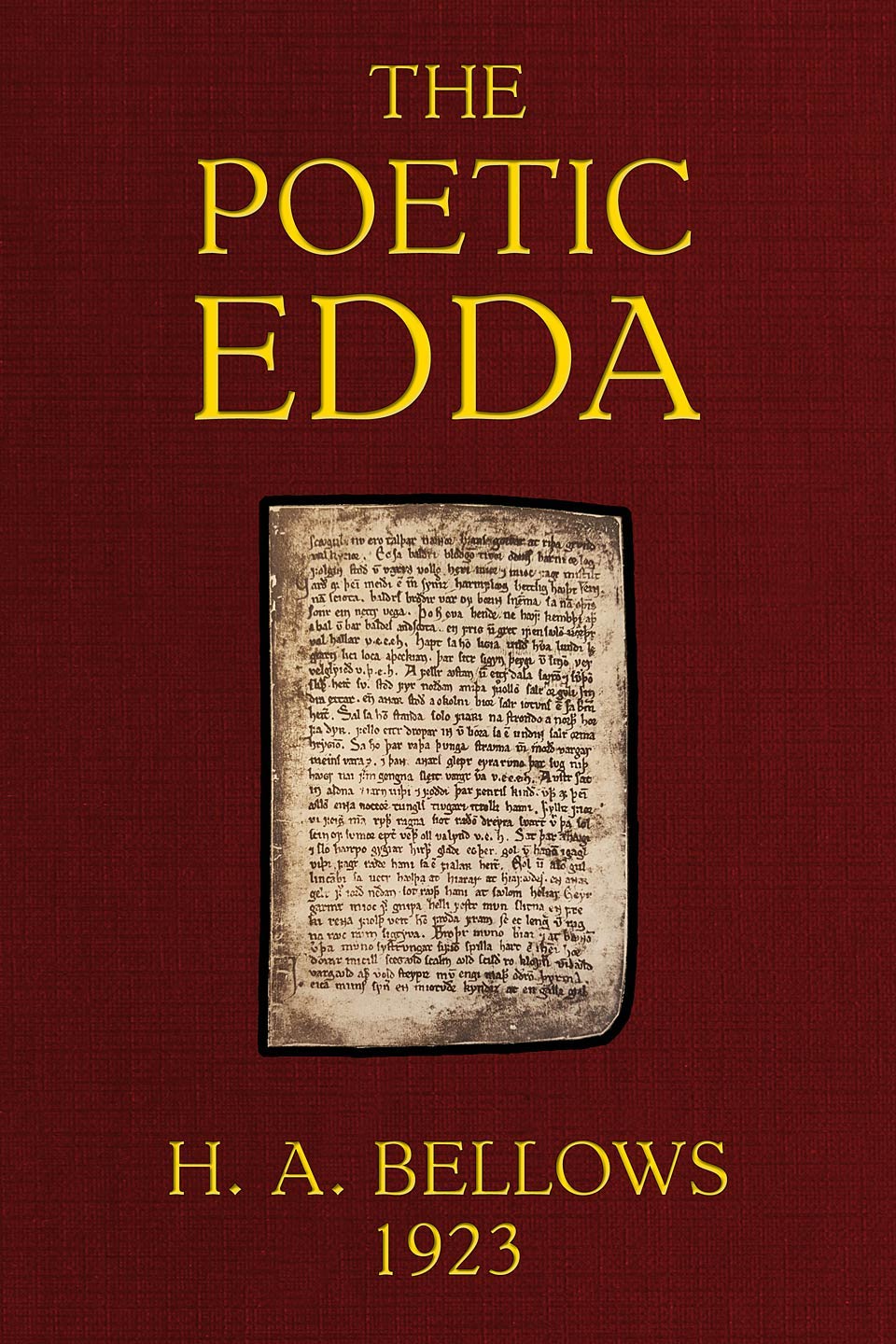
The Poetic Edda: Translated from the Icelandic with an Introduction and Notes
1916

The Poetic Edda: Translated from the Icelandic with an Introduction and Notes
1916
Translated by Henry Adams Bellows
The Poetic Edda is not a book you read so much as a world you enter. Compiled by an anonymous Icelander in the medieval period from older oral traditions, these poems are the raw material of Norse mythology: the creation of the cosmos from the body of a slain giant, Odin's self-sacrifice on the world-tree for a sip of wisdom, the doom of the gods at Ragnarok where even the mightiest fall. Here you'll find the Völva's terrifying prophecy of endings, the heroic legend of Sigurd and the dragon Fafnir, and the intimate domestic dramas of the Aesir that no superhero film has ever captured. This translation preserves the alliterative fire and kennings of the original Old Norse, giving readers access to poems that shaped Tolkien, Wagner, and every thunder god you've ever encountered. It is old, strange, and brutally beautiful. It will make you feel the weight of fate and the terrible glory of fighting anyway.
Editions
X-Ray
“Men brave and generous live the best lives, seldom will they sorrow; then there are fools, afraid of everything, who grumble instead of giving.””
— Unknown
“When a real battle starts, you’ll always find that there is no bravest man.””
— Unknown
“It’s a long and crooked walk to a bad friend, even if he lives nearby. But it’s an easy road to a good friend, no matter how long the journey.””
— Unknown
“That is the true mingling of kinship when a man can tell someone all his thoughts; anything is better than to be fickle; he is no true friend who only says pleasant things.””
— Unknown
“Tell your secret to one person, never to two”
— Unknown
“It is like a man | whom no one loves,-- Why should his life be long?””
— Unknown
“And I said to him that I had made a vow in my turn, that I would never marry a man who knew the meaning of fear.””
— Unknown
“But she awoke to the cold death of her hopes,””
— Unknown
“Men become friends when they can share their minds with one another. Anything is better than being lied to: a real friend will disagree with you openly.””
— Unknown
About The Poetic Edda: Translated from the Icelandic with an Introduction and Notes
Chapter Summaries
- THE POETIC EDDA: Translated from the Icelandic with an Introduction and Notes
- This section presents the title page of the book, identifying it as 'The Poetic Edda' translated from Icelandic with an introduction and notes by Henry Adams Bellows, published in 1923 by The American-Scandinavian Foundation and Oxford University Press. It also includes copyright information and a dedication to George Lyman Kittredge.
- CONTENTS
- This section lists the contents of the book, divided into 'Lays of the Gods' and 'Lays of the Heroes,' with page numbers for each poem. It also includes a note about a pronouncing index for proper names.
- ACKNOWLEDGEMENT
- The author acknowledges scholars who contributed to the translation, specifically mentioning William Henry Schofield (Professor of Comparative Literature at Harvard and President of The American-Scandinavian Foundation), Henry Goddard Leach (Secretary of The American-Scandinavian Foundation), William Witherle Lawrence (Professor of English at Columbia and Chairman of the Foundation’s Committee on Publications), and Hanna Astrup Larsen (literary secretary).
Key Themes
- Cosmology and Creation
- The poems extensively detail the creation of the world from Ymir's body, the ordering of time, and the origin of various races (gods, giants, dwarfs, humans). This theme establishes the foundational understanding of the Norse universe, as seen in Voluspo's opening stanzas.
- Apocalypse and Rebirth (Ragnarok)
- A dominant theme in Voluspo, describing the cataclysmic destruction of the old world, the death of many gods and creatures, and the subsequent emergence of a new, purified world where Baldr returns and a new race of humans thrives, highlighting a cyclical view of existence.
- The Quest for Wisdom and Knowledge
- Othin, the chief god, is portrayed as an insatiable seeker of knowledge, willing to sacrifice an eye (Voluspo) or resort to trickery (Hovamol) to gain wisdom and runes, which are then imparted to mankind. This quest is a driving force behind many of the narratives.
Characters
- Volva (Wise-Woman)(protagonist)
- The prophetess who, summoned by Othin, reveals the past, present, and future of the Norse cosmos in the Voluspo.
- Othin (Valfather, Heerfather, Hor, Ygg, Sigfather, Grimnir, Bolverk, Thund, etc.)(protagonist)
- The chief of the gods, eternally seeking wisdom, who sacrifices an eye for knowledge and is fated to be slain by Fenrir at Ragnarok.
- Frigg(supporting)
- Othin's wife, a goddess who often disagrees with him and weeps for Baldr and Valhall's need.
- Thor (Vingthor, son of Jorth, son of Hlothyn, son of Fjorgyn, Vingnir)(supporting)
- The thunder-god, son of Othin and Jorth, known for his strength and hammer Mjollnir, fated to slay Mithgarthsorm but die from its venom.
- Loki (brother of Byleist)(antagonist)
- A treacherous and ingenious god, son of Laufey, bound for his role in Baldr's death and father of Fenrir, Mithgarthsorm, and Hel.
- Baldr(supporting)
- The fairest and best of the gods, son of Othin and Frigg, whose death through Loki's wiles is a major disaster for the gods, but who is prophesied to return in the new world.
Link to this book
Add a free, dofollow link to Lex on your blog, forum, syllabus, or reading list.

<a href="https://lex-books.com/book/the-poetic-edda-translated-from-the-icelandic-with-an-introduction-and-notes-9d32efa9-126e-4d43-a19a-2085a2758ce7"><img src="https://lex-books.com/badges/read-on-lex.svg" alt="Read The Poetic Edda: Translated from the Icelandic with an Introduction and Notes by Unknown free on Lex" width="160" height="40"></a>[](https://lex-books.com/book/the-poetic-edda-translated-from-the-icelandic-with-an-introduction-and-notes-9d32efa9-126e-4d43-a19a-2085a2758ce7)[url=https://lex-books.com/book/the-poetic-edda-translated-from-the-icelandic-with-an-introduction-and-notes-9d32efa9-126e-4d43-a19a-2085a2758ce7][img]https://lex-books.com/badges/read-on-lex.svg[/img][/url]Read The Poetic Edda: Translated from the Icelandic with an Introduction and Notes by Unknown free on Lex: https://lex-books.com/book/the-poetic-edda-translated-from-the-icelandic-with-an-introduction-and-notes-9d32efa9-126e-4d43-a19a-2085a2758ce7Cite this book
Reading this edition for a paper or guide? Copy a citation.
Unknown. The Poetic Edda: Translated from the Icelandic with an Introduction and Notes. Lex, lex-books.com/book/the-poetic-edda-translated-from-the-icelandic-with-an-introduction-and-notes-9d32efa9-126e-4d43-a19a-2085a2758ce7.Unknown (1916). The Poetic Edda: Translated from the Icelandic with an Introduction and Notes. Lex. https://lex-books.com/book/the-poetic-edda-translated-from-the-icelandic-with-an-introduction-and-notes-9d32efa9-126e-4d43-a19a-2085a2758ce7Unknown. The Poetic Edda: Translated from the Icelandic with an Introduction and Notes. Lex. https://lex-books.com/book/the-poetic-edda-translated-from-the-icelandic-with-an-introduction-and-notes-9d32efa9-126e-4d43-a19a-2085a2758ce7.




![Birds and Nature, Vol. 12 No. 1 [June 1902]illustrated by Color Photography](/_next/image?url=https%3A%2F%2Fd3b2n8gj62qnwr.cloudfront.net%2FCOVERS%2Fgutenberg_covers75k%2Febook-47881.png&w=3840&q=75)