The Old Printer and the Modern Press
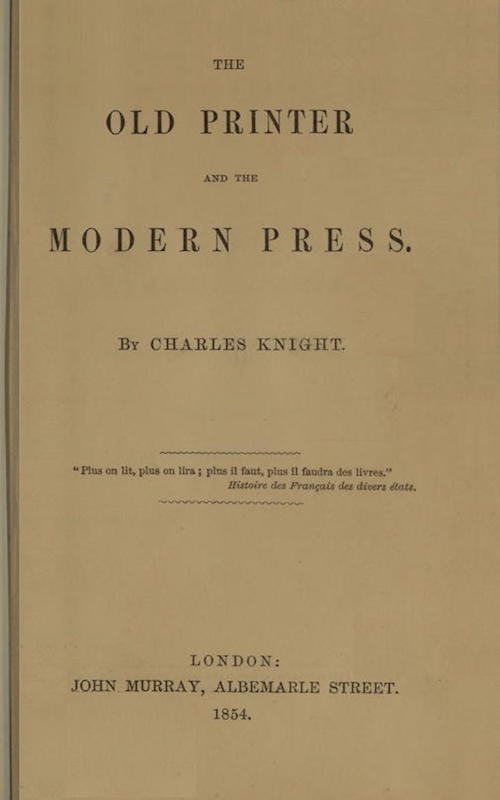
In 1476, a Flemish merchant named William Caxton set up a printing press in a rented house near Westminster Bridge. It was a modest beginning for one of history's most transformative technologies. Charles Knight's vivid account traces Caxton's journey from merchant in Bruges to England's first printer, capturing the moment when written knowledge stopped being the privilege of monasteries and kings and began reaching the emerging middle class. The book is less a dry biography than a meditation on revolution. Knight examines what printing meant for the English language itself, showing how Caxton's choices which books to translate, how to standardize spelling, what to prioritize shaped the language we speak today. He also writes about the socio-economic earthquake that followed: the displacement of scribal culture, the rise of a reading public, the democratization of ideas. Knight wrote in the 19th century with the benefit of centuries to see printing's consequences, and his perspective carries a certain awe. For readers curious about where our information age truly began, this is an essential portrait of the moment everything changed.
Editions
Link to this book
Add a free, dofollow link to Lex on your blog, forum, syllabus, or reading list.

<a href="https://lex-books.com/book/the-old-printer-and-the-modern-press-30b8b6e5-9a26-426e-a796-b166aab7500a"><img src="https://lex-books.com/badges/read-on-lex.svg" alt="Read The Old Printer and the Modern Press by Charles Knight free on Lex" width="160" height="40"></a>[](https://lex-books.com/book/the-old-printer-and-the-modern-press-30b8b6e5-9a26-426e-a796-b166aab7500a)[url=https://lex-books.com/book/the-old-printer-and-the-modern-press-30b8b6e5-9a26-426e-a796-b166aab7500a][img]https://lex-books.com/badges/read-on-lex.svg[/img][/url]Read The Old Printer and the Modern Press by Charles Knight free on Lex: https://lex-books.com/book/the-old-printer-and-the-modern-press-30b8b6e5-9a26-426e-a796-b166aab7500aCite this book
Reading this edition for a paper or guide? Copy a citation.
Knight, Charles. The Old Printer and the Modern Press. Lex, lex-books.com/book/the-old-printer-and-the-modern-press-30b8b6e5-9a26-426e-a796-b166aab7500a.Knight, C. (n.d.). The Old Printer and the Modern Press. Lex. https://lex-books.com/book/the-old-printer-and-the-modern-press-30b8b6e5-9a26-426e-a796-b166aab7500aKnight, Charles. The Old Printer and the Modern Press. Lex. https://lex-books.com/book/the-old-printer-and-the-modern-press-30b8b6e5-9a26-426e-a796-b166aab7500a.