The Medieval Latin Hymn
1953
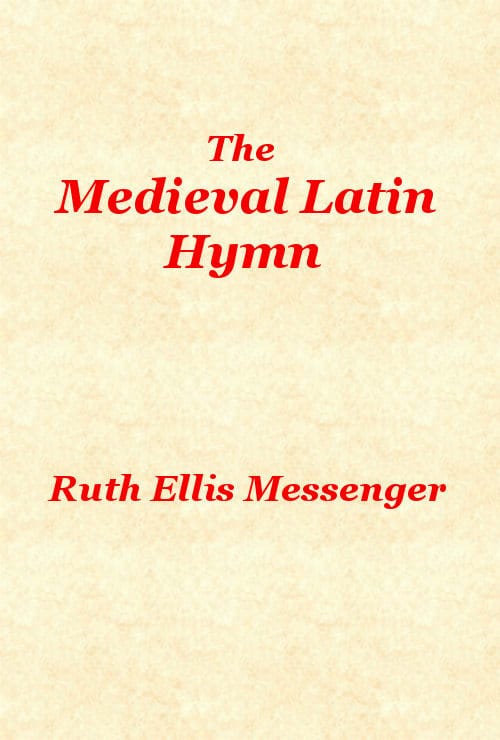
The Medieval Latin Hymn
1953
For over a millennium, Latin hymns served as the soundtrack to Western Christianity, their verses echoing through stone cathedrals, monastery chapels, and private devotions. Ruth Ellis Messenger traces this extraordinary journey from the early Church fathers through the medieval period, revealing how poets like Ambrose of Milan, Prudentius, and Hilary of Poitiers crafted verses that would shape liturgical worship for generations. She demonstrates that these hymns were not mere decoration but dynamic instruments of theological education, spiritual formation, and cultural continuity. The book illuminates how a hymn could transmit doctrine to illiterate congregations, how melody and meaning intertwined in service of worship, and how the medieval Church inherited and transformed the gifts of late antique poets to create something unmistakably its own. Messenger writes for the curious reader rather than the specialist, making the intricate evolution of this sacred poetic tradition accessible and vivid. The result is a window into a world where faith found its voice in some of the most beautiful verses the Western tradition has produced.
Editions
X-Ray
The author of 'The Medieval Latin Hymn,' a scholar of hymnology who traces the history of Latin hymns from the 4th century to modern times.
The first known Christian Latin hymn writer (c. 310-366), who wrote 'Liber Hymnorum' and used hymns to defend Trinitarian doctrine.
The uncontested originator of the medieval Latin hymn in its familiar metrical stanza form, influential in congregational singing and theological expression.
A 4th-5th century lawyer, judge, and poet who wrote two influential collections of hymns (Cathemerinon and Peristephanon) for devotional reading, later appropriated for liturgical use.
About The Medieval Latin Hymn
Chapter Summaries
- 1
- This chapter introduces the earliest known Christian Latin hymn writers, including Hilary of Poitiers, Pope Damasus, Ambrose of Milan, Prudentius, and Venantius Fortunatus. It discusses their motivations for writing hymns, the metrical forms they employed, and the initial integration of hymns into Christian worship, emphasizing their role in expressing Trinitarian doctrine and scriptural narratives.
- 2
- The chapter details how early Latin hymns were preserved through monastic practice and incorporated into the canonical hours, forming the 'Old Hymnal.' It explores the historical context of prohibitions against non-scriptural hymns, the crucial role of the Benedictine Order in their diffusion, and the distinct contributions of Mozarabic and Celtic hymnody, leading to a diversified hymnological landscape by 750 AD.
- 3
- This chapter focuses on the Carolingian revival of Latin hymnology (750-900 AD), driven by liturgical reforms under rulers like Pippin and Charlemagne, and the expansion of the Benedictine Order. It describes the emergence of the 'Later Hymnal,' the shift towards classical meters, and the contributions of notable authors such as Alcuin, Theodulphus of Orleans, Rabanus Maurus, and Walafrid Strabo, highlighting the increasing adoption of hymns by secular clergy.
Key Themes
- Evolution of Liturgical Practice
- The book meticulously traces how Latin hymns transitioned from early Christian devotional practices to becoming integral components of daily monastic offices (canonical hours) and the Mass. It highlights the development of hymn cycles and the establishment of specific hymns for various feasts and ceremonies, demonstrating the dynamic adaptation of hymnody to the evolving structure of Christian worship.
- Influence of Historical Figures and Institutions
- Key individuals like Ambrose, Notker Balbulus, and Adam of St. Victor are presented as pivotal innovators who shaped the form and content of Latin hymns and sequences. Additionally, institutions such as the Benedictine Order, Carolingian rulers, and various councils played crucial roles in preserving, standardizing, and diffusing hymnological traditions across Western Europe.
- Cultural Exchange and Adaptation
- The text explores the significant impact of diverse cultural streams—including Greek, Byzantine, Celtic, and Germanic influences—on the development of Latin hymnody. It discusses how foreign musical practices, literary forms, and theological ideas were assimilated and adapted, enriching the Latin hymn tradition and contributing to its unique character.
Characters
- Ruth Ellis Messenger(author)
- The author of 'The Medieval Latin Hymn,' a scholar of hymnology who traces the history of Latin hymns from the 4th century to modern times.
- Hilary, Bishop of Poitiers(supporting)
- The first known Christian Latin hymn writer (c. 310-366), who wrote 'Liber Hymnorum' and used hymns to defend Trinitarian doctrine.
- Ambrose, Bishop of Milan(protagonist)
- The uncontested originator of the medieval Latin hymn in its familiar metrical stanza form, influential in congregational singing and theological expression.
- Prudentius(supporting)
- A 4th-5th century lawyer, judge, and poet who wrote two influential collections of hymns (Cathemerinon and Peristephanon) for devotional reading, later appropriated for liturgical use.
- Venantius Fortunatus(supporting)
- A 6th-century poet and churchman who served as Bishop of Poitiers, known for his Carmina, including influential processional hymns like 'Vexilla regis prodeunt' and 'Salve festa dies'.
- Benedict(supporting)
- Founder of the Benedictine Order (d. 543), whose monastic rule incorporated existing Latin hymns into daily worship, thereby preserving and diffusing them.
Link to this book
Add a free, dofollow link to Lex on your blog, forum, syllabus, or reading list.

<a href="https://lex-books.com/book/the-medieval-latin-hymn-08f52547-5a1f-463d-9fc4-2a218ddd4520"><img src="https://lex-books.com/badges/read-on-lex.svg" alt="Read The Medieval Latin Hymn by Ruth Ellis Messenger free on Lex" width="160" height="40"></a>[](https://lex-books.com/book/the-medieval-latin-hymn-08f52547-5a1f-463d-9fc4-2a218ddd4520)[url=https://lex-books.com/book/the-medieval-latin-hymn-08f52547-5a1f-463d-9fc4-2a218ddd4520][img]https://lex-books.com/badges/read-on-lex.svg[/img][/url]Read The Medieval Latin Hymn by Ruth Ellis Messenger free on Lex: https://lex-books.com/book/the-medieval-latin-hymn-08f52547-5a1f-463d-9fc4-2a218ddd4520Cite this book
Reading this edition for a paper or guide? Copy a citation.
Messenger, Ruth Ellis. The Medieval Latin Hymn. Lex, lex-books.com/book/the-medieval-latin-hymn-08f52547-5a1f-463d-9fc4-2a218ddd4520.Messenger, R. E. (1953). The Medieval Latin Hymn. Lex. https://lex-books.com/book/the-medieval-latin-hymn-08f52547-5a1f-463d-9fc4-2a218ddd4520Messenger, Ruth Ellis. The Medieval Latin Hymn. Lex. https://lex-books.com/book/the-medieval-latin-hymn-08f52547-5a1f-463d-9fc4-2a218ddd4520.