The Letters of Gracchus on the East India Question
1813
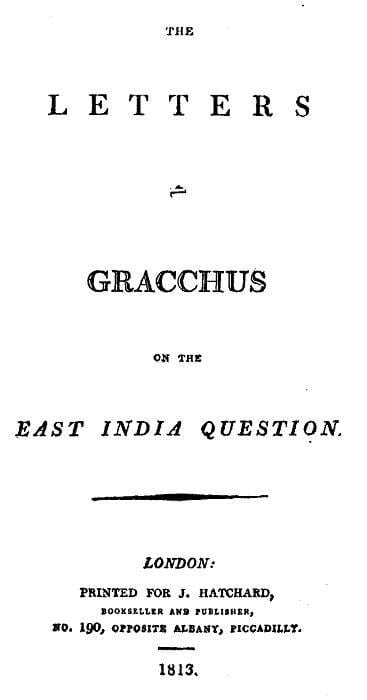
The Letters of Gracchus on the East India Question
1813
In 1813, Britain faced a question that would reshape its empire: should the East India Company keep its 250-year monopoly on trade with India, or should the doors be thrown open to free commerce? William Augustus Miles, writing under the Roman pseudonym Gracchus, enters a fiery parliamentary debate where Liverpool merchants, Manchester industrialists, and Company directors clash over the soul of British trade policy. TheLetters dissects the Company's desperate arguments that losing their charter would mean losing India itself, while exposing the raw economics of empire, the rising tide of public opinion, and the delicate balance between corporate privilege and national interest. Miles writes as a reformer convinced that monopoly breeds corruption and that empire, if it must exist, should serve the many rather than the few. This is political polemic at its most immediate: urgent, argumentative, and deeply engaged with the economic forces that would define the nineteenth century. For anyone curious about where modern debates about free trade, corporate power, and imperial overreach began, these letters offer a startlingly relevant window into a moment when Britain decided what kind of empire it wanted to be.
Editions
Link to this book
Add a free, dofollow link to Lex on your blog, forum, syllabus, or reading list.

<a href="https://lex-books.com/book/the-letters-of-gracchus-on-the-east-india-question-60e059c4-c85e-42b7-9348-abe78f5ea389"><img src="https://lex-books.com/badges/read-on-lex.svg" alt="Read The Letters of Gracchus on the East India Question by William Augustus Miles free on Lex" width="160" height="40"></a>[](https://lex-books.com/book/the-letters-of-gracchus-on-the-east-india-question-60e059c4-c85e-42b7-9348-abe78f5ea389)[url=https://lex-books.com/book/the-letters-of-gracchus-on-the-east-india-question-60e059c4-c85e-42b7-9348-abe78f5ea389][img]https://lex-books.com/badges/read-on-lex.svg[/img][/url]Read The Letters of Gracchus on the East India Question by William Augustus Miles free on Lex: https://lex-books.com/book/the-letters-of-gracchus-on-the-east-india-question-60e059c4-c85e-42b7-9348-abe78f5ea389Cite this book
Reading this edition for a paper or guide? Copy a citation.
Miles, William Augustus. The Letters of Gracchus on the East India Question. Lex, lex-books.com/book/the-letters-of-gracchus-on-the-east-india-question-60e059c4-c85e-42b7-9348-abe78f5ea389.Miles, W. A. (1813). The Letters of Gracchus on the East India Question. Lex. https://lex-books.com/book/the-letters-of-gracchus-on-the-east-india-question-60e059c4-c85e-42b7-9348-abe78f5ea389Miles, William Augustus. The Letters of Gracchus on the East India Question. Lex. https://lex-books.com/book/the-letters-of-gracchus-on-the-east-india-question-60e059c4-c85e-42b7-9348-abe78f5ea389.