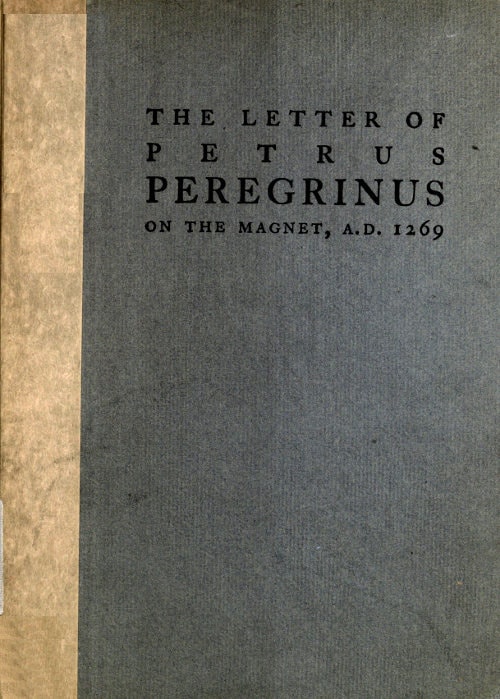
The Letter of Petrus Peregrinus on the Magnet, A.d. 1269
1269
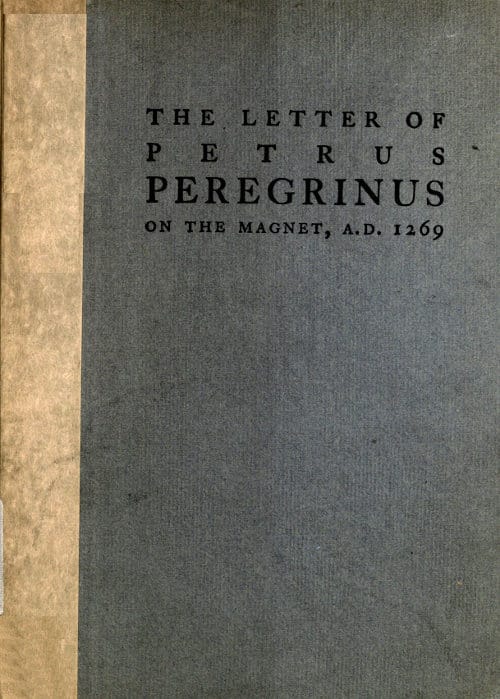
The Letter of Petrus Peregrinus on the Magnet, A.d. 1269
de Maricourt, active 13th century Pierre
1269
Translated by Brother Arnold
In the summer of 1269, a French soldier-scholar named Pierre de Maricourt sat down to write a letter to his friend Sigerus de Foucaucourt. What he produced was nothing less than the first systematic treatise on magnetism ever composed. Working with lodestones in what appears to have been a small courtyard workshop, Peregrinus conducted experiments that would not be surpassed for centuries. He mapped the behavior of magnetic poles, documented how like poles repel and opposites attract, and explained how a magnetized needle floating on water can reveal the cardinal directions. But the letter contains something stranger still: an audacious design for a perpetual motion machine, a wheel powered entirely by the invisible forces of magnetism. Whether he ever built it remains unknown. What survives is a document that reveals a medieval mind entirely alive to wonder, patiently testing nature's secrets through careful observation. Here is the birth of experimental physics, preserved in a personal letter written eight centuries ago.
Editions
X-Ray
A 13th-century French engineer and scholar, author of the foundational 'Letter on the Magnet,' who pioneered experimental magnetism.
The translator of 'The Letter of Petrus Peregrinus on the Magnet' into English for this 1904 edition.
The author of the introductory notice for this 1904 edition, providing historical and scientific context for Peregrinus's work.
A Franciscan monk and contemporary of Peregrinus who praised him as an unparalleled experimental philosopher.
About The Letter of Petrus Peregrinus on the Magnet, A.d. 1269
Chapter Summaries
- Introductory Notice
- This section provides a historical overview of magnetic lore from antiquity to the 13th century, highlighting early mentions of magnetic properties and the mariner's compass. It then introduces Petrus Peregrinus as a key figure who moved beyond speculation to experimental philosophy, detailing his life, his work on the magnet, and his influence on later scientists.
- PART I, Chapter I
- Peregrinus addresses his friend, Sigerus, promising to reveal the hidden virtues of the lodestone in a simple style. He states that this tract is part of a larger work on philosophical instruments and aims to make evident what is considered illusion by common folk but will delight astrologers and naturalists.
- PART I, Chapter II
- This chapter outlines the necessary qualities for an experimenter: knowledge of nature and celestial bodies, and crucial manual dexterity. Peregrinus emphasizes that skill in manipulation is essential for occult experimentation, as it can correct theoretical errors and achieve desired results.
Key Themes
- Experimental Philosophy
- The book strongly advocates for empirical observation and experimentation over mere book learning or speculative discourse. Peregrinus is presented as a prime example of an experimental philosopher, whose discoveries were based on diligent work and direct engagement with natural phenomena, a method championed by Roger Bacon.
- Discovery and Innovation
- The text highlights Peregrinus's numerous original discoveries in magnetism, such as identifying poles, demonstrating attraction/repulsion, and conceiving a magnetic motor. It positions his letter as a landmark in scientific innovation, contrasting it with the 'scanty' magnetic lore of antiquity and the limited contributions of his contemporaries.
- The Nature of Magnetism
- Peregrinus's letter systematically explores the fundamental properties of lodestones, including how to identify poles, how magnets interact with each other and with iron, and the concept of magnetic induction. He delves into the underlying 'virtue' of the lodestone, attributing it to the poles of the heavens rather than terrestrial mines.
Characters
- Petrus Peregrinus(protagonist)
- A 13th-century French engineer and scholar, author of the foundational 'Letter on the Magnet,' who pioneered experimental magnetism.
- Brother Arnold(supporting)
- The translator of 'The Letter of Petrus Peregrinus on the Magnet' into English for this 1904 edition.
- Brother Potamian(supporting)
- The author of the introductory notice for this 1904 edition, providing historical and scientific context for Peregrinus's work.
- Roger Bacon(supporting)
- A Franciscan monk and contemporary of Peregrinus who praised him as an unparalleled experimental philosopher.
- Sigerus de Foucaucourt(minor)
- The 'dearest of friends' to whom Petrus Peregrinus addressed his famous letter on the magnet.
- William Gilbert(supporting)
- A later English scientist whose seminal work 'De Magnete' (1600) frequently referenced Peregrinus's earlier discoveries.
Link to this book
Add a free, dofollow link to Lex on your blog, forum, syllabus, or reading list.

<a href="https://lex-books.com/book/the-letter-of-petrus-peregrinus-on-the-magnet-a-d-1269-183ec27f-7c52-4c6a-9abe-e1809a128f47"><img src="https://lex-books.com/badges/read-on-lex.svg" alt="Read The Letter of Petrus Peregrinus on the Magnet, A.d. 1269 by de Maricourt, active 13th century Pierre free on Lex" width="160" height="40"></a>[](https://lex-books.com/book/the-letter-of-petrus-peregrinus-on-the-magnet-a-d-1269-183ec27f-7c52-4c6a-9abe-e1809a128f47)[url=https://lex-books.com/book/the-letter-of-petrus-peregrinus-on-the-magnet-a-d-1269-183ec27f-7c52-4c6a-9abe-e1809a128f47][img]https://lex-books.com/badges/read-on-lex.svg[/img][/url]Read The Letter of Petrus Peregrinus on the Magnet, A.d. 1269 by de Maricourt, active 13th century Pierre free on Lex: https://lex-books.com/book/the-letter-of-petrus-peregrinus-on-the-magnet-a-d-1269-183ec27f-7c52-4c6a-9abe-e1809a128f47Cite this book
Reading this edition for a paper or guide? Copy a citation.
de Maricourt, active 13th century Pierre. The Letter of Petrus Peregrinus on the Magnet, A.d. 1269. Lex, lex-books.com/book/the-letter-of-petrus-peregrinus-on-the-magnet-a-d-1269-183ec27f-7c52-4c6a-9abe-e1809a128f47.de Maricourt, A. 1. C. P. (1269). The Letter of Petrus Peregrinus on the Magnet, A.d. 1269. Lex. https://lex-books.com/book/the-letter-of-petrus-peregrinus-on-the-magnet-a-d-1269-183ec27f-7c52-4c6a-9abe-e1809a128f47de Maricourt, active 13th century Pierre. The Letter of Petrus Peregrinus on the Magnet, A.d. 1269. Lex. https://lex-books.com/book/the-letter-of-petrus-peregrinus-on-the-magnet-a-d-1269-183ec27f-7c52-4c6a-9abe-e1809a128f47.