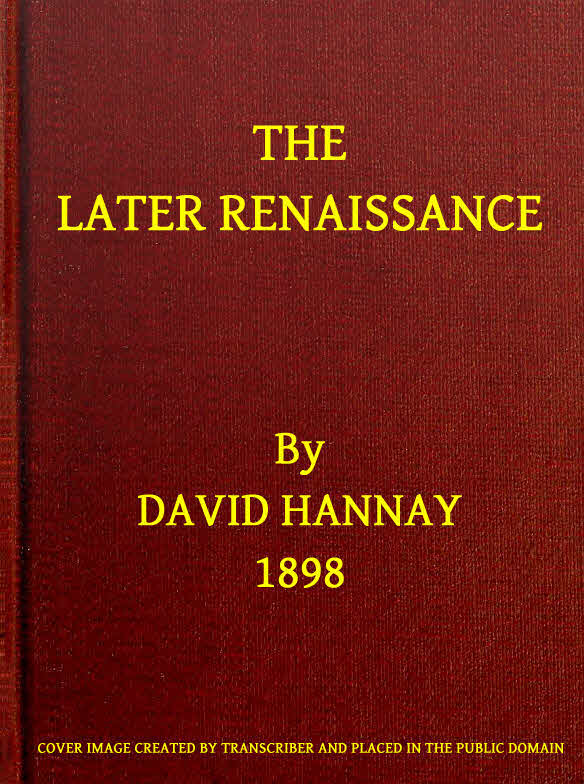
The Later Renaissance
1898
Few literary histories capture the feverish energy of Spain's Golden Age quite like this. Written with Victorian precision and genuine passion, Hannay traces how Spanish writers of the 16th and 17th centuries didn't merely imitate Italian forms, but weaponized them into something entirely their own. The book maps the tension between native Spanish voice and foreign influence, showing how Lope de Vega, Cervantes, and their contemporaries built a literary tradition that still pulses through Western culture. Hannay pays particular attention to the poets who bridged the learned and popular traditions, those who could write for court and street alike. The result is a portrait of a literature that refused to be derivative, that answered the Renaissance on its own terms. Though written in 1898, this remains essential reading for anyone who wants to understand how Spain invented itself through words, and why that invention still matters.
Editions
Link to this book
Add a free, dofollow link to Lex on your blog, forum, syllabus, or reading list.

<a href="https://lex-books.com/book/the-later-renaissance-b250b819-5379-439c-b074-3dbf0e3caed7"><img src="https://lex-books.com/badges/read-on-lex.svg" alt="Read The Later Renaissance by David Hannay free on Lex" width="160" height="40"></a>[](https://lex-books.com/book/the-later-renaissance-b250b819-5379-439c-b074-3dbf0e3caed7)[url=https://lex-books.com/book/the-later-renaissance-b250b819-5379-439c-b074-3dbf0e3caed7][img]https://lex-books.com/badges/read-on-lex.svg[/img][/url]Read The Later Renaissance by David Hannay free on Lex: https://lex-books.com/book/the-later-renaissance-b250b819-5379-439c-b074-3dbf0e3caed7Cite this book
Reading this edition for a paper or guide? Copy a citation.
Hannay, David. The Later Renaissance. Lex, lex-books.com/book/the-later-renaissance-b250b819-5379-439c-b074-3dbf0e3caed7.Hannay, D. (1898). The Later Renaissance. Lex. https://lex-books.com/book/the-later-renaissance-b250b819-5379-439c-b074-3dbf0e3caed7Hannay, David. The Later Renaissance. Lex. https://lex-books.com/book/the-later-renaissance-b250b819-5379-439c-b074-3dbf0e3caed7.