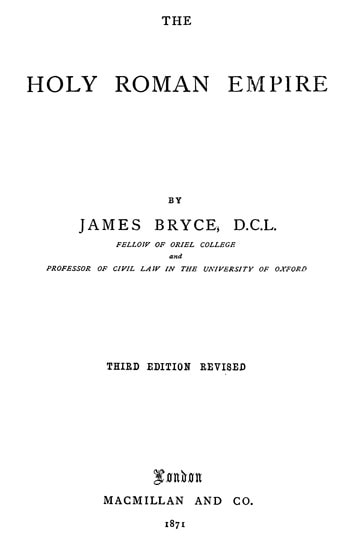
The Holy Roman Empire
1864
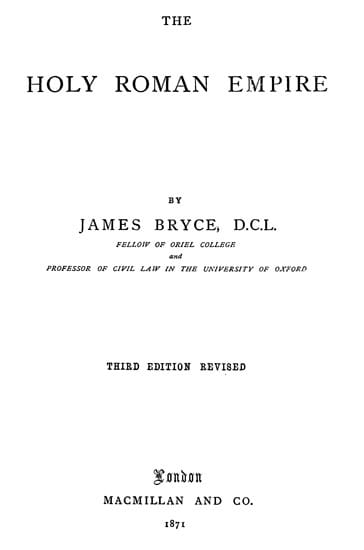
The Holy Roman Empire
1864
Few institutions have puzzled historians quite like the Holy Roman Empire. Existing in various forms for over a thousand years, it was neither holy, nor Roman, nor truly an empire in any conventional sense. Yet as James Bryce argues in this landmark 1864 study, it was something perhaps more fascinating: a living idea, a political organism born from the unlikely marriage of Roman imperial tradition and Teutonic tribal custom. Bryce traces the empire's strange evolution from the collapse of the Western Roman Empire through the medieval period, examining how it absorbed barbarian invasions, the rise of Christianity, and the competing ambitions of popes and emperors to become something unprecedented in European history. The book culminates with the resignation of Emperor Francis II in 1806, an event that ended not just a polity but a millennium of political and spiritual imagination. Bryce's achievement lies in treating the empire as an institution rather than a mere sequence of events, revealing the beliefs and traditions that sustained it long after any practical necessity had passed. For anyone seeking to understand how medieval Europeans conceived of legitimate governance, and why the ghost of this strange empire still haunts modern European politics, Bryce's analysis remains indispensable.
Editions
X-Ray
The author and narrator of this historical treatise on the Holy Roman Empire. A distinguished Oxford professor and legal scholar who provides analytical commentary throughout the work.
Frankish king crowned Roman Emperor in 800 AD, founding the Holy Roman Empire. A towering figure whose coronation by Pope Leo III marked the beginning of the medieval imperial system.
Saxon king who revived the Holy Roman Empire in 962 AD and established the Germanic imperial tradition. Known for his strong rule and conflicts with the Papacy.
Pope who crowned Charlemagne as Roman Emperor on Christmas Day 800 AD. His actions established the papal role in imperial coronations.
About The Holy Roman Empire
Chapter Summaries
- 1
- Bryce introduces his subject by noting the end of the Holy Roman Empire in 1806 and explaining his approach to study it as an institution rather than through narrative history. He emphasizes the Empire's role as a link between ancient and modern worlds.
- 2
- Describes the condition of the Roman Empire in its later centuries, including the rise of Christianity and the gradual obliteration of national distinctions under Roman rule. Sets the stage for understanding what the barbarians encountered.
- 3
- Examines how Germanic tribes viewed and interacted with the Roman Empire, their desire to preserve rather than destroy Roman institutions, and the gradual dissolution of Western imperial authority.
Key Themes
- Church and State Relations
- The complex relationship between temporal and spiritual authority, exemplified by the ongoing conflicts between Emperors and Popes over who held ultimate power in Christian Europe.
- The Decline of Universal Authority
- The gradual weakening of the imperial ideal of universal monarchy as national kingdoms emerged and local powers asserted independence from central authority.
- Legitimacy and Tradition
- The importance of historical precedent and traditional forms in maintaining political authority, as seen in the Empire's claim to Roman succession and papal coronation ceremonies.
Characters
- James Bryce(protagonist)
- The author and narrator of this historical treatise on the Holy Roman Empire. A distinguished Oxford professor and legal scholar who provides analytical commentary throughout the work.
- Charles the Great (Charlemagne)(major)
- Frankish king crowned Roman Emperor in 800 AD, founding the Holy Roman Empire. A towering figure whose coronation by Pope Leo III marked the beginning of the medieval imperial system.
- Otto the Great(major)
- Saxon king who revived the Holy Roman Empire in 962 AD and established the Germanic imperial tradition. Known for his strong rule and conflicts with the Papacy.
- Pope Leo III(major)
- Pope who crowned Charlemagne as Roman Emperor on Christmas Day 800 AD. His actions established the papal role in imperial coronations.
- Frederick Barbarossa(major)
- Holy Roman Emperor (1152-1189) who represented the height of imperial power and prestige. Known for his conflicts with the Pope and Italian cities.
- Pope Gregory VII (Hildebrand)(major)
- Reforming Pope who initiated the great struggle between Church and Empire. Famous for humiliating Emperor Henry IV at Canossa.
Link to this book
Add a free, dofollow link to Lex on your blog, forum, syllabus, or reading list.

<a href="https://lex-books.com/book/the-holy-roman-empire-72cc61b2-e200-41a5-b24f-6af9e36a58ef"><img src="https://lex-books.com/badges/read-on-lex.svg" alt="Read The Holy Roman Empire by James Bryce, Viscount Bryce free on Lex" width="160" height="40"></a>[](https://lex-books.com/book/the-holy-roman-empire-72cc61b2-e200-41a5-b24f-6af9e36a58ef)[url=https://lex-books.com/book/the-holy-roman-empire-72cc61b2-e200-41a5-b24f-6af9e36a58ef][img]https://lex-books.com/badges/read-on-lex.svg[/img][/url]Read The Holy Roman Empire by James Bryce, Viscount Bryce free on Lex: https://lex-books.com/book/the-holy-roman-empire-72cc61b2-e200-41a5-b24f-6af9e36a58efCite this book
Reading this edition for a paper or guide? Copy a citation.
James Bryce, Viscount Bryce. The Holy Roman Empire. Lex, lex-books.com/book/the-holy-roman-empire-72cc61b2-e200-41a5-b24f-6af9e36a58ef.James Bryce, V. B. (1864). The Holy Roman Empire. Lex. https://lex-books.com/book/the-holy-roman-empire-72cc61b2-e200-41a5-b24f-6af9e36a58efJames Bryce, Viscount Bryce. The Holy Roman Empire. Lex. https://lex-books.com/book/the-holy-roman-empire-72cc61b2-e200-41a5-b24f-6af9e36a58ef.