The Dwelling House
1897
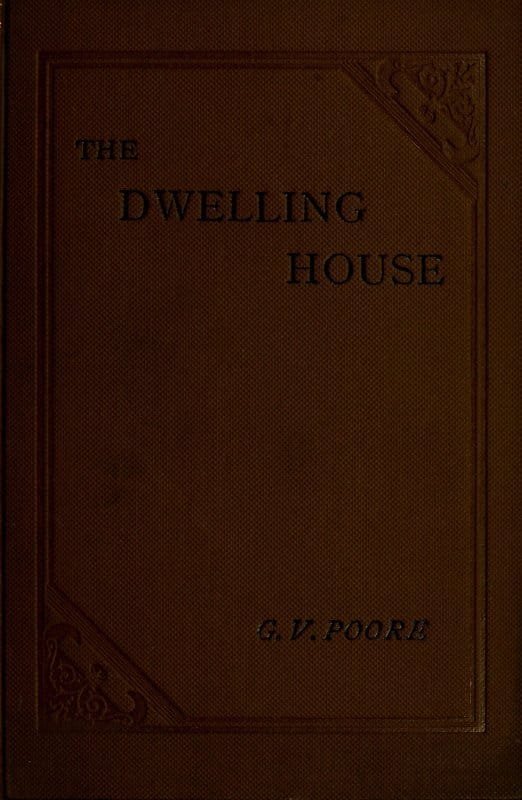
The Dwelling House
1897
In the fog-choked streets of late Victorian London, a physician turns his analytical gaze on the most intimate of spaces: the home. George Vivian Poore's 1897 treatise dissects the house as a living, breathing organism whose design can nurture or destroy the humans within. With the bacteriology revolution freshly underway, Poore maps the invisible war between fresh air and contamination, showing how architectural choices determine whether families prosper or succumb to consumption, typhoid, and the host of diseases bred by damp foundations and fetid basements. He spares no typical London row house, exposing their cross-ventilation failures, their sewage-adjacent water supplies, their death-trap bedrooms where generations coughed through endless winters. For the modern reader, the book operates as both historical artifact and uncanny prophecy: here is the sanitary anxiety that birthed modern plumbing, the germ-theory revolution just then reshaping medicine, and the surprisingly persistent questions about indoor air quality and building-related illness that haunt us still. Essential for anyone curious about how we learned to make homes healthy, or simply fascinated by the Victorians' obsessive, often desperate campaign against invisible enemies.
Editions
Link to this book
Add a free, dofollow link to Lex on your blog, forum, syllabus, or reading list.

<a href="https://lex-books.com/book/the-dwelling-house-6caff80d-381a-4cc8-a8b1-a3597e01e069"><img src="https://lex-books.com/badges/read-on-lex.svg" alt="Read The Dwelling House by George Vivian Poore free on Lex" width="160" height="40"></a>[](https://lex-books.com/book/the-dwelling-house-6caff80d-381a-4cc8-a8b1-a3597e01e069)[url=https://lex-books.com/book/the-dwelling-house-6caff80d-381a-4cc8-a8b1-a3597e01e069][img]https://lex-books.com/badges/read-on-lex.svg[/img][/url]Read The Dwelling House by George Vivian Poore free on Lex: https://lex-books.com/book/the-dwelling-house-6caff80d-381a-4cc8-a8b1-a3597e01e069Cite this book
Reading this edition for a paper or guide? Copy a citation.
Poore, George Vivian. The Dwelling House. Lex, lex-books.com/book/the-dwelling-house-6caff80d-381a-4cc8-a8b1-a3597e01e069.Poore, G. V. (1897). The Dwelling House. Lex. https://lex-books.com/book/the-dwelling-house-6caff80d-381a-4cc8-a8b1-a3597e01e069Poore, George Vivian. The Dwelling House. Lex. https://lex-books.com/book/the-dwelling-house-6caff80d-381a-4cc8-a8b1-a3597e01e069.