The Conspiracy of Gianluigi Fieschi, or, Genoa in the Sixteenth Century.
1866
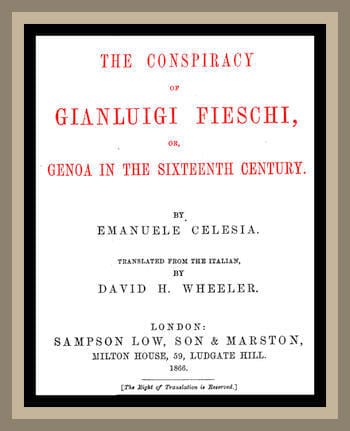
The Conspiracy of Gianluigi Fieschi, or, Genoa in the Sixteenth Century.
1866
Translated by David H. Wheeler
In sixteenth-century Genoa, one nobleman plotted to overthrow the most powerful family in the city and break the Spanish Empire's grip on Italian liberty. For centuries, history remembered Gianluigi Fieschi as a treacherous conspirator. Emanuele Celesia's 1866 masterwork argues we got him all wrong. Drawing on extensive archival research, Celesia reconstructs Fieschi's 1547 conspiracy against Andrea Doria, not as a simple power grab, but as a genuine attempt to restore Genoese autonomy against Spanish hegemony. The book meticulously details the political machinations, the noble factionalism, and the tragic failure of Italian republicanism in an era when the peninsula fell beneath foreign domination. But Celesia does something more radical: he turns his attention to the common people, the masses systematically excluded from power and from history itself, showing how their struggles were crushed by two vast despotisms, imperial Spain and the Papacy, working in concert to strangle Italian political life. This is not dry chronicle but passionate advocacy: a Victorian Italian scholar's attempt to restore dignity to a misunderstood figure and to illuminate a painful chapter when Italians were denied the freedoms their European neighbors were gaining.
Editions
Link to this book
Add a free, dofollow link to Lex on your blog, forum, syllabus, or reading list.

<a href="https://lex-books.com/book/the-conspiracy-of-gianluigi-fieschi-or-genoa-in-the-sixteenth-century-0935ba0d-f291-4113-bceb-4f39a68ec960"><img src="https://lex-books.com/badges/read-on-lex.svg" alt="Read The Conspiracy of Gianluigi Fieschi, or, Genoa in the Sixteenth Century. by Emanuele Celesia free on Lex" width="160" height="40"></a>[](https://lex-books.com/book/the-conspiracy-of-gianluigi-fieschi-or-genoa-in-the-sixteenth-century-0935ba0d-f291-4113-bceb-4f39a68ec960)[url=https://lex-books.com/book/the-conspiracy-of-gianluigi-fieschi-or-genoa-in-the-sixteenth-century-0935ba0d-f291-4113-bceb-4f39a68ec960][img]https://lex-books.com/badges/read-on-lex.svg[/img][/url]Read The Conspiracy of Gianluigi Fieschi, or, Genoa in the Sixteenth Century. by Emanuele Celesia free on Lex: https://lex-books.com/book/the-conspiracy-of-gianluigi-fieschi-or-genoa-in-the-sixteenth-century-0935ba0d-f291-4113-bceb-4f39a68ec960Cite this book
Reading this edition for a paper or guide? Copy a citation.
Celesia, Emanuele. The Conspiracy of Gianluigi Fieschi, or, Genoa in the Sixteenth Century.. Lex, lex-books.com/book/the-conspiracy-of-gianluigi-fieschi-or-genoa-in-the-sixteenth-century-0935ba0d-f291-4113-bceb-4f39a68ec960.Celesia, E. (1866). The Conspiracy of Gianluigi Fieschi, or, Genoa in the Sixteenth Century.. Lex. https://lex-books.com/book/the-conspiracy-of-gianluigi-fieschi-or-genoa-in-the-sixteenth-century-0935ba0d-f291-4113-bceb-4f39a68ec960Celesia, Emanuele. The Conspiracy of Gianluigi Fieschi, or, Genoa in the Sixteenth Century.. Lex. https://lex-books.com/book/the-conspiracy-of-gianluigi-fieschi-or-genoa-in-the-sixteenth-century-0935ba0d-f291-4113-bceb-4f39a68ec960.