The Chautauquan, Vol. 04, January 1884a Monthly Magazine Devoted to the Promotion of True Culture.organ of the Chautauqua Literary and Scientific Circle.
1884
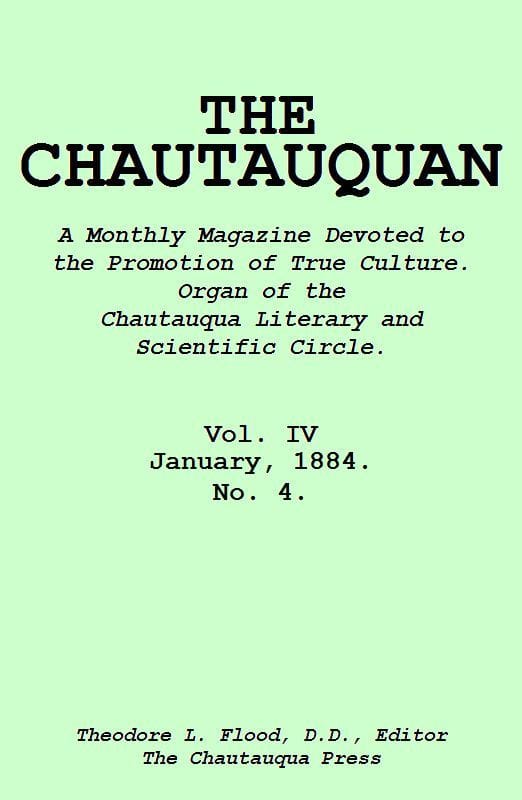
The Chautauquan, Vol. 04, January 1884a Monthly Magazine Devoted to the Promotion of True Culture.organ of the Chautauqua Literary and Scientific Circle.
Chautauqua Literary and Scientific Circle
1884
A monthly magazine focused on the promotion of true culture, published in the late 19th century. This periodical serves as a platform for readers engaged in the Chautauqua Literary and Scientific Circle, featuring a diverse array of articles that cover topics such as history, literature, science, art, and spirituality. The content within reflects the intellectual pursuits and cultural interests of its time, likely appealing to an audience seeking both education and inspiration. The opening portion of this volume introduces various planned articles and sections, including readings on German history, literature, physical science, and spiritual topics. A significant highlight is a detailed narrative discussing the period between the death of Charlemagne and the Reformation, emphasizing historical context and key figures such as Martin Luther. The magazine aims to stimulate further study and engagement with these subjects, establishing a rich tapestry of knowledge and cultural discourse for its readers. Through its structured approach, the magazine encourages intellectual growth while fostering a sense of community among those involved in its literary and scientific circle.
Editions
X-Ray
German monk and reformer who challenged papal authority and sparked the Protestant Reformation. Born in 1483, he nailed his 95 theses to the Wittenberg church door in 1517 and translated the New Testament into German.
Pope who sold indulgences to fund his luxurious lifestyle and artistic patronage. He excommunicated Luther and ordered his writings burned.
German Emperor who was forced to seek papal forgiveness at Canossa, demonstrating the power of the church over secular rulers in medieval times.
Powerful medieval pope who established papal supremacy over secular rulers and forced Emperor Henry IV to submit at Canossa.
About The Chautauquan, Vol. 04, January 1884a Monthly Magazine Devoted to the Promotion of True Culture.organ of the Chautauqua Literary and Scientific Circle.
Chapter Summaries
- German History IV
- Traces German history from Charlemagne's death through the dark ages to Martin Luther's birth and early Reformation. Focuses on the rise of papal power, exemplified by Henry IV's humiliation at Canossa, and the conditions that made Luther's protest possible.
- Extracts from German Literature
- Presents selections from major German literary figures including Winckelmann's art criticism, Schiller's poetry and religious struggles, Goethe's nature writing and Faust excerpts, and Schlegel's literary history. Demonstrates the richness of German cultural achievement.
- Readings in Physical Science IV
- Provides a scientific explanation of ocean characteristics including saltwater composition, tides, waves, currents, and sea floor geology. Uses accessible language to explain complex oceanographic concepts for general readers.
Key Themes
- Religious Reform and Corruption
- The magazine explores how the Catholic Church's corruption, particularly the sale of indulgences, sparked Luther's protest and the broader Protestant Reformation. It examines the tension between spiritual purity and institutional power.
- Individual Conscience vs. Authority
- Luther's famous declaration 'Here I stand, I cannot do otherwise' exemplifies the theme of individual moral conviction challenging established religious and political authority, even at great personal risk.
- The Power of the Written Word
- The invention of the printing press and Luther's translation of the Bible into German demonstrate how literacy and accessible texts can democratize knowledge and challenge institutional control over information.
Characters
- Martin Luther(protagonist)
- German monk and reformer who challenged papal authority and sparked the Protestant Reformation. Born in 1483, he nailed his 95 theses to the Wittenberg church door in 1517 and translated the New Testament into German.
- Pope Leo X(antagonist)
- Pope who sold indulgences to fund his luxurious lifestyle and artistic patronage. He excommunicated Luther and ordered his writings burned.
- Henry IV(major)
- German Emperor who was forced to seek papal forgiveness at Canossa, demonstrating the power of the church over secular rulers in medieval times.
- Pope Gregory VII(major)
- Powerful medieval pope who established papal supremacy over secular rulers and forced Emperor Henry IV to submit at Canossa.
- Frederick the Wise(major)
- Elector of Saxony who protected Luther from papal and imperial persecution, refusing to hand him over to authorities.
- Tetzel(minor)
- Dominican monk who sold papal indulgences throughout Germany, sparking Luther's initial protest with his 95 theses.
Link to this book
Add a free, dofollow link to Lex on your blog, forum, syllabus, or reading list.

<a href="https://lex-books.com/book/the-chautauquan-vol-04-january-1884a-monthly-magazine-devoted-to-the-promotion-o-6bb3d1ee-2825-4960-a877-bf679c77aaea"><img src="https://lex-books.com/badges/read-on-lex.svg" alt="Read The Chautauquan, Vol. 04, January 1884a Monthly Magazine Devoted to the Promotion of True Culture.organ of the Chautauqua Literary and Scientific Circle. by Chautauqua Literary and Scientific Circle free on Lex" width="160" height="40"></a>[](https://lex-books.com/book/the-chautauquan-vol-04-january-1884a-monthly-magazine-devoted-to-the-promotion-o-6bb3d1ee-2825-4960-a877-bf679c77aaea)[url=https://lex-books.com/book/the-chautauquan-vol-04-january-1884a-monthly-magazine-devoted-to-the-promotion-o-6bb3d1ee-2825-4960-a877-bf679c77aaea][img]https://lex-books.com/badges/read-on-lex.svg[/img][/url]Read The Chautauquan, Vol. 04, January 1884a Monthly Magazine Devoted to the Promotion of True Culture.organ of the Chautauqua Literary and Scientific Circle. by Chautauqua Literary and Scientific Circle free on Lex: https://lex-books.com/book/the-chautauquan-vol-04-january-1884a-monthly-magazine-devoted-to-the-promotion-o-6bb3d1ee-2825-4960-a877-bf679c77aaeaCite this book
Reading this edition for a paper or guide? Copy a citation.
Circle, Chautauqua Literary and Scientific. The Chautauquan, Vol. 04, January 1884a Monthly Magazine Devoted to the Promotion of True Culture.organ of the Chautauqua Literary and Scientific Circle.. Lex, lex-books.com/book/the-chautauquan-vol-04-january-1884a-monthly-magazine-devoted-to-the-promotion-o-6bb3d1ee-2825-4960-a877-bf679c77aaea.Circle, C. L. A. S. (1884). The Chautauquan, Vol. 04, January 1884a Monthly Magazine Devoted to the Promotion of True Culture.organ of the Chautauqua Literary and Scientific Circle.. Lex. https://lex-books.com/book/the-chautauquan-vol-04-january-1884a-monthly-magazine-devoted-to-the-promotion-o-6bb3d1ee-2825-4960-a877-bf679c77aaeaCircle, Chautauqua Literary and Scientific. The Chautauquan, Vol. 04, January 1884a Monthly Magazine Devoted to the Promotion of True Culture.organ of the Chautauqua Literary and Scientific Circle.. Lex. https://lex-books.com/book/the-chautauquan-vol-04-january-1884a-monthly-magazine-devoted-to-the-promotion-o-6bb3d1ee-2825-4960-a877-bf679c77aaea.





![Birds and Nature Vol. 11 No. 4 [April 1902]illustrated by Color Photography](/_next/image?url=https%3A%2F%2Fd3b2n8gj62qnwr.cloudfront.net%2FCOVERS%2Fgutenberg_covers75k%2Febook-47570.png&w=3840&q=75)