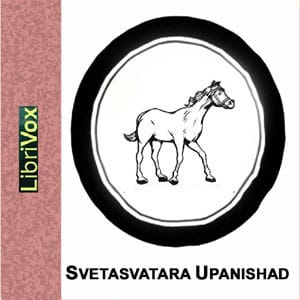
Svetasvatara Upanishad
Among the oldest voices in human philosophy, the Svetasvatara Upanishad asks the questions that still wake us at night: What is the primal cause of all existence? Where did we come from, and what lies beyond? Written between 400 and 200 BCE and embedded in the White Yajurveda, this brief but revolutionary text sits the reader down before a teacher to wrestle with the nature of time, nature, necessity, and spirit. It does not offer easy answers. Instead, it builds a systematic vision of Brahman, the ultimate reality, and Atman, the self within, laying groundwork that would shape Indian thought for millennia. Here too is one of the earliest articulations of devotion as a path to liberation, of cosmic law as something one can know and merge with. The text's power lies not in its length but in its directness: six chapters, fewer than a hundred verses, and yet a complete framework for understanding consciousness, the divine, and the self's escape from the wheel of existence. For readers drawn to the philosophical roots of meditation, yoga, and Eastern spirituality, this is where the river begins.
Editions

Link to this book
Add a free, dofollow link to Lex on your blog, forum, syllabus, or reading list.

<a href="https://lex-books.com/book/svetasvatara-upanishad-19aadb6e-48fa-486b-86f0-d34101d777ec"><img src="https://lex-books.com/badges/read-on-lex.svg" alt="Read Svetasvatara Upanishad by Unknown free on Lex" width="160" height="40"></a>[](https://lex-books.com/book/svetasvatara-upanishad-19aadb6e-48fa-486b-86f0-d34101d777ec)[url=https://lex-books.com/book/svetasvatara-upanishad-19aadb6e-48fa-486b-86f0-d34101d777ec][img]https://lex-books.com/badges/read-on-lex.svg[/img][/url]Read Svetasvatara Upanishad by Unknown free on Lex: https://lex-books.com/book/svetasvatara-upanishad-19aadb6e-48fa-486b-86f0-d34101d777ecCite this book
Reading this edition for a paper or guide? Copy a citation.
Unknown. Svetasvatara Upanishad. Lex, lex-books.com/book/svetasvatara-upanishad-19aadb6e-48fa-486b-86f0-d34101d777ec.Unknown (n.d.). Svetasvatara Upanishad. Lex. https://lex-books.com/book/svetasvatara-upanishad-19aadb6e-48fa-486b-86f0-d34101d777ecUnknown. Svetasvatara Upanishad. Lex. https://lex-books.com/book/svetasvatara-upanishad-19aadb6e-48fa-486b-86f0-d34101d777ec.