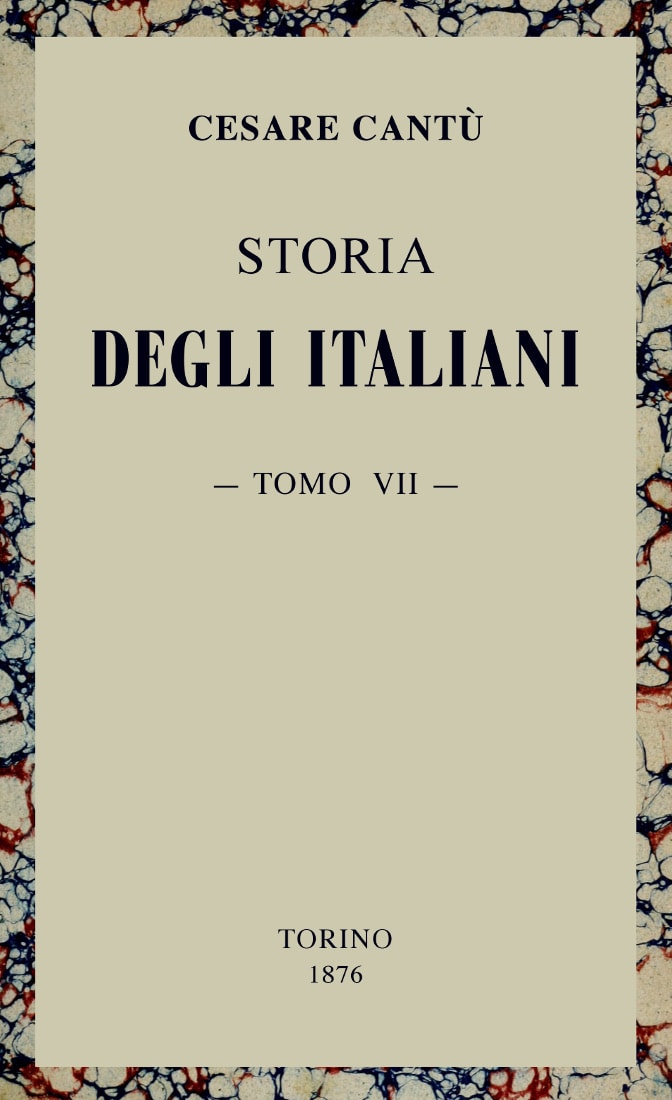
Storia Degli Italiani, Vol. 07 (di 15)
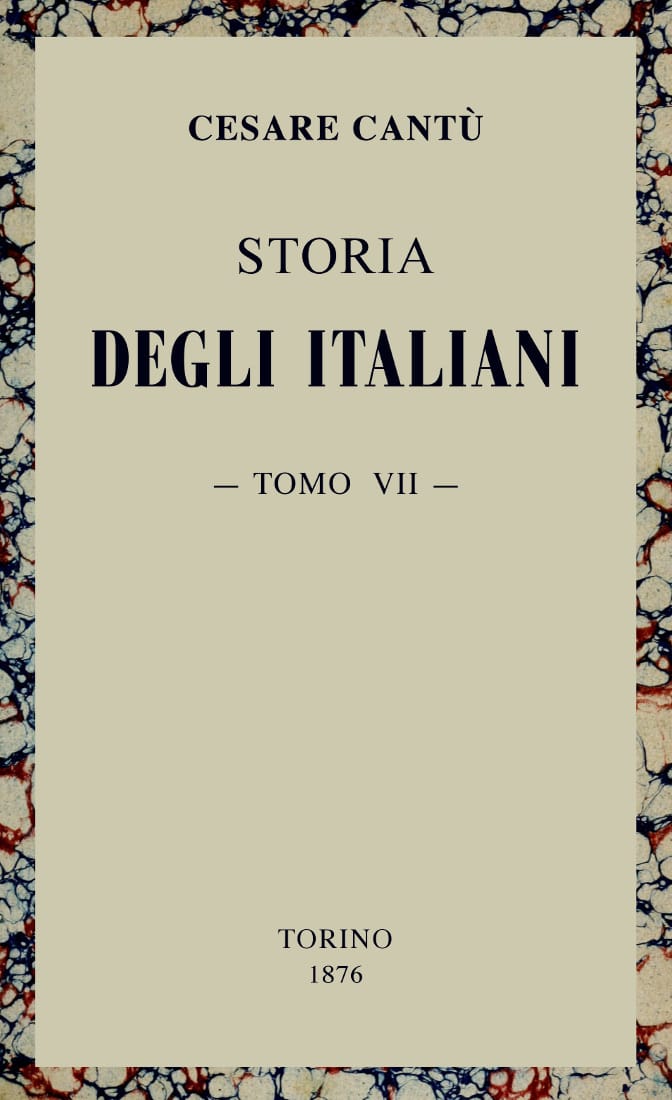
Storia Degli Italiani, Vol. 07 (di 15)
''Storia degli Italiani, vol. 07 (di 15)'' by Cesare Cantù is a historical account written during the late 19th century. This volume continues a detailed exploration of Italy's complex social and political landscape, delving into the power dynamics of the feudal system, the rise of communes, and the influential families that shaped the region during turbulent times. The book provides insights into Italy's historical evolution, particularly after the fall of the Hohenstaufen dynasty. The opening of this volume begins by discussing the fragmentation of Italy post-Hohenstaufen, highlighting the struggles for power between various noble families and the emerging cities that began to form their own communes. It illustrates a landscape characterized by feudal lords and their vassals, detailing how the notion of national unity was virtually nonexistent, with the population often divided by loyalty to local lords rather than any broader Italian identity. Cantù describes the rise of influential factions, particularly the Torriani and Visconti families, amid the sociopolitical chaos, setting the scene for the shifting allegiances and conflicts that would continue to shape Italy's historical trajectory.
Editions

X-Ray
Holy Roman Emperor who dominated Italian politics in the 13th century. A central figure in the struggle between imperial and papal power.
Pope who opposed Federico II and worked to establish papal temporal power. Key figure in the Guelph-Ghibelline conflicts.
Tyrannical lord of Padua and Verona, Federico II's most ruthless supporter. Known for extreme cruelty and despotic rule.
Florentine Ghibelline leader who defended Florence from destruction after Montaperti. Embodied aristocratic honor and civic pride.
About Storia Degli Italiani, Vol. 07 (di 15)
Chapter Summaries
- 94
- After the fall of the Hohenstaufen dynasty, Italy fragments into numerous independent communes and signorie. The chapter traces the rise of the Torriani and Visconti families in Milan, showing how republican governments gave way to hereditary lordships.
- 95
- Examines the political development of Tuscan cities, particularly Florence's rise to prominence through the Guelph-Ghibelline conflicts. Details the Battle of Montaperti and Florence's subsequent recovery and expansion.
- 96
- Analyzes the maritime republics, focusing on Venice's unique constitutional development and the serrata del maggior consiglio that established aristocratic rule. Also covers Genoa and Pisa's commercial and political evolution.
Key Themes
- Liberty vs Tyranny
- The tension between communal freedom and despotic rule, as Italian cities fought to maintain independence against imperial control and internal tyrants.
- Religious vs Secular Power
- The fundamental conflict between papal authority and imperial claims, which shaped Italian politics and divided loyalties throughout the peninsula.
- Artistic Renaissance
- The revolutionary transformation of art and literature as Italian masters like Dante, Giotto, and Nicola Pisano broke from medieval traditions to create new forms of expression.
Characters
- Federico II(major)
- Holy Roman Emperor who dominated Italian politics in the 13th century. A central figure in the struggle between imperial and papal power.
- Innocent IV(major)
- Pope who opposed Federico II and worked to establish papal temporal power. Key figure in the Guelph-Ghibelline conflicts.
- Ezzelino IV da Romano(major)
- Tyrannical lord of Padua and Verona, Federico II's most ruthless supporter. Known for extreme cruelty and despotic rule.
- Farinata degli Uberti(major)
- Florentine Ghibelline leader who defended Florence from destruction after Montaperti. Embodied aristocratic honor and civic pride.
- Charles of Anjou(major)
- French prince brought to Italy by the Pope to defeat the Hohenstaufen. Established Angevin rule in southern Italy.
- Dante Alighieri(major)
- Greatest Italian poet, author of the Divine Comedy. Embodied the intellectual and artistic flowering of medieval Italy.
Link to this book
Add a free, dofollow link to Lex on your blog, forum, syllabus, or reading list.

<a href="https://lex-books.com/book/storia-degli-italiani-vol-07-di-15-3e77b3ec-3d70-4f8f-b27a-79d3e5fc8349"><img src="https://lex-books.com/badges/read-on-lex.svg" alt="Read Storia Degli Italiani, Vol. 07 (di 15) by Cesare Cantù free on Lex" width="160" height="40"></a>[](https://lex-books.com/book/storia-degli-italiani-vol-07-di-15-3e77b3ec-3d70-4f8f-b27a-79d3e5fc8349)[url=https://lex-books.com/book/storia-degli-italiani-vol-07-di-15-3e77b3ec-3d70-4f8f-b27a-79d3e5fc8349][img]https://lex-books.com/badges/read-on-lex.svg[/img][/url]Read Storia Degli Italiani, Vol. 07 (di 15) by Cesare Cantù free on Lex: https://lex-books.com/book/storia-degli-italiani-vol-07-di-15-3e77b3ec-3d70-4f8f-b27a-79d3e5fc8349Cite this book
Reading this edition for a paper or guide? Copy a citation.
Cantù, Cesare. Storia Degli Italiani, Vol. 07 (di 15). Lex, lex-books.com/book/storia-degli-italiani-vol-07-di-15-3e77b3ec-3d70-4f8f-b27a-79d3e5fc8349.Cantù, C. (n.d.). Storia Degli Italiani, Vol. 07 (di 15). Lex. https://lex-books.com/book/storia-degli-italiani-vol-07-di-15-3e77b3ec-3d70-4f8f-b27a-79d3e5fc8349Cantù, Cesare. Storia Degli Italiani, Vol. 07 (di 15). Lex. https://lex-books.com/book/storia-degli-italiani-vol-07-di-15-3e77b3ec-3d70-4f8f-b27a-79d3e5fc8349.