Song Celestial; Or, Bhagavad-Gîtâ
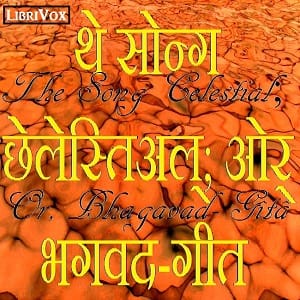
On a battlefield about to erupt in war, a prince raises his bow and asks his charioteer the question that has echoed across millennia: what is our duty when the world demands we act, yet our soul craves stillness? The Bhagavad Gita answers nothing so simply as a doctrine. It answers with a god in disguise, Krishna, who reveals himself as the infinite ground of being and speaks through Arjuna's paralysis to address every soul that has ever stood frozen between what must be done and what feels impossible to bear. This is not a scripture to be merely read. It is a text that has shaped Gandhi's nonviolent resistance, Tolstoy's theology, Emerson's transcendentalism, and the spiritual imagination of the modern world. Arnold's 1885 blank verse rendering captures the original Sanskrit's rhythmic pulse, shifting from measured meditation to lyric heights when the divine speaks. The result is a translation that respects the sacred text's mystery while rendering it into English that still crackles with urgency. For readers drawn to the great spiritual classics, to philosophy that refuses abstraction, to poetry that serves as a vessel for the infinite.
Editions

Link to this book
Add a free, dofollow link to Lex on your blog, forum, syllabus, or reading list.

<a href="https://lex-books.com/book/song-celestial-or-bhagavad-g-t-2e661783-6953-4c5d-a739-67d3fb86c130"><img src="https://lex-books.com/badges/read-on-lex.svg" alt="Read Song Celestial; Or, Bhagavad-Gîtâ by Unknown free on Lex" width="160" height="40"></a>[](https://lex-books.com/book/song-celestial-or-bhagavad-g-t-2e661783-6953-4c5d-a739-67d3fb86c130)[url=https://lex-books.com/book/song-celestial-or-bhagavad-g-t-2e661783-6953-4c5d-a739-67d3fb86c130][img]https://lex-books.com/badges/read-on-lex.svg[/img][/url]Read Song Celestial; Or, Bhagavad-Gîtâ by Unknown free on Lex: https://lex-books.com/book/song-celestial-or-bhagavad-g-t-2e661783-6953-4c5d-a739-67d3fb86c130Cite this book
Reading this edition for a paper or guide? Copy a citation.
Unknown. Song Celestial; Or, Bhagavad-Gîtâ. Lex, lex-books.com/book/song-celestial-or-bhagavad-g-t-2e661783-6953-4c5d-a739-67d3fb86c130.Unknown (n.d.). Song Celestial; Or, Bhagavad-Gîtâ. Lex. https://lex-books.com/book/song-celestial-or-bhagavad-g-t-2e661783-6953-4c5d-a739-67d3fb86c130Unknown. Song Celestial; Or, Bhagavad-Gîtâ. Lex. https://lex-books.com/book/song-celestial-or-bhagavad-g-t-2e661783-6953-4c5d-a739-67d3fb86c130.
