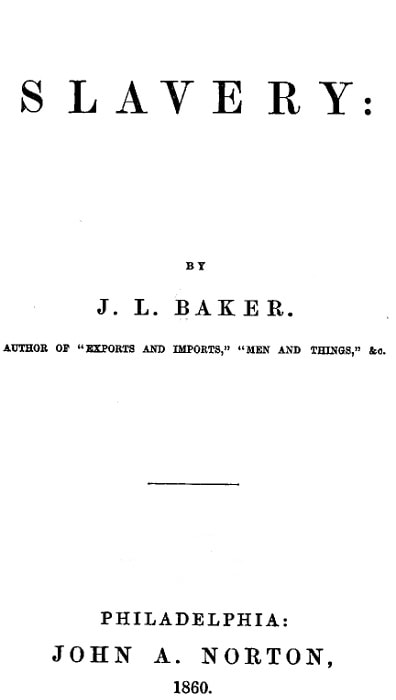
Slavery
1859
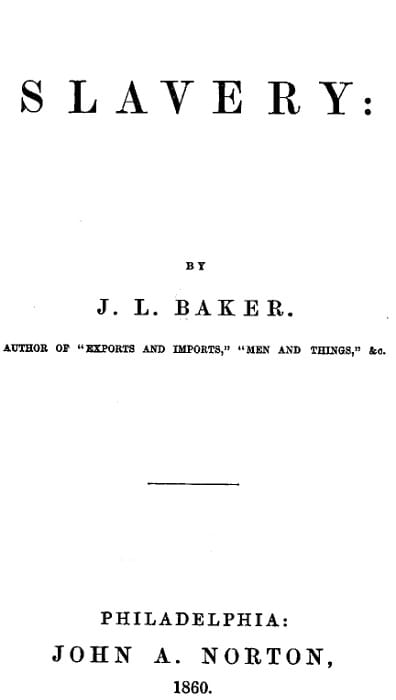
A rare firsthand defense of slavery written in 1859 by a South Carolina slaveholder during the most volatile period of American history. James L. Baker constructed his argument in the shadow of John Brown's raid at Harper's Ferry, and the urgency permeates every page. He contends that emancipation would bring catastrophe to both races, that enslaved people enjoyed genuine contentment under paternalistic masters, and that Black Americans lacked the capacity for self-governance without white supervision. Baker draws on pseudo-scientific racial theory, economic anxiety, and biblical interpretation to construct his case, presenting the South as a benevolent hierarchy under siege from Northern abolitionists. The text is not a manifesto of monsters but something more unsettling: the sincere reasoning of a man who believed he was saving souls and protecting families. For modern readers, the value lies not in persuasion but in preservation. This is one of the clearest windows into how enslavers understood themselves, their institution, and the coming crisis. Essential for anyone studying American history, antebellum ideology, or the machinery of white supremacy.
Editions
Link to this book
Add a free, dofollow link to Lex on your blog, forum, syllabus, or reading list.

<a href="https://lex-books.com/book/slavery-424ee4f8-ec60-4e7e-bed1-78a4c7a1e626"><img src="https://lex-books.com/badges/read-on-lex.svg" alt="Read Slavery by James L. Baker free on Lex" width="160" height="40"></a>[](https://lex-books.com/book/slavery-424ee4f8-ec60-4e7e-bed1-78a4c7a1e626)[url=https://lex-books.com/book/slavery-424ee4f8-ec60-4e7e-bed1-78a4c7a1e626][img]https://lex-books.com/badges/read-on-lex.svg[/img][/url]Read Slavery by James L. Baker free on Lex: https://lex-books.com/book/slavery-424ee4f8-ec60-4e7e-bed1-78a4c7a1e626Cite this book
Reading this edition for a paper or guide? Copy a citation.
Baker, James L.. Slavery. Lex, lex-books.com/book/slavery-424ee4f8-ec60-4e7e-bed1-78a4c7a1e626.Baker, J. L. (1859). Slavery. Lex. https://lex-books.com/book/slavery-424ee4f8-ec60-4e7e-bed1-78a4c7a1e626Baker, James L.. Slavery. Lex. https://lex-books.com/book/slavery-424ee4f8-ec60-4e7e-bed1-78a4c7a1e626.