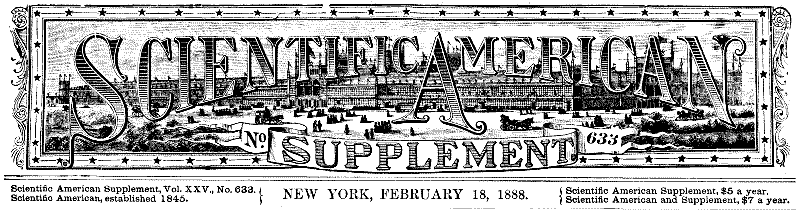
Scientific American Supplement, No. 633, February 18, 1888
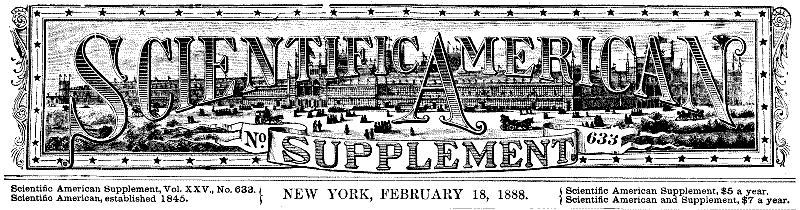
Scientific American Supplement, No. 633, February 18, 1888
A fascinating time capsule of Victorian-era scientific thought, this February 1888 supplement to Scientific American gathers lectures and articles spanning architecture, astronomy, chemistry, engineering, and technology. The opening piece, H.H. Statham's lecture series on architectural design, argues that architecture is an intellectual art form balancing beauty with practicality, exploring how buildings should reflect both purpose and emotion. Other contributions capture the era's cutting-edge discussions: advances in astronomical observation, contemporary chemical experiments, and the latest engineering feats. What makes this volume remarkable is not merely its technical content but its window into late 19th-century intellectual life. These pages reveal what educated readers in 1888 considered important, what questions scientists were wrestling with, and how the boundaries between disciplines were then understood. For historians of science, Victorian enthusiasts, and anyone curious about how we arrived at modern knowledge, this supplement offers an unfiltered view of a pivotal moment in human understanding.
Editions

Link to this book
Add a free, dofollow link to Lex on your blog, forum, syllabus, or reading list.

<a href="https://lex-books.com/book/scientific-american-supplement-no-633-february-18-1888-0d38ddcf-15b8-416c-91dc-4c9a4efc3960"><img src="https://lex-books.com/badges/read-on-lex.svg" alt="Read Scientific American Supplement, No. 633, February 18, 1888 by Various free on Lex" width="160" height="40"></a>[](https://lex-books.com/book/scientific-american-supplement-no-633-february-18-1888-0d38ddcf-15b8-416c-91dc-4c9a4efc3960)[url=https://lex-books.com/book/scientific-american-supplement-no-633-february-18-1888-0d38ddcf-15b8-416c-91dc-4c9a4efc3960][img]https://lex-books.com/badges/read-on-lex.svg[/img][/url]Read Scientific American Supplement, No. 633, February 18, 1888 by Various free on Lex: https://lex-books.com/book/scientific-american-supplement-no-633-february-18-1888-0d38ddcf-15b8-416c-91dc-4c9a4efc3960Cite this book
Reading this edition for a paper or guide? Copy a citation.
Various. Scientific American Supplement, No. 633, February 18, 1888. Lex, lex-books.com/book/scientific-american-supplement-no-633-february-18-1888-0d38ddcf-15b8-416c-91dc-4c9a4efc3960.Various (n.d.). Scientific American Supplement, No. 633, February 18, 1888. Lex. https://lex-books.com/book/scientific-american-supplement-no-633-february-18-1888-0d38ddcf-15b8-416c-91dc-4c9a4efc3960Various. Scientific American Supplement, No. 633, February 18, 1888. Lex. https://lex-books.com/book/scientific-american-supplement-no-633-february-18-1888-0d38ddcf-15b8-416c-91dc-4c9a4efc3960.