Riot Act
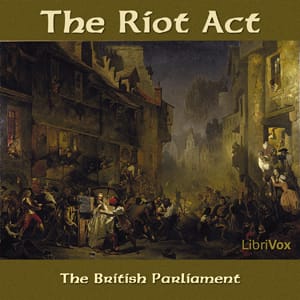
The Riot Act, passed by the British Parliament in 1714 and effective from August 1715, aimed to quell social disturbances by allowing authorities to disperse groups of twelve or more people unlawfully assembled. The Act mandated that a proclamation be read, giving the assembly one hour to disperse, with severe penalties for noncompliance, including death. It established legal immunity for law enforcement in cases of injury or death during riots. The phrase 'to read the riot act' originated from this legislation, which was repealed in Britain in 1973 but remains in effect in Canada.
Editions

Audiobook
Human narrated
Link to this book
Add a free, dofollow link to Lex on your blog, forum, syllabus, or reading list.

HTML
<a href="https://lex-books.com/book/riot-act-7ffc2509-272d-4c5b-aaf6-1277ed0d17c4"><img src="https://lex-books.com/badges/read-on-lex.svg" alt="Read Riot Act by Parliament of the United Kingdom of Great Britain free on Lex" width="160" height="40"></a>Markdown
[](https://lex-books.com/book/riot-act-7ffc2509-272d-4c5b-aaf6-1277ed0d17c4)BBCode
[url=https://lex-books.com/book/riot-act-7ffc2509-272d-4c5b-aaf6-1277ed0d17c4][img]https://lex-books.com/badges/read-on-lex.svg[/img][/url]Plain link
Read Riot Act by Parliament of the United Kingdom of Great Britain free on Lex: https://lex-books.com/book/riot-act-7ffc2509-272d-4c5b-aaf6-1277ed0d17c4Cite this book
Reading this edition for a paper or guide? Copy a citation.
MLA
Britain, Parliament of the United Kingdom of Great. Riot Act. Lex, lex-books.com/book/riot-act-7ffc2509-272d-4c5b-aaf6-1277ed0d17c4.APA
Britain, P. O. T. U. K. O. G. (n.d.). Riot Act. Lex. https://lex-books.com/book/riot-act-7ffc2509-272d-4c5b-aaf6-1277ed0d17c4Chicago
Britain, Parliament of the United Kingdom of Great. Riot Act. Lex. https://lex-books.com/book/riot-act-7ffc2509-272d-4c5b-aaf6-1277ed0d17c4.