Puella Mea
1921
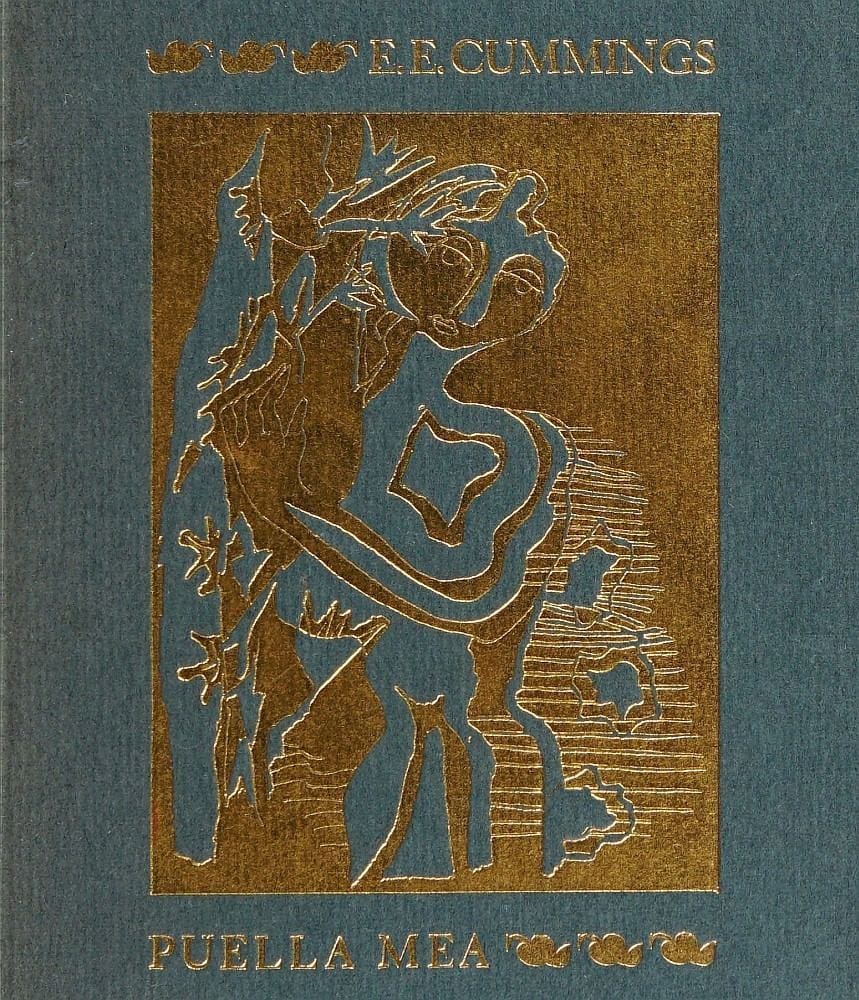
This is E. E. Cummings at his most unguarded. Puella Mea is his longest poem at 290 lines, and it reads as a sustained, breathless declaration to his young wife, Elaine Orr Thayer. Cummings builds an extraordinary argument across these verses: that his beloved is more beautiful than Helen of Troy, Cleopatra, and every legendary woman woven through history and mythology. But the poem's power lies not in mere flattery. It grapples with beauty's fragility, the ache of loving something that will not last. Using his signature fractured syntax, unconventional punctuation, and experimental typography, Cummings creates a voice that feels both ancient and startlingly modern. This was his departure from the witty romanticism of his earlier work into something more tender and urgent. The poem first appeared in The Dial in 1921, then vanished into his first collection Tulips and Chimneys before emerging as a standalone book in 1949 with illustrations by Picasso, Klee, and Modigliani. It remains a rare document: Cummings stripped of irony, reaching for something eternal and finding only time.
Editions
Link to this book
Add a free, dofollow link to Lex on your blog, forum, syllabus, or reading list.

<a href="https://lex-books.com/book/puella-mea-545955d2-25ff-4e6e-9f73-754cfcf5f22f"><img src="https://lex-books.com/badges/read-on-lex.svg" alt="Read Puella Mea by E. E. Cummings free on Lex" width="160" height="40"></a>[](https://lex-books.com/book/puella-mea-545955d2-25ff-4e6e-9f73-754cfcf5f22f)[url=https://lex-books.com/book/puella-mea-545955d2-25ff-4e6e-9f73-754cfcf5f22f][img]https://lex-books.com/badges/read-on-lex.svg[/img][/url]Read Puella Mea by E. E. Cummings free on Lex: https://lex-books.com/book/puella-mea-545955d2-25ff-4e6e-9f73-754cfcf5f22fCite this book
Reading this edition for a paper or guide? Copy a citation.
Cummings, E. E.. Puella Mea. Lex, lex-books.com/book/puella-mea-545955d2-25ff-4e6e-9f73-754cfcf5f22f.Cummings, E. E. (1921). Puella Mea. Lex. https://lex-books.com/book/puella-mea-545955d2-25ff-4e6e-9f73-754cfcf5f22fCummings, E. E.. Puella Mea. Lex. https://lex-books.com/book/puella-mea-545955d2-25ff-4e6e-9f73-754cfcf5f22f.


![Birds and Nature, Vol. 12 No. 1 [June 1902]illustrated by Color Photography](/_next/image?url=https%3A%2F%2Fd3b2n8gj62qnwr.cloudfront.net%2FCOVERS%2Fgutenberg_covers75k%2Febook-47881.png&w=3840&q=75)