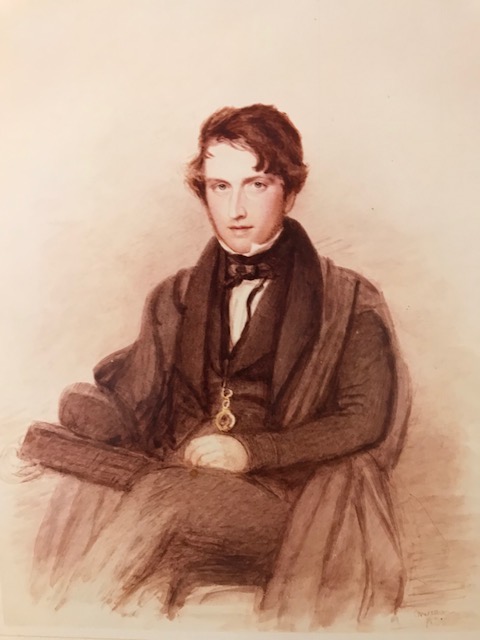
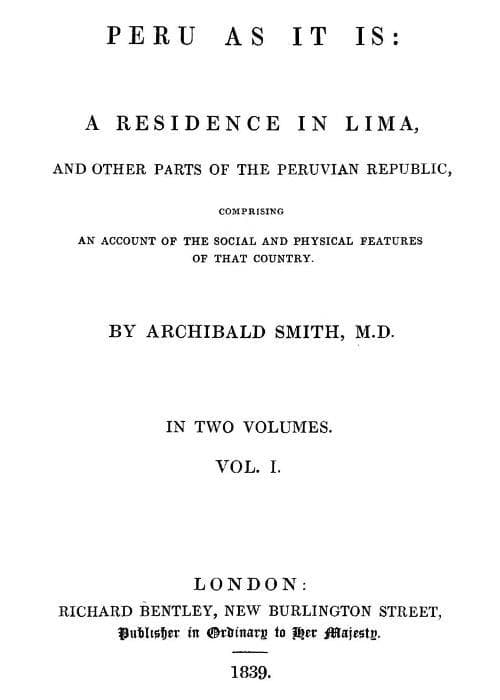
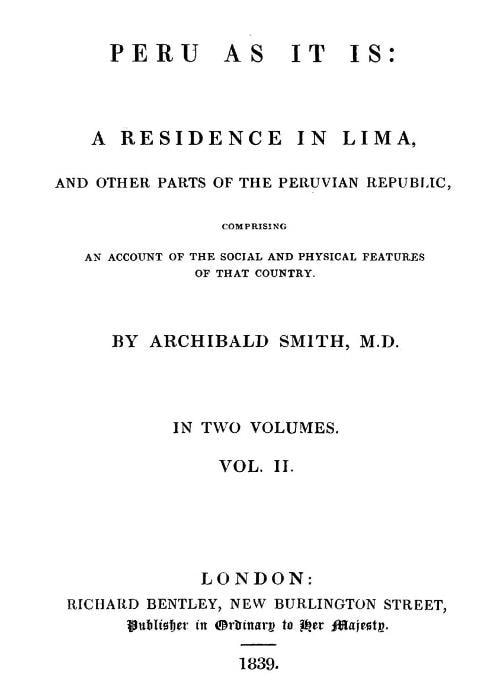
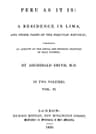
Peru as It Is, Volume 2 (of 2)
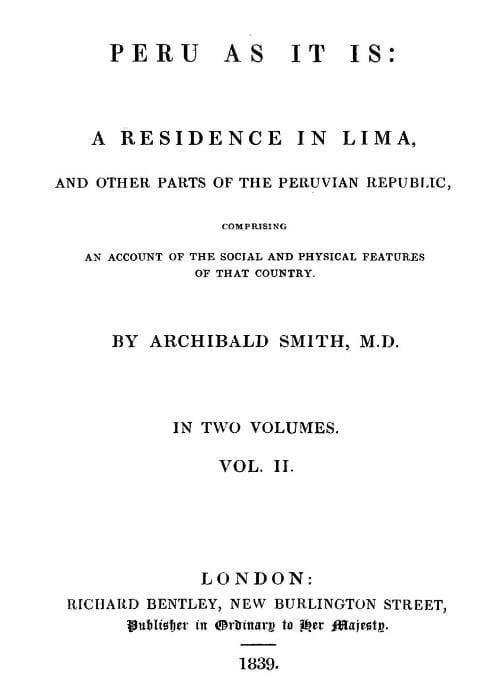
Archibald Smith's meticulous account of early 19th-century Peru reads like a journalist's notebook from a world barely known to Europeans. Written during his residence in Lima and travels through the Andes, this volume moves beyond mere travelogue into something more valuable: a firsthand witness to a nation in transformation. Smith catalogs everything from the brutal economics of silver mining in the highlands to the particular rhythms of Limeño society, from agricultural practices in the coastal valleys to the complex governance structures left behind by collapsing Spanish rule. His eye is precise, his curiosity voracious. What emerges is not a romanticized portrait but a stubborn insistence on seeing Peru as it actually was, messy, stratified, economically desperate, culturally layered. For readers interested in Latin American history, the aftermath of colonial independence, or the genre of early travel writing itself, Smith's work offers a window onto a moment when Peru was negotiating its future while still steeped in its Inca and Spanish past.
Editions
Link to this book
Add a free, dofollow link to Lex on your blog, forum, syllabus, or reading list.

<a href="https://lex-books.com/book/peru-as-it-is-volume-2-of-2-0b29ba6c-e871-4316-8e62-32a1ac86f124"><img src="https://lex-books.com/badges/read-on-lex.svg" alt="Read Peru as It Is, Volume 2 (of 2) by Archibald Smith free on Lex" width="160" height="40"></a>[](https://lex-books.com/book/peru-as-it-is-volume-2-of-2-0b29ba6c-e871-4316-8e62-32a1ac86f124)[url=https://lex-books.com/book/peru-as-it-is-volume-2-of-2-0b29ba6c-e871-4316-8e62-32a1ac86f124][img]https://lex-books.com/badges/read-on-lex.svg[/img][/url]Read Peru as It Is, Volume 2 (of 2) by Archibald Smith free on Lex: https://lex-books.com/book/peru-as-it-is-volume-2-of-2-0b29ba6c-e871-4316-8e62-32a1ac86f124Cite this book
Reading this edition for a paper or guide? Copy a citation.
Smith, Archibald. Peru as It Is, Volume 2 (of 2). Lex, lex-books.com/book/peru-as-it-is-volume-2-of-2-0b29ba6c-e871-4316-8e62-32a1ac86f124.Smith, A. (n.d.). Peru as It Is, Volume 2 (of 2). Lex. https://lex-books.com/book/peru-as-it-is-volume-2-of-2-0b29ba6c-e871-4316-8e62-32a1ac86f124Smith, Archibald. Peru as It Is, Volume 2 (of 2). Lex. https://lex-books.com/book/peru-as-it-is-volume-2-of-2-0b29ba6c-e871-4316-8e62-32a1ac86f124.