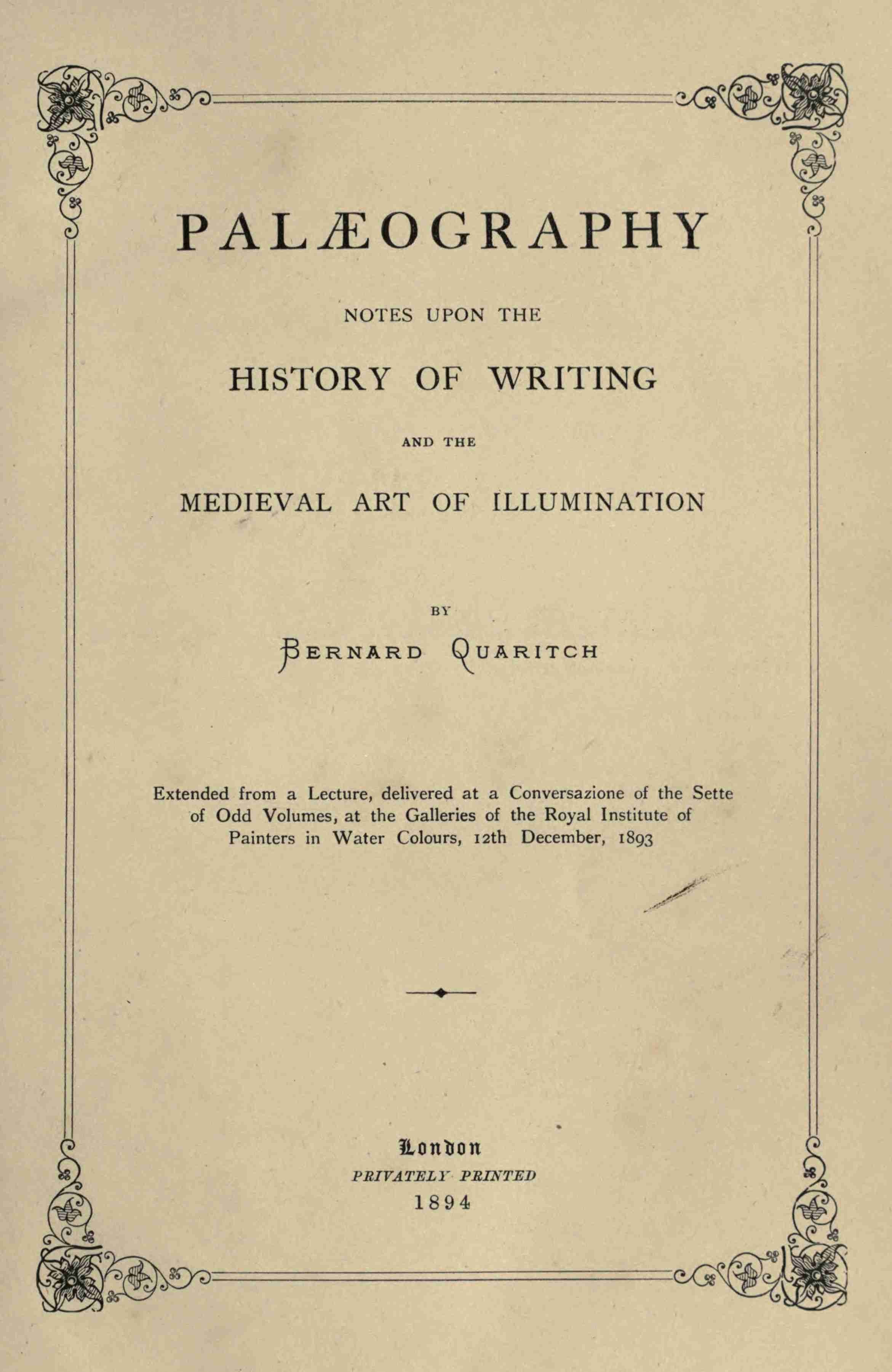
Palæographynotes Upon the History of Writing and the Medieval Art of Illumination
1894
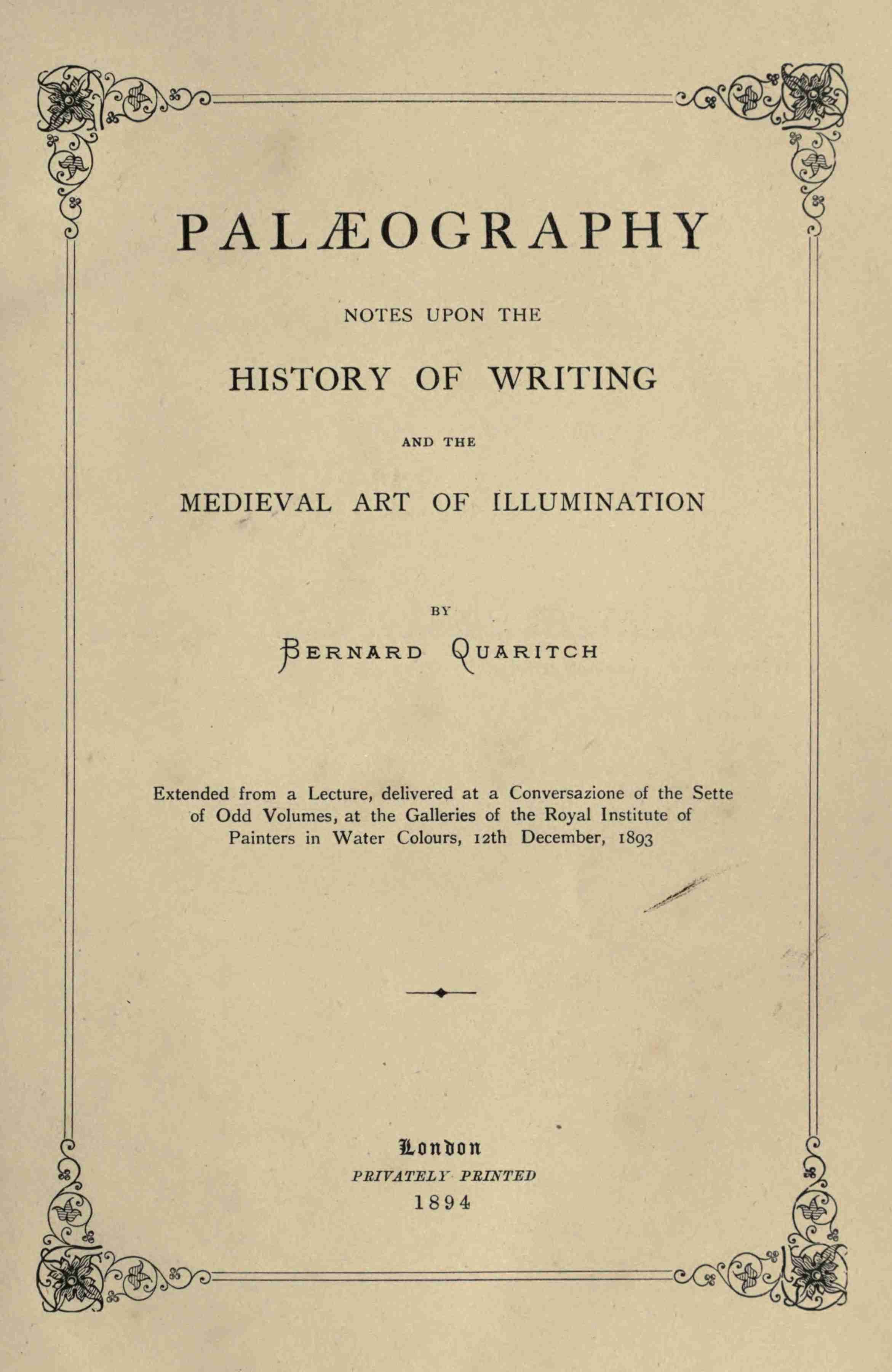
Palæographynotes Upon the History of Writing and the Medieval Art of Illumination
1894
A scholarly work focused on the history of writing and the medieval art of illumination, written in the late 19th century. This treatise extends from a lecture delivered by Quaritch, utilizing his experiences in the manuscript market to explore the intricacies of manuscripts from various time periods, particularly before the advent of printing. The work aims to provide readers with a foundational understanding of palæography, summarizing key historical developments and methods of manuscript production. The opening of this text sets the scene by emphasizing the vast yet scattered nature of pre-printing books, acknowledging the author's own qualifications and experiences as a manuscript buyer. Quaritch outlines the framework of the study as a series of cursory remarks on medieval calligraphy and ornamental practices, beginning with the origins of writing itself. He provides insight into the various ancient modes of writing, materials used, and the evolution of different scripts across cultures, illustrating how the art of writing has evolved over millennia, laying the groundwork for a deeper exploration of palæography that follows.
Editions
X-Ray
The author and narrator, a distinguished antiquarian bookseller and scholar of manuscripts. He serves as Librarian to the Sette of Odd Volumes and has extensive experience in the manuscript trade.
President of the Sette of Odd Volumes in 1893-94, described as an 'Artificer' and friend to whom the work is dedicated.
Author of 'The Stones of Venice' who expressed surprise at Quaritch's knowledge of manuscript commercial values.
A contemporary palaeographical scholar whose work Quaritch references and respects, though he suggests it may mislead inexperienced students.
About Palæographynotes Upon the History of Writing and the Medieval Art of Illumination
Chapter Summaries
- Foreword
- Quaritch acknowledges the difficulties of writing about manuscripts and palaeography, citing the scattered nature of surviving examples. He justifies his approach based on twenty years of experience in the manuscript trade.
- The Beginnings of Writing
- Defines palaeography and explains the etymology of words for 'book' in various languages. Discusses the evolution from rolls to codex format and the use of different writing materials.
- Writing in Egypt 5000 B.C.
- Traces the origins of writing to ancient Egypt, discussing hieroglyphic and hieratic scripts. Emphasizes that writing belongs to 'Ham' rather than Aryan or Semitic peoples.
Key Themes
- Evolution of Human Communication
- The work traces how writing systems developed from primitive symbols to sophisticated alphabets, showing the gradual refinement of human communication methods across millennia.
- Cultural Transmission and Preservation
- Quaritch emphasizes how writing systems and artistic traditions spread between civilizations, with particular focus on how knowledge was preserved and transmitted through manuscript copying.
- The Intersection of Art and Learning
- The book explores how medieval illuminated manuscripts represented a unique fusion of artistic beauty and scholarly knowledge, creating works that were both functional and aesthetically magnificent.
Characters
- Bernard Quaritch(protagonist)
- The author and narrator, a distinguished antiquarian bookseller and scholar of manuscripts. He serves as Librarian to the Sette of Odd Volumes and has extensive experience in the manuscript trade.
- Alexander T. Hollingsworth(minor)
- President of the Sette of Odd Volumes in 1893-94, described as an 'Artificer' and friend to whom the work is dedicated.
- John Ruskin(minor)
- Author of 'The Stones of Venice' who expressed surprise at Quaritch's knowledge of manuscript commercial values.
- E. Maunde Thompson(minor)
- A contemporary palaeographical scholar whose work Quaritch references and respects, though he suggests it may mislead inexperienced students.
Link to this book
Add a free, dofollow link to Lex on your blog, forum, syllabus, or reading list.

<a href="https://lex-books.com/book/pal-ographynotes-upon-the-history-of-writing-and-the-medieval-art-of-illuminatio-db56ace8-272e-442e-b408-a85ab71b22c2"><img src="https://lex-books.com/badges/read-on-lex.svg" alt="Read Palæographynotes Upon the History of Writing and the Medieval Art of Illumination by Bernard Quaritch free on Lex" width="160" height="40"></a>[](https://lex-books.com/book/pal-ographynotes-upon-the-history-of-writing-and-the-medieval-art-of-illuminatio-db56ace8-272e-442e-b408-a85ab71b22c2)[url=https://lex-books.com/book/pal-ographynotes-upon-the-history-of-writing-and-the-medieval-art-of-illuminatio-db56ace8-272e-442e-b408-a85ab71b22c2][img]https://lex-books.com/badges/read-on-lex.svg[/img][/url]Read Palæographynotes Upon the History of Writing and the Medieval Art of Illumination by Bernard Quaritch free on Lex: https://lex-books.com/book/pal-ographynotes-upon-the-history-of-writing-and-the-medieval-art-of-illuminatio-db56ace8-272e-442e-b408-a85ab71b22c2Cite this book
Reading this edition for a paper or guide? Copy a citation.
Quaritch, Bernard. Palæographynotes Upon the History of Writing and the Medieval Art of Illumination. Lex, lex-books.com/book/pal-ographynotes-upon-the-history-of-writing-and-the-medieval-art-of-illuminatio-db56ace8-272e-442e-b408-a85ab71b22c2.Quaritch, B. (1894). Palæographynotes Upon the History of Writing and the Medieval Art of Illumination. Lex. https://lex-books.com/book/pal-ographynotes-upon-the-history-of-writing-and-the-medieval-art-of-illuminatio-db56ace8-272e-442e-b408-a85ab71b22c2Quaritch, Bernard. Palæographynotes Upon the History of Writing and the Medieval Art of Illumination. Lex. https://lex-books.com/book/pal-ographynotes-upon-the-history-of-writing-and-the-medieval-art-of-illuminatio-db56ace8-272e-442e-b408-a85ab71b22c2.