Oscar Wilde, a Study
1905
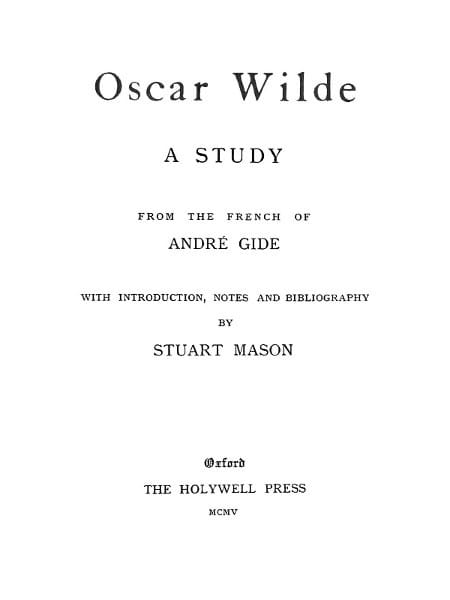
In 1905, five years after Oscar Wilde's death in exile, the French writer André Gide published this slender, fierce study: part memoir, part defense, part literary criticism written from the inside. Gide had known Wilde intimately, had loved him, and was one of the few who refused to abandon him when Victorian England turned savage. This book is the record of that loyalty. Rather than a comprehensive biography, it is an act of witness: Gide examines Wilde's plays and essays, traces the arc of his brilliant rise and catastrophic fall, and confronts the hypocrisy of a society that celebrated Wilde's wit while destroying him for who he loved. The study is also deeply personal, sketching the man behind the legend with an intimacy no outsider could achieve. Gide does not apologize for Wilde or sanitize him; he presents him as an artist of terrifying honesty in a world that could not tolerate the truth. More than a century later, this remains essential reading for anyone who wants to understand how one great writer saw another, and what it cost to speak honestly about art, desire, and moral courage when the world demanded silence.
Editions
X-Ray
“There are,” he would say, “two kinds of artist: one brings answers, and the other, questions. We have to know whether one belongs to those who answer or to those who question; for the kind which questions is never that which answers. There are works which wait, and which one does not understand for long time; the reason is that they bring answers to questions which have not yet been raised; for the question often arrives a terribly long time after the answer.””
— André Gide
Link to this book
Add a free, dofollow link to Lex on your blog, forum, syllabus, or reading list.

<a href="https://lex-books.com/book/oscar-wilde-a-study-55ab04f7-349a-4c45-bce0-9173b22947f2"><img src="https://lex-books.com/badges/read-on-lex.svg" alt="Read Oscar Wilde, a Study by André Gide free on Lex" width="160" height="40"></a>[](https://lex-books.com/book/oscar-wilde-a-study-55ab04f7-349a-4c45-bce0-9173b22947f2)[url=https://lex-books.com/book/oscar-wilde-a-study-55ab04f7-349a-4c45-bce0-9173b22947f2][img]https://lex-books.com/badges/read-on-lex.svg[/img][/url]Read Oscar Wilde, a Study by André Gide free on Lex: https://lex-books.com/book/oscar-wilde-a-study-55ab04f7-349a-4c45-bce0-9173b22947f2Cite this book
Reading this edition for a paper or guide? Copy a citation.
Gide, André. Oscar Wilde, a Study. Lex, lex-books.com/book/oscar-wilde-a-study-55ab04f7-349a-4c45-bce0-9173b22947f2.Gide, A. (1905). Oscar Wilde, a Study. Lex. https://lex-books.com/book/oscar-wilde-a-study-55ab04f7-349a-4c45-bce0-9173b22947f2Gide, André. Oscar Wilde, a Study. Lex. https://lex-books.com/book/oscar-wilde-a-study-55ab04f7-349a-4c45-bce0-9173b22947f2.