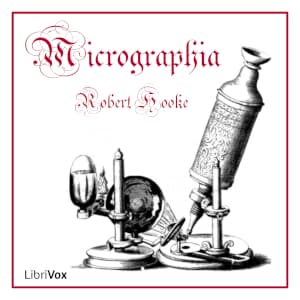
Micrographia: Some Physiological Descriptions of Minute Bodies Made by Magnifying Glasses with Observations and Inquiries Thereupon
1665
Micrographia: Some Physiological Descriptions of Minute Bodies Made by Magnifying Glasses with Observations and Inquiries Thereupon
1665
In 1665, a curious Englishman pointed a microscope at a piece of cork and glimpsed something no human had ever seen: tiny box-like structures that reminded him of the small rooms in a monastery. He called them cells, and with that single observation, he launched a biological revolution still unfolding today. But Hooke was just getting started. His microscope revealed a hidden universe that had existed for billions of years unnoticed: the crystalline architecture of a fly's eye, the alien forests of mold, the delicate choreography of a gnat's wing, the unexpected roughness of what appeared to be a smooth needle point. What looked simple to the naked eye became, under magnification, a cosmos of staggering complexity. Micrographia was the first major publication of the Royal Society and the first scientific bestseller in history, captivating a public hungry for the new wonders of experimental science. Hooke wrote for the curious and the uninitiated, inviting anyone with eyes and wonder to see what lay beyond ordinary sight. Nearly four centuries later, it remains a breathtaking artifact: proof that the world always has more secrets to show us, if we simply look closer.
Editions
X-Ray
Link to this book
Add a free, dofollow link to Lex on your blog, forum, syllabus, or reading list.

<a href="https://lex-books.com/book/micrographia-some-physiological-descriptions-of-minute-bodies-made-by-magnifying-17811b6c-ddf3-4ba9-902d-ca0061273bdb"><img src="https://lex-books.com/badges/read-on-lex.svg" alt="Read Micrographia: Some Physiological Descriptions of Minute Bodies Made by Magnifying Glasses with Observations and Inquiries Thereupon by Robert Hooke free on Lex" width="160" height="40"></a>[](https://lex-books.com/book/micrographia-some-physiological-descriptions-of-minute-bodies-made-by-magnifying-17811b6c-ddf3-4ba9-902d-ca0061273bdb)[url=https://lex-books.com/book/micrographia-some-physiological-descriptions-of-minute-bodies-made-by-magnifying-17811b6c-ddf3-4ba9-902d-ca0061273bdb][img]https://lex-books.com/badges/read-on-lex.svg[/img][/url]Read Micrographia: Some Physiological Descriptions of Minute Bodies Made by Magnifying Glasses with Observations and Inquiries Thereupon by Robert Hooke free on Lex: https://lex-books.com/book/micrographia-some-physiological-descriptions-of-minute-bodies-made-by-magnifying-17811b6c-ddf3-4ba9-902d-ca0061273bdbCite this book
Reading this edition for a paper or guide? Copy a citation.
Hooke, Robert. Micrographia: Some Physiological Descriptions of Minute Bodies Made by Magnifying Glasses with Observations and Inquiries Thereupon. Lex, lex-books.com/book/micrographia-some-physiological-descriptions-of-minute-bodies-made-by-magnifying-17811b6c-ddf3-4ba9-902d-ca0061273bdb.Hooke, R. (1665). Micrographia: Some Physiological Descriptions of Minute Bodies Made by Magnifying Glasses with Observations and Inquiries Thereupon. Lex. https://lex-books.com/book/micrographia-some-physiological-descriptions-of-minute-bodies-made-by-magnifying-17811b6c-ddf3-4ba9-902d-ca0061273bdbHooke, Robert. Micrographia: Some Physiological Descriptions of Minute Bodies Made by Magnifying Glasses with Observations and Inquiries Thereupon. Lex. https://lex-books.com/book/micrographia-some-physiological-descriptions-of-minute-bodies-made-by-magnifying-17811b6c-ddf3-4ba9-902d-ca0061273bdb.