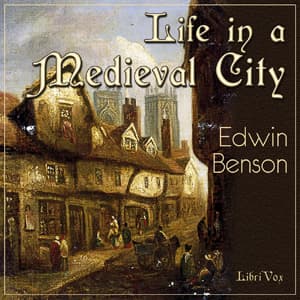
Life in a Mediæval City: Illustrated by York in the Xvth Century
1920
Life in a Mediæval City: Illustrated by York in the Xvth Century
1920
Published in 1920, 'Life in a Mediæval City' by Edwin Benson provides a detailed historical account of York, England, during the 15th century. The book examines various aspects of urban life, including governance, trade, social classes, and architecture, highlighting York's significance as a bridge between the Middle Ages and the Renaissance. Benson explores the socio-political landscape of the time, addressing key events such as the Wars of the Roses and the city's resilience amidst national turbulence. This work serves as a valuable resource for understanding the complexities of life in a medieval city.
Editions
X-Ray
The author and historian who presents this detailed study of medieval York. He serves as the scholarly guide through 15th-century urban life.
King of England who frequently visited York, particularly during rebellions. He withdrew York's right of self-government in 1405 after Archbishop Scrope's revolt.
Popular Archbishop of York who led a revolt and was executed by Henry IV. His death caused intense indignation among York's people.
A great friend to York who was very popular in the north. The city was loyal to him and helped raise troops in his support.
About Life in a Mediæval City: Illustrated by York in the Xvth Century
Chapter Summaries
- 1
- Establishes the 15th century as the last of the Middle Ages, characterized by intense humanity and political unrest. Despite wars and baronial conflicts, towns like York developed through trade and municipal unity.
- 2
- Examines York's strategic geographical position as the natural center of northern England, its military value at the junction of rivers, and its political importance as an ecclesiastical metropolis and administrative center.
- 3
- Describes 15th-century York's physical layout dominated by Church, State, and People. Details the Minster, castle fortifications, narrow streets, timber houses, and religious buildings that defined the medieval cityscape.
Key Themes
- Church Dominance in Medieval Life
- The overwhelming influence of the Church permeated every aspect of 15th-century York, from the massive Minster dominating the skyline to daily religious observances, education, and charitable works.
- Rise of the Merchant Middle Class
- The emergence of wealthy traders as a powerful social force who controlled guilds, governed the city, and challenged traditional hierarchies while maintaining religious devotion.
- Urban vs. Rural Medieval Life
- York as an oasis of civilization surrounded by forests and wilderness, representing the concentrated nature of medieval urban culture and its contrast with the dangerous countryside.
Characters
- Edwin Benson(major)
- The author and historian who presents this detailed study of medieval York. He serves as the scholarly guide through 15th-century urban life.
- Henry IV(major)
- King of England who frequently visited York, particularly during rebellions. He withdrew York's right of self-government in 1405 after Archbishop Scrope's revolt.
- Archbishop Scrope(major)
- Popular Archbishop of York who led a revolt and was executed by Henry IV. His death caused intense indignation among York's people.
- Richard, Duke of Gloucester (Richard III)(major)
- A great friend to York who was very popular in the north. The city was loyal to him and helped raise troops in his support.
- The Mayor of York(major)
- The real governor of the city, typically a wealthy merchant who ruled with considerable power. Wore rich state robes and held court in the Common Hall.
- The Archbishop of York(major)
- Spiritual head of the Church in northern England and a great landowner. Possessed palaces, extensive lands, and significant political influence.
Link to this book
Add a free, dofollow link to Lex on your blog, forum, syllabus, or reading list.

<a href="https://lex-books.com/book/life-in-a-medi-val-city-illustrated-by-york-in-the-xvth-century-878167e8-cc32-42bd-af02-f640bc66cdd4"><img src="https://lex-books.com/badges/read-on-lex.svg" alt="Read Life in a Mediæval City: Illustrated by York in the Xvth Century by Edwin Benson free on Lex" width="160" height="40"></a>[](https://lex-books.com/book/life-in-a-medi-val-city-illustrated-by-york-in-the-xvth-century-878167e8-cc32-42bd-af02-f640bc66cdd4)[url=https://lex-books.com/book/life-in-a-medi-val-city-illustrated-by-york-in-the-xvth-century-878167e8-cc32-42bd-af02-f640bc66cdd4][img]https://lex-books.com/badges/read-on-lex.svg[/img][/url]Read Life in a Mediæval City: Illustrated by York in the Xvth Century by Edwin Benson free on Lex: https://lex-books.com/book/life-in-a-medi-val-city-illustrated-by-york-in-the-xvth-century-878167e8-cc32-42bd-af02-f640bc66cdd4Cite this book
Reading this edition for a paper or guide? Copy a citation.
Benson, Edwin. Life in a Mediæval City: Illustrated by York in the Xvth Century. Lex, lex-books.com/book/life-in-a-medi-val-city-illustrated-by-york-in-the-xvth-century-878167e8-cc32-42bd-af02-f640bc66cdd4.Benson, E. (1920). Life in a Mediæval City: Illustrated by York in the Xvth Century. Lex. https://lex-books.com/book/life-in-a-medi-val-city-illustrated-by-york-in-the-xvth-century-878167e8-cc32-42bd-af02-f640bc66cdd4Benson, Edwin. Life in a Mediæval City: Illustrated by York in the Xvth Century. Lex. https://lex-books.com/book/life-in-a-medi-val-city-illustrated-by-york-in-the-xvth-century-878167e8-cc32-42bd-af02-f640bc66cdd4.