Kultur in Cartoons
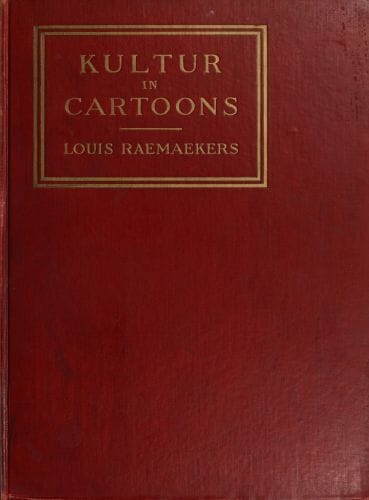
Between 1914 and 1918, one Dutch artist declared visual war on the German Empire. Louis Raemaekers' cartoons were so explosively critical of German militarism that Germany placed a price on his head. This 1917 collection gathers his most biting work: savage, oversized illustrations that lampooned the 'Kultur' the Germans claimed as their civilizing mission, while documenting the devastation wrought upon Belgium and the grotesque vanity of the kaiser and his generals. These are not subtle drawings. Raemaekers rendered German soldiers as hulking apes, the kaiser as a bloated puppet, and 'Kultur' itself as a smilingExecutioner holding a trident beside a ruined cathedral. The accompanying text by English writers contextualizes each assault, but the images need little explanation. They functioned then as viral propaganda, reproduced in newspapers across Britain and America, shaping how millions understood the war. A century later, these cartoons remain staggering documents of how art can weaponize outrage. They capture the allied moral certainty of 1917, the raw anger at Belgian atrocities, and the visual rhetoric that helped tip American public opinion toward intervention. For anyone studying WWI propaganda, political art, or the aesthetics of dehumanization, this is an essential, unsettling artifact.
Editions
Link to this book
Add a free, dofollow link to Lex on your blog, forum, syllabus, or reading list.

<a href="https://lex-books.com/book/kultur-in-cartoons-88ebdbbb-4ca3-4526-86bd-e9756e7d7851"><img src="https://lex-books.com/badges/read-on-lex.svg" alt="Read Kultur in Cartoons by Louis Raemaekers free on Lex" width="160" height="40"></a>[](https://lex-books.com/book/kultur-in-cartoons-88ebdbbb-4ca3-4526-86bd-e9756e7d7851)[url=https://lex-books.com/book/kultur-in-cartoons-88ebdbbb-4ca3-4526-86bd-e9756e7d7851][img]https://lex-books.com/badges/read-on-lex.svg[/img][/url]Read Kultur in Cartoons by Louis Raemaekers free on Lex: https://lex-books.com/book/kultur-in-cartoons-88ebdbbb-4ca3-4526-86bd-e9756e7d7851Cite this book
Reading this edition for a paper or guide? Copy a citation.
Raemaekers, Louis. Kultur in Cartoons. Lex, lex-books.com/book/kultur-in-cartoons-88ebdbbb-4ca3-4526-86bd-e9756e7d7851.Raemaekers, L. (n.d.). Kultur in Cartoons. Lex. https://lex-books.com/book/kultur-in-cartoons-88ebdbbb-4ca3-4526-86bd-e9756e7d7851Raemaekers, Louis. Kultur in Cartoons. Lex. https://lex-books.com/book/kultur-in-cartoons-88ebdbbb-4ca3-4526-86bd-e9756e7d7851.