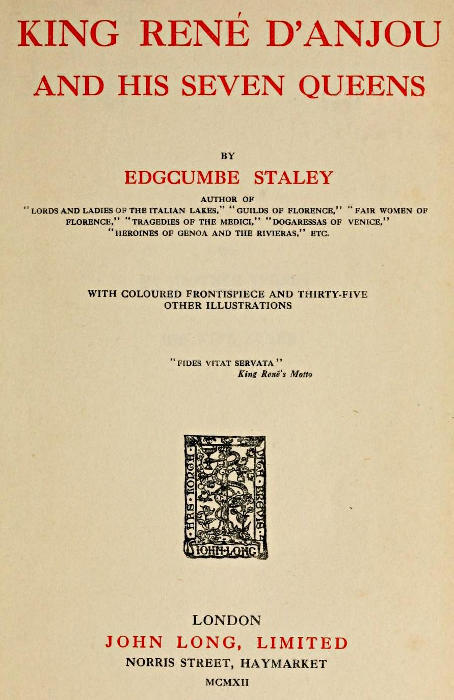
King René D'anjou and His Seven Queens
1912
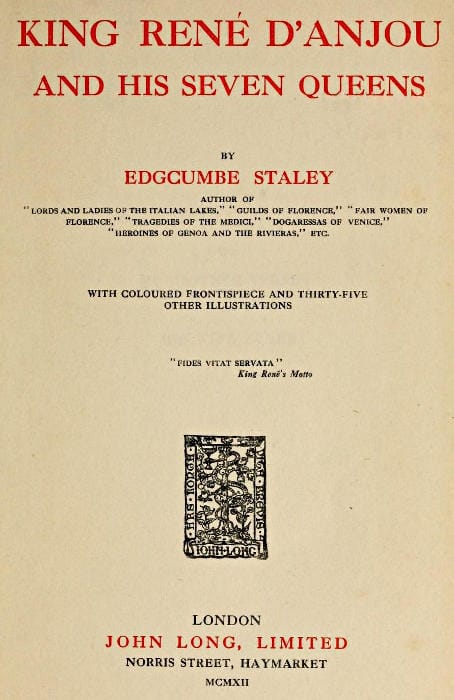
King René D'anjou and His Seven Queens
1912
René of Anjou was the most titled man in 15th-century Europe: Duke of Anjou, Duke of Lorraine, King of Naples, and titular King of Jerusalem and Aragon. He was also a poet, a patron of the arts, a failed crusader, a prisoner of war, and a man who managed to lose every kingdom he ever inherited yet somehow earned the epithet 'Good King René.' This early 20th-century historical account traces his remarkable life through the seven queens and powerful women who shaped his court and his destiny. From Yolanda d'Arragonia, his first wife who ruled Sicily with him, to his daughter Marguerite d'Anjou who became a queen of England and led armies in the Wars of the Roses, the women around René were never merely consorts. They were political players, poets, and power brokers in their own right. Staley renders the intricate web of Renaissance nobility with narrative verve, bringing to life an era when a French duke could claim Jerusalem by marriage and Naples by inheritance, only to watch it all slip away. For readers who wonder why history remembers some losers with affection, René offers a compelling answer.
Editions

X-Ray
The central figure, King of Sicily, Naples, and Jerusalem, Duke of Anjou and Lorraine. A Renaissance prince renowned as artist, poet, musician, and patron of arts. Known as 'le bon roy' by his subjects.
Queen of Sicily-Anjou, René's mother. A powerful political figure who effectively ruled France during Charles VII's weakness. Known as 'a good mother and a great Queen.'
René's first wife, known as 'the Pride of Lorraine.' A courageous duchess who led armies and governed during René's imprisonment. Died in 1453.
René's second wife, called 'Queen of Beauty.' A young noblewoman who brought joy to René's later years and shared his artistic pursuits.
About King René D'anjou and His Seven Queens
Chapter Summaries
- 1
- Introduces René d'Anjou with his numerous titles and accomplishments as artist, poet, musician, and ruler. Details his artistic works, literary achievements, and patronage of crafts, establishing him as the ideal Renaissance prince.
- 2
- Chronicles the early life of René's mother, from her birth in Aragon to her marriage to Louis II d'Anjou. Describes her role as a troubadour queen and her political acumen in managing the duchy during wartime.
- 3
- Continues Yolanda's story through her widowhood and regency, showing her as the power behind the French throne. Details her influence over Charles VII and her role in French politics until her death.
Key Themes
- Art vs. Power
- René embodies the tension between artistic pursuits and political responsibility, preferring painting and poetry to warfare and statecraft. His artistic nature often conflicts with the demands of kingship.
- Female Power and Influence
- The narrative demonstrates how women wielded significant political power in medieval France, from Yolanda's regency to Jeanne d'Arc's military leadership and the queens who shaped their husbands' reigns.
- Chivalry and Honor
- The code of chivalry governs relationships and conflicts throughout, from René's treatment of enemies to the courtly love traditions and the honor-bound behavior of knights and nobles.
Characters
- King René d'Anjou(protagonist)
- The central figure, King of Sicily, Naples, and Jerusalem, Duke of Anjou and Lorraine. A Renaissance prince renowned as artist, poet, musician, and patron of arts. Known as 'le bon roy' by his subjects.
- Yolanda d'Arragona(major)
- Queen of Sicily-Anjou, René's mother. A powerful political figure who effectively ruled France during Charles VII's weakness. Known as 'a good mother and a great Queen.'
- Isabelle de Lorraine(major)
- René's first wife, known as 'the Pride of Lorraine.' A courageous duchess who led armies and governed during René's imprisonment. Died in 1453.
- Jehanne de Laval(major)
- René's second wife, called 'Queen of Beauty.' A young noblewoman who brought joy to René's later years and shared his artistic pursuits.
- Marguerite d'Anjou(major)
- René's daughter, Queen of England as wife of Henry VI. Described as 'the most intrepid of Queens,' she led the Lancastrian forces during the Wars of the Roses.
- Marie d'Anjou(major)
- René's sister, Queen of France as wife of Charles VII. Known as 'la petite Reine de Bourges,' she was a devoted wife who endured her husband's infidelities with dignity.
Link to this book
Add a free, dofollow link to Lex on your blog, forum, syllabus, or reading list.

<a href="https://lex-books.com/book/king-ren-d-anjou-and-his-seven-queens-8d63cf02-febd-47e5-801e-fe816d6a9c80"><img src="https://lex-books.com/badges/read-on-lex.svg" alt="Read King René D'anjou and His Seven Queens by Edgcumbe Staley free on Lex" width="160" height="40"></a>[](https://lex-books.com/book/king-ren-d-anjou-and-his-seven-queens-8d63cf02-febd-47e5-801e-fe816d6a9c80)[url=https://lex-books.com/book/king-ren-d-anjou-and-his-seven-queens-8d63cf02-febd-47e5-801e-fe816d6a9c80][img]https://lex-books.com/badges/read-on-lex.svg[/img][/url]Read King René D'anjou and His Seven Queens by Edgcumbe Staley free on Lex: https://lex-books.com/book/king-ren-d-anjou-and-his-seven-queens-8d63cf02-febd-47e5-801e-fe816d6a9c80Cite this book
Reading this edition for a paper or guide? Copy a citation.
Staley, Edgcumbe. King René D'anjou and His Seven Queens. Lex, lex-books.com/book/king-ren-d-anjou-and-his-seven-queens-8d63cf02-febd-47e5-801e-fe816d6a9c80.Staley, E. (1912). King René D'anjou and His Seven Queens. Lex. https://lex-books.com/book/king-ren-d-anjou-and-his-seven-queens-8d63cf02-febd-47e5-801e-fe816d6a9c80Staley, Edgcumbe. King René D'anjou and His Seven Queens. Lex. https://lex-books.com/book/king-ren-d-anjou-and-his-seven-queens-8d63cf02-febd-47e5-801e-fe816d6a9c80.