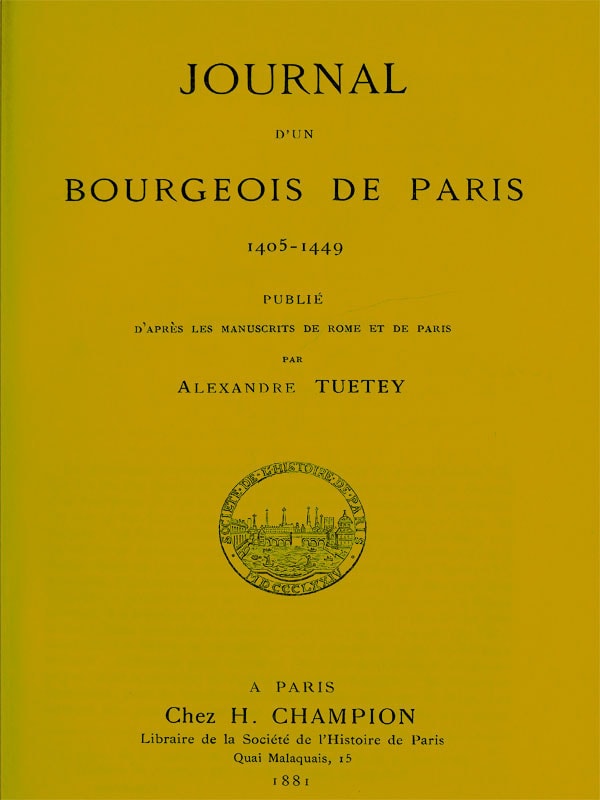
Journal D'un Bourgeois De Paris, 1405-1449
1968
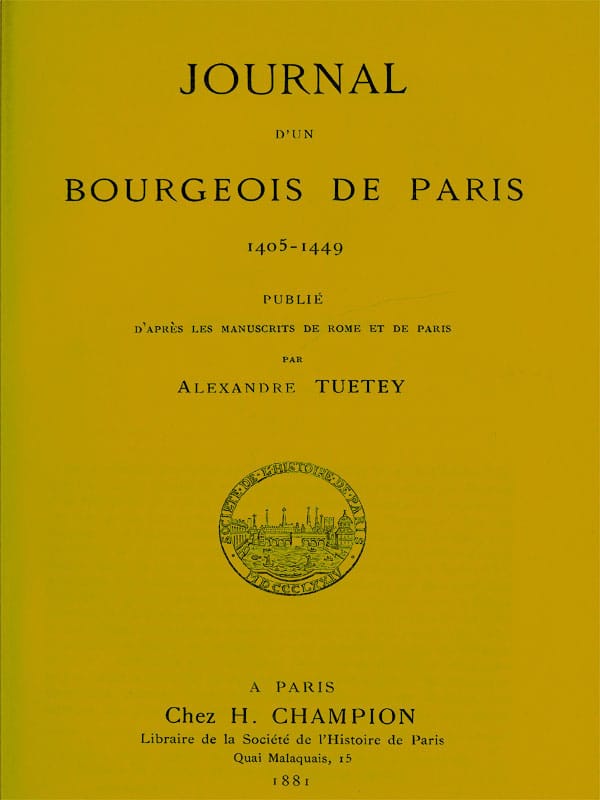
Journal D'un Bourgeois De Paris, 1405-1449
1968
A historical account written in the late 19th century. This chronicle provides a valuable insight into the sociopolitical climate of Paris during the reigns of Charles VI and Charles VII, capturing events and daily life through the eyes of an anonymous Parisian citizen. The narrative comprises personal observations and detailed accounts of significant historical events, illustrating the complex dynamics of power and factional violence in a city under stress from both internal strife and external threats. The opening of the chronicle establishes its significance, indicating a wealth of archival research and manuscript evidence that supports its authenticity and historical importance. It discusses various manuscripts that have survived and the chronicle's early reception, suggesting an enduring academic interest in this work throughout the centuries. The introduction sets the stage for a detailed exploration of the experiences of a Parisian bourgeois, reflecting on tumultuous events from the early 15th century, including political intrigue, warfare, and the social struggles faced by ordinary citizens amidst the broader historical narrative.
Editions
X-Ray
The chronicler and narrator, likely a cleric or educated bourgeois who witnessed and recorded events in Paris from 1405-1449. Shows strong Burgundian sympathies initially, later supporting the English occupation.
Powerful duke who controlled Paris for periods, murdered in 1419. The chronicler's political hero and symbol of order against the Armagnacs.
King of France suffering from mental illness, died in 1422. Portrayed sympathetically as a victim of political manipulation.
Leader of the Armagnac faction, portrayed as cruel and tyrannical. Constable of France, murdered in 1418.
About Journal D'un Bourgeois De Paris, 1405-1449
Chapter Summaries
- 1405
- The chronicle begins with political tensions in Paris, the arrival of the Bishop of Liège, and early signs of the Burgundian-Armagnac conflict that would dominate the following decades.
- 1408-1409
- The civil war intensifies with the siege of Liège and Charles VI's forced departure from Paris, followed by his triumphant return orchestrated by the Duke of Burgundy.
- 1410-1412
- Jean de Montagu's execution marks the beginning of systematic political violence. Extensive religious processions reflect popular desperation as civil war devastates the countryside.
Key Themes
- Political Chaos and Civil War
- The chronicle vividly depicts how the Burgundian-Armagnac conflict destroyed French unity and enabled English conquest. The author shows how political divisions led to social collapse and foreign domination.
- Urban Life and Popular Suffering
- Detailed accounts of daily life in Paris reveal how political turmoil affected ordinary citizens through famine, violence, economic hardship, and social disorder.
- Religious Faith and Divine Justice
- The chronicler interprets events through a religious lens, seeing God's punishment for sin in France's sufferings while maintaining faith in eventual divine justice.
Characters
- The Anonymous Bourgeois of Paris(protagonist)
- The chronicler and narrator, likely a cleric or educated bourgeois who witnessed and recorded events in Paris from 1405-1449. Shows strong Burgundian sympathies initially, later supporting the English occupation.
- Duke of Burgundy (Jean sans Peur)(major)
- Powerful duke who controlled Paris for periods, murdered in 1419. The chronicler's political hero and symbol of order against the Armagnacs.
- Charles VI(major)
- King of France suffering from mental illness, died in 1422. Portrayed sympathetically as a victim of political manipulation.
- Count of Armagnac (Bernard VII)(antagonist)
- Leader of the Armagnac faction, portrayed as cruel and tyrannical. Constable of France, murdered in 1418.
- Henry V of England(major)
- English king who conquered much of France, died in 1422. Initially enemy, later seen as necessary ally against Armagnacs.
- Duke of Bedford(major)
- English regent of France after Henry V's death, married to Burgundian princess. Portrayed as competent administrator.
Link to this book
Add a free, dofollow link to Lex on your blog, forum, syllabus, or reading list.

<a href="https://lex-books.com/book/journal-d-un-bourgeois-de-paris-1405-1449-97c3e709-8d4e-4a47-8f17-085b9b0b9d16"><img src="https://lex-books.com/badges/read-on-lex.svg" alt="Read Journal D'un Bourgeois De Paris, 1405-1449 by Unknown free on Lex" width="160" height="40"></a>[](https://lex-books.com/book/journal-d-un-bourgeois-de-paris-1405-1449-97c3e709-8d4e-4a47-8f17-085b9b0b9d16)[url=https://lex-books.com/book/journal-d-un-bourgeois-de-paris-1405-1449-97c3e709-8d4e-4a47-8f17-085b9b0b9d16][img]https://lex-books.com/badges/read-on-lex.svg[/img][/url]Read Journal D'un Bourgeois De Paris, 1405-1449 by Unknown free on Lex: https://lex-books.com/book/journal-d-un-bourgeois-de-paris-1405-1449-97c3e709-8d4e-4a47-8f17-085b9b0b9d16Cite this book
Reading this edition for a paper or guide? Copy a citation.
Unknown. Journal D'un Bourgeois De Paris, 1405-1449. Lex, lex-books.com/book/journal-d-un-bourgeois-de-paris-1405-1449-97c3e709-8d4e-4a47-8f17-085b9b0b9d16.Unknown (1968). Journal D'un Bourgeois De Paris, 1405-1449. Lex. https://lex-books.com/book/journal-d-un-bourgeois-de-paris-1405-1449-97c3e709-8d4e-4a47-8f17-085b9b0b9d16Unknown. Journal D'un Bourgeois De Paris, 1405-1449. Lex. https://lex-books.com/book/journal-d-un-bourgeois-de-paris-1405-1449-97c3e709-8d4e-4a47-8f17-085b9b0b9d16.